
Alejandro Ceva: Classical Afterlives in Athens and London
Alejandro Ceva: Classical Afterlives in Athens and London

Thanks to the generous support of the Classics Department travel grant and The Europe Center's Fellowship for Undergraduate Travel and Research, I embarked on a research journey to Athens and London that fundamentally reframed my approach to scholarship and experience of the classical world. My experience illuminated the essential relationship between theoretical frameworks developed in the classroom and the empirical investigation of artifacts, manuscripts, and archeological remains that constitute the material foundation of historical analysis.
Athens-
My time in Athens began with the wealth of museums housing important works of ancient Greece. At the Archaeological Museum, I encountered artifacts I had studied extensively in my coursework with Prof. Maxmin in Art History. Seeing these pieces in person- their scale, craftsmanship, and historical weight- brought a new depth to my knowledge. The Acropolis Museum provided another layer of understanding, with its careful presentation of architectural elements and sculptures that I had previously known only through photographs and reproductions. Many of these pieces I have written papers about, or discussed in seminars with various professors and students.
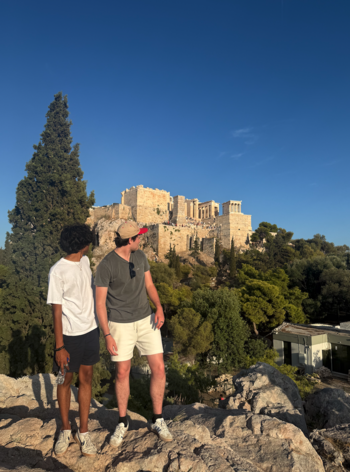
An obvious highlight of my Athenian experience was visiting the Acropolis herself. Standing among these monumental structures, I could revel in the ancient principles I had studied during my time abroad in BOSP Florence, where my architecture course had introduced me to the various classical orders. The cultural and historical significance of the site resonated deeply with themes from my Classics courses on the Greeks, particularly our discussions of how the Persians had burned the original Acropolis during their invasion, making the Parthenon I stood before a symbol of Athenian resilience and reconstruction. Seeing the Charyatids of the Erechtion up close allowed me to appreciate their individuality and function, while also preparing me for what would become a poignant encounter with their lost sister during my later research at the British Museum in London.
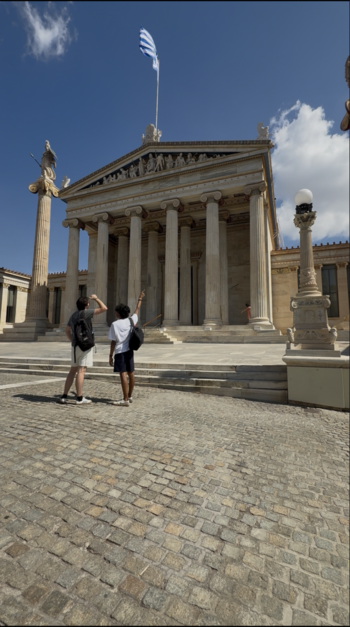
Equally valuable was my access to the Gennadius Library in the American School for Classical Studies in Athens. As a special reader, I had privileged access to the restricted collection of the library, allowing me to conduct research for my honors thesis using rare books and out-of-print materials that would have been impossible to access elsewhere. The library's collection is housed in a beautifully designed classical structure, significantly enhancing both the depth and authenticity of my research.
London-
In London, I was granted the extraordinary opportunity to work in a private reading room at the British Museum. The highlight of this access was handling unpublished 18th-century prints depicting important passages from Homer and Vergil. These visual interpretations of classical texts offered a unique perspective on how different eras have understood and represented classical literature. The tactile experience of examining these prints- feeling the paper, observing the printing techniques, and studying the artistic choices- provided insights into the reception history of classical texts that no digital reproduction could match. My time in the British Museum's public exhibits complemented this private research.
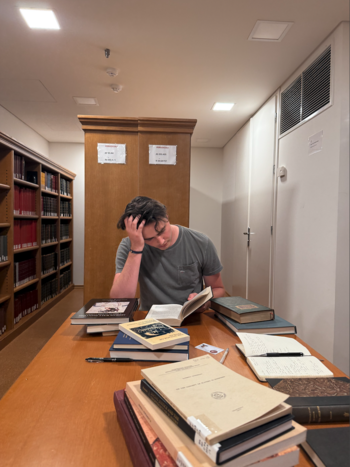
Becoming a reader at the British Library opened another world of valuable manuscript. The most remarkable discover was "King's Vergil", a medieval illuminated manuscript containing all three of Vergil's works that are central to my thesis: the Eclogues, Georgics, and Aeneid. Each work was accompanied by exquisite miniatures and depictions that revealed how medieval scholars and artists interpreted Vergilian themes. Additionally, I examined a 15th-century copy of Homer's Iliad, whose marginalia and illustrations provided fascinating insights into how Renaissance readers engaged with the Homeric epic.
Reflection-
This summer experience has fundamentally enriched my study of Classics in ways I could not have anticipated. The physical encounter with primary sources has made me a more nuanced and critical scholar as I now approach texts with a deeper appreciation for their material history and cultural transmission. Seeing how different periods have interpreted, illustrated, and preserved classical works has expanded my understanding of reception studies and the living tradition of classical literature. Working with rare manuscripts and unpublished materials has given me confidence in conducting primary research and has show me the importance of archival work in classical studies. Finally, this experience has proved crucial to my development as a Stanford student by demonstrating the vital connection between theoretical knowledge and empirical research. It has inspired me to pursue more interdisciplinary approaches in my work, incorporating art history, manuscript studies, and archaeology into my literary analysis.