
Ana Nuñez- Dynasty, Identity, Authority: Female Rule and Political Culture in the Kingdom of Jerusalem, 1131-1228
Ana Nuñez- Dynasty, Identity, Authority: Female Rule and Political Culture in the Kingdom of Jerusalem, 1131-1228

With the generous support of The Europe Center, I spent four days in Siena, Italy conducting manuscript research that will be instrumental for the completion of my doctoral dissertation, Dynasty, Identity, Authority: Female Rule and Political Culture in the Kingdom of Jerusalem, 1131-1228.
The medieval Kingdom of Jerusalem was an incipient, militant polity, founded after European crusaders conquered the Holy City in 1099. For nearly two hundred years (1099-1291), men and money poured into this nascent Christian kingdom as both monarchy and church sought to maintain a presence among their Christian and Muslim neighbors. My dissertation investigates the values and practices that facilitated the active governance of five regnant queens of Jerusalem. Between 1131 and 1228, five women inherited the throne of Jerusalem by dynastic right- an unprecedented number of reigning women rulers were an inherent problem that medieval contemporaries- who were more typically governed by kings- had to overcome. My dissertation begins with a different premise: the fact that women rulers were a consistent (and largely unchallenged) feature in the geopolitical transformation of Jerusalem into a Christian capital suggests that medieval contemporaries viewed women rulers as appropriate to the political enterprise at hand.
My dissertation further contends that the regnant queens of Jerusalem were more than wives of kings or passive inheritors of dynastic rights. As I show, these women meaningfully exercised a political office that responded to the pressures of successive crusades and fluctuating territorial boundaries. My dissertation examines how their office was expressly outlined in the inauguration ceremony that transformed these women from rightful heir to queen, and how they executed their office in their issuing of charters, documentary sealing, religious and artistic patronage, bestowal of economic privileges, gift-giving, letter-writing, marriage diplomacy, and military involvement.
With The Europe Center's support, I was able to consult Siena, Biblioteca Comunale degli Intronati, MS G.V.12- a manuscript containing instructions for the various ceremonies that a bishop might perform during the inauguration of a medieval Christian king or queen. The manuscript was originally copied in Tyre during the early thirteenth century and arrived in Italy by the end of the same century. This manuscript is the only surviviving liturgical source for the inauguration of the kings and queens of the Kingdom of Jerusalem. Additional information on this all-important religious-political ceremony can be found in Latin and Old French chronicles that narrate the history of the kingdom and the crusading campaigns, as well as a thirteenth-century legal text detailing the laws and procedures of the Kingdom of Jerusalem. However, both the chronicles and the legal text focus primarily or exclusively on the deeds and procedures of the king. Therefore, Siena, Biblioteca Comunale degli Intronati, MS G.V.12 provides invaluable evidence for the queen's inauguration ceremony- largely ignored until now.
Consultation of the manuscript in person allowed me to answer the following questions: Does the manuscript include sketches or illuminations that depict some of the ceremonies that the text describes? Does the manuscript include marginal text annotations or maniculae (little pointing hands in the margins)? In the text of the queen's inauguration, are there rubrics (red-colored text), capitalization, or larger typesets that could suggest that certain parts of the ceremony were of heightened importance? Does the text show signs of erasure or emendation that could suggest the ongoing evolution of the queen's inauguration liturgy, either during its use in the Kingdom of Jerusalem or subsequently in western Europe?
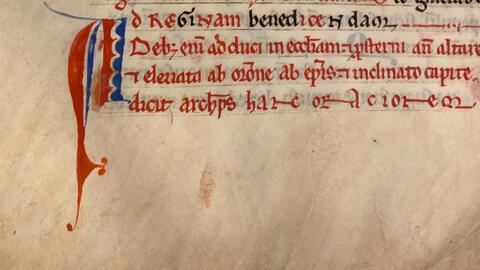
The text of the queen's inauguration ceremony was very well-preserved. It did not include any annotations or emendations (unlike other folios of the manuscript), but it did feature alternating red and blue capital initials. The queen's inauguration order also included an elaborate initial letter at the very beginning of the instructions. This initial letter, I was interested to discover, is noticeably larger and more ornate than the initial letter that begins the king's inauguration order. I was also interested to discover a set of instructions preceding the king's investment with the crown. They read: "Moreover the king, who orders her to be crowned, comes forward and then the crown is placed on her head (Ad veniat autem rex qui eam coronari precipiat et tunc capiti eius corona superponatur)." Such instructions create an image of the queen's authority as something deriving from the king's will. And yet, elsewhere the inauguration order noticeably de-emphasizes the queen's association with the king, instead emphasizing the queen's own explicit occupation of a role endowed with authority, judgment, and justice- attributes more commonly associated with kings. The queen's inauguration order is thus complex and nuanced in its depiction of the queen's power.
Siena, Biblioteca Comunale degli Intronati, MS G.V.12 constitutes the principal primary source of my dissertation's first chapter: "From 'plus dreit heir' to queen: The Inauguration order." Consultation of the mauscript in person has been instrumental in completing this chapter. My many thanks to The Europe Center for making this research possible.