Norman Naimark earned his PhD in History from Stanford in 1972 and returned to join the faculty in 1988. He is currently a Senior Fellow at both Hoover and the Freeman Spogli Institute for International Studies, Robert & Florence McDonnell Professor of East European Studies, and professor of History and German Studies (by courtesy). He has been recognized for his research, faculty service, and teaching, including being awarded the Officer's Cross of the Order of Merit of the Federal Republic of Germany. His research interests include the Soviet Union and Europe in the post-WWII period, and the history of genocide worldwide.
Norman’s forthcoming book,
A Will of Their Own: Stalin, Europe, and the Struggle for Sovereignty 1944-1949, is about immediate post-war Europe. The book develops seven case studies that show Europeans exercising a lot of their own agency in the development of their politics after the war. In this research he diverges from the existing literature, which is dominated by the Soviet-United States Cold War confrontation. Norman recently returned from a three-week research trip to archives in Moscow for a book on 20th century genocide that he is coediting with Ben Kiernan (Yale). This will be the second volume in a three-volume Cambridge History of Genocide. While in Russia, Norman consulted the papers of the 1944 Soviet Extraordinary Commission charged with investigating Nazi crimes, including the deaths of 3.1-3.2 million POWs from malnutrition and disease as well as from violence. Whether this was genocide is complicated by several things, including the uneven view of racial hierarchies that different Nazi/SS leaders espoused. Instead of concentrating on definition problems however, Norman is now focused on the why and how of what the Nazis did, and what they thought about the Soviet POWs and Slavic peoples in general.
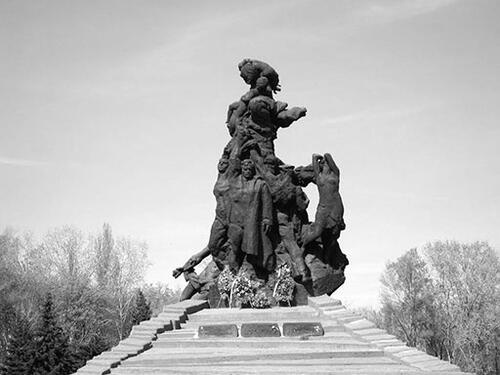
In September 2016, Norman traveled to Ukraine to participate in the commemoration of the 75th anniversary of the Babi Yar Massacre. There, in a ravine on the outskirts of Kyiv, 34,000 Jews were murdered in 1941. “People talk about the brutal nature of the war, but the war had just started, so that kind of unbelievable inhumanity is shocking,” he says. The Nazis became worried that their atrocities would be discovered, so two years later they forced other prisoners to dig up what was probably closer to 100,000 bodies by then, construct huge pyres, incinerate the bodies, and scatter the ashes. “People have known about that brutality, but when you read the historical documents, and the accounts of people who crawled out of the ravine; and then you read about how the Nazis tried to destroy the evidence through this whole macabre burning of the bodies, it's just awful, awful stuff. ” Norman has also seen incredible stories of heroism on the other side, stories of people saving other people and people sacrificing themselves for others.
Based on his World War II research, one of Norman’s biggest concerns is that, if a terrible thing like this can happen in the middle of the 20th century, there is no reason it cannot happen in the middle of the 21st century as well. He argues that the only solution is through an international body, which should be empowered to act on the 2005 United Nations Responsibility to Protect resolution, a global political commitment adopted in response to the international community’s failure to intervene in the Rwandan Genocide in 1994, the Srebrenica Massacre in 1995, and in other atrocity crime situations.
At Stanford, Norman’s courses include The History of Occupation, 1914-2010; The History of Genocide; History of the International System since 1914; and The Soviet Union and the World: View from the Hoover Archives.