
Featured Faculty Research: Priya Satia
Featured Faculty Research: Priya Satia

In trying to understand these mysteries, I discovered a new possible narrative of Britain's industrial revolution. For, in defending his gun-making business to concerned fellow Quakers in 1796, Samuel Galton Junior argued that there was no way to participate in the emerging industrial economy of the Midlands without contributing to war. As he saw it, complicity in war was general and inescapable.
The industrial revolution is typically imagined as a story of the triumph of unfettered entrepreneurial genius embodied by the likes of Matthew Boulton and James Watt—a view that deeply influences conversations about what drives innovation and what role governments should have in economies. I wondered, what if Galton was right? What if, in fact, the industrial revolution was driven by Britain’s nearly continuous wars from 1689 to 1815?
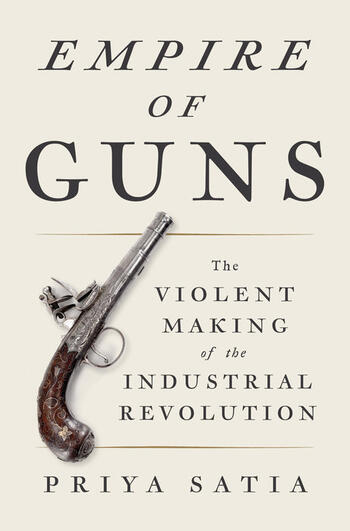
To find out, I combed through thousands of records and accounts of gun-makers, gun users, government offices, Quakers, the East India Company, and more. In the end I was persuaded that the gun industry’s dramatic transformation from an annual production capacity of tens of thousands in the 1690s to millions by 1815 was driven by state demand, and the gun industry had important ripple effects in allied fields. Government officials were involved in knowledge networks, and military contracts triggered innovation in technology and industrial organization. In short, the guns that enabled the rule of property in Britain, the trade in slaves in West Africa, the rise of the plantation system in North America, and the conquest of North America, South Asia, and the South Pacific also enabled industrial revolution in Britain. British officials in India were so alive to the connection between arms-making and industrialism that they actively suppressed Indian arms-making explicitly to prevent industrial take-off in the subcontinent. Britain’s industrial revolution was global in its sources and impact.
Evidence scattered across the literature on the industrial revolution confirmed that the gun trade was no anomaly, that many trades and sectors benefited from government contracts in this period—including the financial world. The Galtons themselves became bankers in 1804, as their fortune from gun making skyrocketed during the Napoleonic Wars. Their bank later merged with what became Midland Bank, now part of HSBC. When Galton defended himself as a Quaker gun-maker, he was painfully aware that his prominent Quaker relations, the Lloyds and the Barclays, owned banks intimately involved with war finance; indeed, the Lloyds had also supplied iron to his gun business. The state’s mass consumption for military ends was critical to the rise of modern industry and finance.
This is the new narrative of the industrial revolution that I offer in Empire of Guns. Boulton and Watt were certainly heroic, but they were also government contractors mixed up with gun-makers. As Americans struggle to tame the gun industry’s influence on our society, we must do so well aware of the historically central place of military- (or “defense-”) industries in our economy. By focusing on Galton Junior’s particular villainy, the British Quaker community absolved Friends who profited more elliptically from war. But Galton was right: war was central to the first industrial revolution, and it remains central to our industrial way of life today.
Priya Satia is Professor of Modern British History University and a faculty affiliate at The Europe Center. She earned her PhD at the University of California, Berkeley and came to Stanford in 2004. Priya's research focuses on modern British and British empire history, especially in the Middle East and South Asia. At Stanford, Priya's courses include Modern Britain and the British Empire; Global History: Empires, Technology, and Modernity; and A History of the Global Left: Revolutionary Movements against Empire.