
Tomás Guarna (Communication) | The Politics of Technology Safety (WZB Berlin Social Science Center)
Tomás Guarna (Communication) | The Politics of Technology Safety (WZB Berlin Social Science Center)
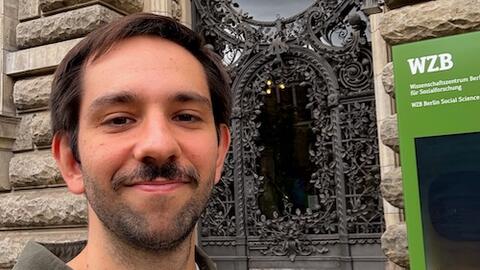
Through Stanford's Graduate Research and Internship Program in Germany, I spent July and August at the WZB Berlin Social Science Center as a visiting researcher, where I advanced my research on technology governance from a sociocultural perspective. This experience provided me with invaluable access to Berlin's vibrant tech policy community and allowed me to conduct fieldwork that will be central to my dissertation research.
At WZB, I was hosted by Dr. Robert Gorwa, an expert in technology governance and platform regulation. The center proved to be an ideal setting for developing my work, while Berlin's dynamic tech policy scene offered me the opportunity to observe firsthand how governance concepts take shape in a European context that differs significantly from the United States. Throughout my stay, I attended numerous events focused on platform and AI policy, which provided crucial real-world context that grounded my academic work in contemporary policy debates.
My primary research focus centered on a paper examining how Trust and Safety specialists—the tech workers in platform companies who design content moderation policies and mechanisms—incorporate critiques about the harms caused by the companies they work for. WZB’s collaborative environment facilitated rich conversations about this work, while the center's resources and dedicated workspace allowed me to make meaningful progress on this research.
Building on this foundation in platform governance, I also explored new directions for my dissertation by investigating the emerging field of AI safety. I conducted interviews with AI safety experts and enthusiasts to understand how technical communities conceptualize and frame risks associated with artificial intelligence. This fieldwork included ethnographic observation of a three-day conference where participants gathered to discuss AI risks and governance approaches. These conversations with actively engaged experts revealed how technical knowledge intersects with cultural contexts, while my ethnographic observations illuminated how communities of practice develop shared understandings of risk and governance frameworks. The interviews and observations I conducted in Berlin will serve as crucial data for my PhD dissertation, and I look forward to analyzing these as I return to Stanford.
The intellectual richness of my research experience was complemented by my experiences as a temporary resident of Berlin. Living in Neukölln proved to be an unexpectedly enriching part of my experience; the neighborhood's deeply intercultural and intergenerational character allowed me to think differently about public life. As someone interested in the changing nature of the public square, I was particularly struck by Berlin’s approach to public spaces—the shared parks, cafés, and community areas that foster exchanges and opportunities for collective experiences. Overall, spending time in Berlin helped me understand much about the German theorists I had been reading for years.
The convergence of rigorous research opportunities, cultural immersion, and intellectual community made my summer at WZB both transformative and foundational for my PhD trajectory. The focused research time, access to Berlin’s tech policy scene, and the experience of living in a culturally rich environment allowed me to grow as a researcher across multiple dimensions. I am deeply grateful for the support from The Europe Center and the Stanford Club of Germany that made this experience possible.