
Hannah Johnston- Go-Betweens: Sex, Labor, and Community in Early Modern Italy
Hannah Johnston- Go-Betweens: Sex, Labor, and Community in Early Modern Italy
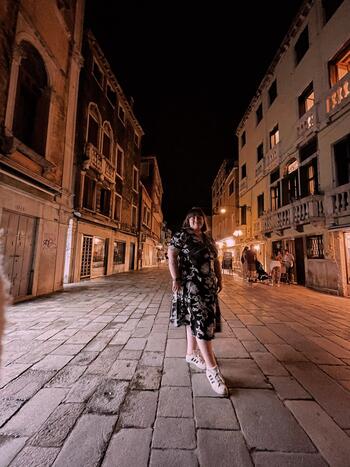
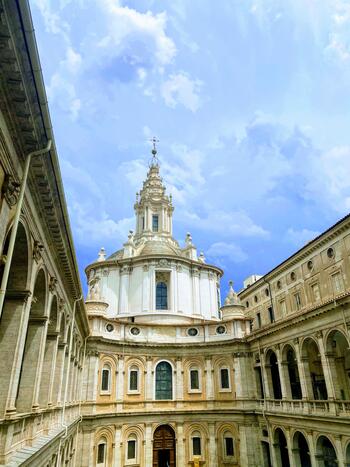
With the support of The Europe Center, I was able to spend a month in Italy conducting archival research to enrich my doctoral dissertation. I spent the majority of the month in Rome, but made a short trip to Venice for a few days to conduct some follow-up research there as well. In Rome, I worked primarily at the Archivio di Stato di Roma as well as the Biblioteca Casanatense and the Archivio del Vicariato di Roma; in Venice, I worked at the Archivio di Stato di Venezia.
I began my trip with the intention of finding a broader corpus of documents pertaining to the sixteenth- and seventeenth-century legislation and regulation of go-betweens in Rome, and of exploring a set of injury cases in Venice which I thought might contain references to go-betweens or the sex workers for whom they procured. Ultimately, the results of my research were fruitful, but not necessarily in the ways I expected. I did not find any significant legislative record pertaining to go-betweens in Rome, one potential exception being several bandi, or printed edicts, which vaguely referenced the connections between the sex trade and industries like hospitality and transportation. Those were held in large collections, organized by topic in some places and chronology in others, at the Biblioteca Casanatense. Although I didn't find quite what I was looking for, the organization of these collections of bandi allowed me to view these proclamations in their contexts and better understand the kinds of social concerns that Roman authorities attempted to address in the early modern period.
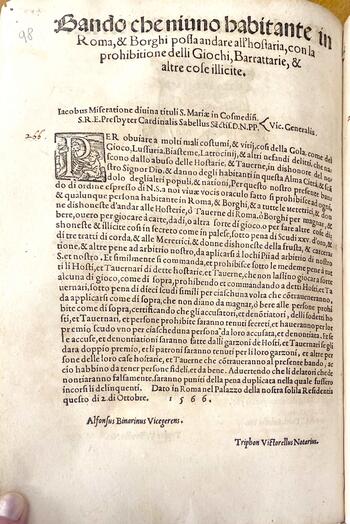
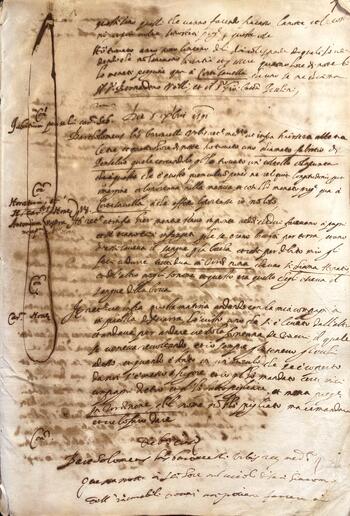
The bandi which did reference the sex industry tended to attempt to restrict sex workers from certain public places, most notably inns and taverns. This became useful information as I continued to explore criminal records in the Archivio di Stato di Roma, and found no shortage of innkeepers and travelkeepers in the orbits of sex workers in the city. It is likely that these men and women would have seen the financial opportunities to be had by welcoming sex workers into their establishments and, in many cases, helping them to find clients. Many innkeepers or lodging house owners would have rented rooms to sex workers, providing them with the space to conduct their business out of sight. One of the most valuable insights I gained from this research trip was realizing just how deeply intertwined the sex industry was with the hospitality industry in this period. This is something I had previously known about Venice, but the nature of the records in Rome made it harder to discern until I came across the bandi and started to think more about generally what kinds of spaces sex workers found themselves in when they came to the attention of authorities.
In Venice, I had a more concrete goal; to explore the records of the Cinque alla Pace, a magistrate tasked with weighing in on minor injury cases in the city (specifically, interpersonal fights in which no one died- Venice was known for its very specific magistracies!). I had not come across these records on prior research trips, but had recently read that sex workers and their associates appeared frequently in these records. I was glad to find that this was true! Although the records were very brief, they offered a great glimpse into some of the interpersonal relationships that defined the industry, and also gave me a sense of what neighborhoods tended to be populated by sex workers. As is the case for many kinds of records, go-betweens were not explicitly identified in these records, but I found one case involving a woman, named Chate Schiavona, who I suspect may have been one of the highest-earning go-betweens in Venice. It's impossible to confirm given the lack of detail in the record, but if this injury case did involve her, it points to her presence in one of the city's neighborhoods that was known for its sex work activity in the period.
Overall, my month in Italy was immensely productive, albeit in unexpected ways, and I would not have been able to learn as much as I did were it not for the support of The Europe Center. I am immensely grateful for the opportunity the Center gave me to explore these fascinating documents further this year.