
Johannes Stupperich- Institutional Redundancies in Autocracy
Johannes Stupperich- Institutional Redundancies in Autocracy

Motivation
Autocratic regimes adopt a number of different strategies to guarantee their own survival and incentivize their elites to fulfill tasks relevant to the regime, in an environment in which external enforcement mechanisms, e.g. via constitutionally guaranteed institutions are oftentimes absent.
General Idea
The idea for this project is to study how elite organizations in Nazi-Germany set incentives for elite members to comply with the goals of the organization and the regime more broadly and therefore contribute to an understanding of the above defined problem. National Socialist organizations such as the Schutzstaffel (SS) and the Wehrmacht kept detailed personal records of high officers, which do not only include, as we found out over the summer, a record of postings, promotions and awards but for a larger share of officers also personal evaluations by superiors. These evaluations give an insight into the skills as well as ideological alignment of elite members as perceived by the regime. Since German federal archives have these records for both SS and some Wehrmacht members one can even attempt a comparative analysis across institutions.
Summer Work Insights
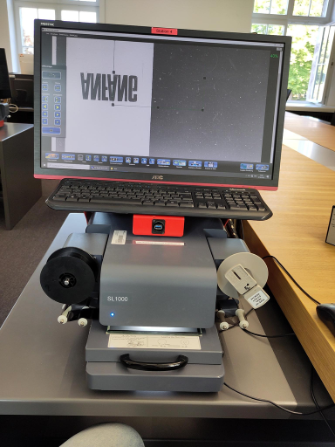
Thanks to The Europe Center grant, I was able to visit the German Bundesarchiv in Berlin, which keeps personal records for SS officers. National Socialists kept personal records on paper and tried to destroy part of them when they realized that they would lose the war. The Allies saved many of these documents on microfilms. Unfortunately, it is not possible to access these microfilms online or remotely. Since our project is at a very early stage, the work over summer consisted mostly in viewing a lot of these personal records in Berlin to be able to assess which information documents contain, how detailed this information is and how complete surviving personal records are given the destruction attempts by the Nazis and additional storage challenges. While we found out, for example, how detailed personal records for SS and Wehrmacht are, we also concluded that analysis of the Nazi party register would probably not be useful for our purposes given the paucity of information about individuals. This would not have been possible without visiting the archives.
Apart from exploring availability of data, The Europe Center grant also provided us with the possibility to assess how challenging a potential data collection effort would be. While, Wehrmacht data, stored in Freiburg, were mostly digitized already and just need to be transferred to a hard drive, the fact that SS personal records are stored on microfilms let us conclude that collecting this data would be more cumbersome. For the purposes of pre-processing, we found out that even though typewriters were used for some forms, many documents were handwritten, some of them using an old German handwriting style called Sütterlin.
Outlook
The immediate availability of the Wehrmacht data allowed us, thanks to The Europe Center, to ask the archives to provide the relevant documents on hard drive, which we hope to process in the near future. Given the potential we see in the SS dataset, which contains even more detailed information than the Wehrmacht data and covers a larger number of officers and therefore a greater share of the organization, we are currently in further contact with the archives on whether and how a data transfer to us and subsequent analysis in collaboration with the federal archives would be possible. In that sense, visiting the archives was also useful because it helped us better understand their working procedures and refine our way of approaching them accordingly. We are thankful for the support and patience of archival workers.
In sum, The Europe Center grant allowed us to set the foundation for our project and assess whether a refined version of our first idea could be executed or not. It also helped us to buy our first dataset, which we look forward to analyzing.