
Kaja Elisa Fink- Tracing Women's Care and Agency in the Late Medieval Beguine Movement
Kaja Elisa Fink- Tracing Women's Care and Agency in the Late Medieval Beguine Movement
I am grateful for the support and resources provided by the Europe Center, which enabled me to conduct research for my dissertation. My dissertation examines women’s care work and agency in 15th- and 16th-century German-language literature. I focus particularly on non-cloistered lay religious women, especially Beguines, who financed their communal, religious lives through activities such as nursing the sick and providing end-of-life care. The support I received enabled me to undertake an eight-day trip in July 2026 through southern Germany (the Black Forest) and Belgium (Bruges, Brussels, Leuven). My aim was to explore how care work manifests itself as a religious practice and as a form of agency among women in the late medieval Beguine movement. I focused primarily on two women central to my dissertation: Luitgard of Wittichen (1291–1348) and Gertrud of Ortenberg (1275/85–1335). The trip allowed me to examine both key manuscripts and the physical sites of female religiosity and agency.
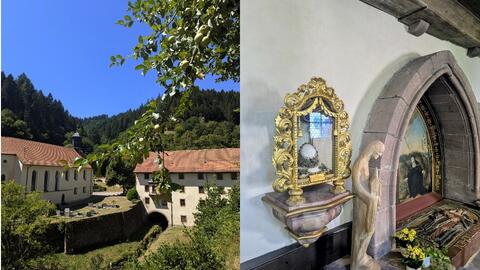
The first stop on my research journey was at the Wittichen Abbey in Schenkenzell, Black Forest, Germany. It was founded in 1324 by the Beguine and mystic Luitgard of Wittichen. Luitgard grew up as the daughter of wealthy farmers in the Black Forest. According to her vita, written by Berthold von Bombach, she joined a Beguine hermitage near Oberwolfach, Germany at the age of twelve. After living in the community for twenty years, she received a divine mandate to establish her own Beguine hermitage in Wittichen. Despite lacking support of the ecclesiastical authorities, she began building her hermitage deep in the Black Forest with thirty-three other women, facing the most adverse conditions. As recounted in the vita, Luitgard spent much of her life on pilgrimages across vast areas of what is now southern Germany and adjacent regions of France in search of support. Interwoven into the accounts of her pilgrimages and the hostility she faced, there are reports of her care work, primarily focused on attending to the dying and securing the salvation of their souls. Luitgard’s life demonstrates that women’s care work was not just a consequence of their religious marginality; it could also be a source of authority through which women could establish, legitimize, and sustain their religious communities. After great effort, Luitgard secured the support of Agnes of Hungary (1281–1364) and won papal recognition for her hermitage. She died in 1348 while caring for plague victims. Her grave at Wittichen Abbey became a pilgrimage site, visited especially by women seeking help with fertility issues and complicated pregnancies. Although Luitgard was never canonized or beatified, she remains a revered regional folk saint to this day. This summer, I had the opportunity to visit the remaining building, the abbey museum, and the abbey’s church, including Luitgard’s tomb and relics, alongside my advisor Kathryn Starkey and a group of fellow medievalists and literary scholars from Stanford. During a private tour, the site administrator, Dr. Rombach, shared valuable insights into the institution as it exists today, its history, and the enduring cult of veneration surrounding Luitgard. The visit fostered a deep understanding of the sheer scale of what was once a highly powerful abbey.
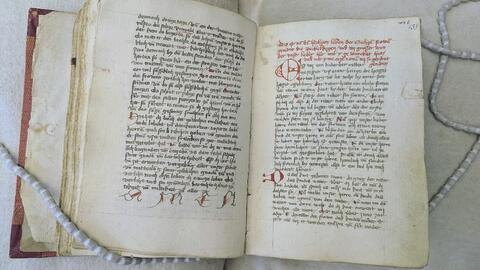
I then spent several days in Brussels, where I had the opportunity to examine various lives and legends of lay religious women at the Royal Library of Belgium (KBR). However, my main focus was the non-digitized Vita of Gertrud of Ortenberg (MS 8507–09), which is preserved in a unique manuscript from the second half of the 15th century and constitutes one of the core texts of my dissertation corpus. Gertrud of Ortenberg grew up at Ortenberg Castle near Offenburg, Germany, and joined a Beguine community after her husband died. After two years in the community, she adopted the Franciscan Third Order Rule and lived as a tertiary thereafter – a common development resulting from efforts, driven by ecclesiastical decrees and the Observance reform, to bring unregulated women's communities more firmly under institutional control. Gertrud is not the sole protagonist of her vita. A second key figure, Heilke of Stauffenberg, who joined the Beguine community to escape forced marriage, soon appears and remains by Gertrud’s side for the rest of her life as a close companion and caregiver. Alongside Gertrud’s mystical ascent, the text consistently emphasizes her dedication to caring for the sick, the poor, and others in need in Offenburg and Strasbourg. Her vita, written by an unknown female author, is an invaluable document for exploring the concept of care work in literature. The close caregiving relationship between Gertrud and Heilke demonstrates that agency does not emerge individually, but relationally. Care work is a practice through which women create and secure scope for action for each other. In addition to examining the content and materiality of the composite manuscript, the codicological analysis proved illuminating. The Vita of Gertrud von Ortenberg is placed between the works by Gertrud the Great (of Helfta) and Raymond of Capua’s Legend of Catherine of Siena. The compilation speaks for a deliberate choice. Positioning the vita of a comparatively unknown folk saint between the works related to two renowned, canonized saints both sheds light on her regional significance and reveals how Gertrud’s spiritual way of life – dedicated to poverty – could have served as a concrete example for the abstract theological questions and concepts found in the writings of Gertrud the Great. The combination of these three saints aligns with the Observant reform movements prevalent in the fifteenth century. The nuns of St. Nikolaus in Undis, where the texts were copied and bound together, participated in these movements. Focusing on the manuscript itself, rather than on a modern edition, allowed me to interpret care not merely as a charitable activity within a saint’s vita, but as a constitutive element of female religious identity, community building, and agency.
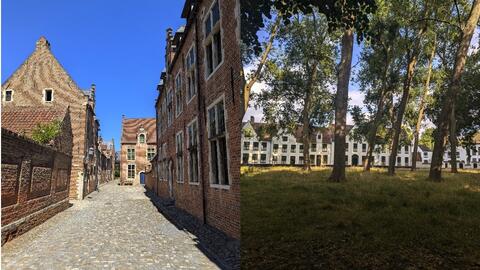
While in Belgium, I also took two day trips to Bruges and Leuven, where I visited the great beguinages, which are now designated as UNESCO World Heritage Sites. As the Beguine movement did not have a uniform, overarching set of rules across Europe, the women organized themselves regionally and over time into different ways of living together. While in Germany, the Beguines were primarily found in individual houses (convents) or living in dedicated streets or neighborhoods, in Flanders, Brabant, and the Netherlands, the women lived in walled settlements. With their own churches, residential buildings, streets, and infirmaries, these beguinages were akin to a city within a city. Despite these differences, all forms of residence shared the same basic socio-religious, legal, and economic principles, as well as the status of existing between the secular world and the monastery. Only through on-site tours was I able to gain an adequate sense of the size and self-sufficiency of these settlements, and it became clear that the agency of the Beguines manifested itself not only in texts but also spatially. While Luitgard of Wittichen’s agency emerged despite – or perhaps precisely because of – structural adversity, here I was able to see how care work could lay the foundation of a stable, collective female autonomy.
The research I conducted in southern Germany and Belgium was essential for my dissertation project. The insights I gained will contribute directly to my chapters on spiritual care and the role of giving and foundation work. I would like to thank the Europe Center for supporting my research.