
Lorenzo Salerno- Libri d'abaco- Teaching Mathematics in Medieval Italy
Lorenzo Salerno- Libri d'abaco- Teaching Mathematics in Medieval Italy
Thanks to the generous support of The Europe Center's 2025 Graduate Student Grant, I spent two weeks (July 7-18) in Florence conducting preliminary archival research on manuscripts of libri and trattati d'abaco - practical mathematical handbooks that played a central role in the education of merchants and craftsmen in late Medieval and Early Modern Italy (13th-16th centuries). These works, composed primarily by the so-called maestri d'abaco ("abacus masters"), were used in the training of apprentice merchants and reflected the economic, social, and intellectual needs of a world increasingly shaped by commerce and numerical calculation.
The libri d'abaco generally contain material ranging from elementary arithmetic operations and practical geometry (methods for calculating areas, volumes, and proportions) to more sophisticated applications in trade, including the computation of interest, exchange rates, and profit distribution. They were written not for professional mathematicians but for a semi-literate audience whose only daily work required a functional and flexible command of numbers. As such, they offer a unique window into the intersection of mathematics, education, and social practice in the Italian communes and early Renaissance cities.

This line of research forms part of my broader academic interest in the relationship between mathematical production and wider educational practices, especially in their rhetorical and pedagogical dimensions. I am especially interested in the degree to which rhetorical habits- such as the use of exempla, narrative framing, and moralized "case studies"- permeated these technical works, possibly serving as cognitive tools for the transmission of abstract principles through memorable practical scenarios. While, as a graduate student in the Classics department, my primary focus lies in the ancient Greco-Roman world (particularly in how mathematical reasoning was taught and conceptualized within philosophical and rhetorical frameworks) I aim to adopt a comparative approach that bridges different synchronic instantiations in antiquity (for example, ancient China), and diachronic instantiations as those in later Europe, up to early Renaissance. The opportunity to examine the abacus tradition firsthand was therfore crucial to developing a diachronic understanding of how mathematical ideas were communicated and taught at the time.
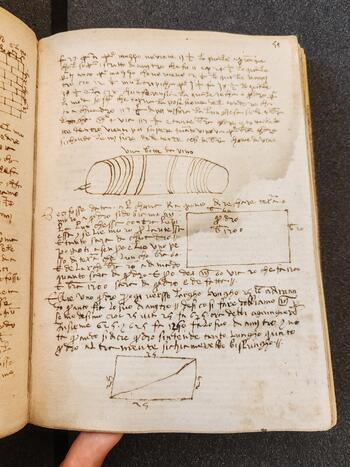
So, during my stay in Florence, I conducted research in three major manuscript libraries: the Biblioteca Medicea Laurenziana, the Biblioteca Riccardiana, and the Biblioteca Nazionale Centrale di Firenze. Each of these institutions preserves manuscripts of libri d'abaco dating from roughly the thirteenth to the sixteenth century. These libraries together offer an unparalleled overview of the genre's chronological development and regional variations. Among the most remarkable items I consulted was a beautifully preserved manuscript containing a mathematical treatise by Piero della Francesca, which combines geometrical reasoning with practical calculation. The experience of examining such manuscripts directly provided valuable insight into the layout, scribal conventions, and paratextual features (diagrams, tables, marginal notes) that shaped their pedagogical function.
The material I gathered will require further analysis and contextualization, but my preliminary observations already suggest a striking difference between these Italian abacus texts and their Greek mathematical counterparts. Unlike the words of Euclid or Archimedes, which strive for universal abstraction and avoid concrete numbers or narrative framing, the libri d'abaco tend to present problems that are explicitly situated: they often take the form of brief story-like exercises describing, for instance, the division of an inheritance or the sale of goods, complete with specific numerical values. It is then left to the reader to extract the general principle or rule underlying each case and to apply it analogically to new situations. This pragmatic and inductive mode of reasoning- "learning by example" rather than by theoretical generalization- reveals a different kind of intellectual engagement with mathematics, one deeply embedded in the rhetorical culture of the time.
These findings raise several questions that I intend to pursue in future research. Was the influence of rhetoric stronger, or at least differently oriented, in this kind of mathematical writing than in ancient theoretical mathematics? Could the formulaic, narrative, and example-driven character of the abacus tradition be read as a continuation- albeit transformed- of ancient rhetorical pedagogy. Conversely, to what extent do these texts represent a distinctly post-classical mode of mathematical thinking, one shaped by the practical requirements of trade and bookkeeping rather than philosophical speculation?
Further study will require both textual and contextual analysis: collating different manuscripts to trace the evolution of specific problems and formulations, comparing their linguistic register with contemporary vernacular and Latin prose, and situating them within the broader intellectual networks of late medieval Italy.
As I am still at the beginning of my second year of doctoral research, this fieldwork marks an essential first step in what I hope will become a sustained investigation into the cultural and pedagogical foundations of mathematical practice. The Europe Center's support has been indispensible in enabling this initial phase of research, and I look forward to developing these inquiries through further archival work, comparative study, and interdisciplinary dialogue between the history of mathematics, education, and rhetoric.