
Walker Smith (Music, Science, and Technology) | The Well-Tempered Periodic Table (Ligeti Zentrum, Hamburg)
Walker Smith (Music, Science, and Technology) | The Well-Tempered Periodic Table (Ligeti Zentrum, Hamburg)

I spent this summer as a guest researcher at the Ligeti Zentrum in Hamburg, supported by the Graduate Research & Internship Program in Germany (GRIP). It was easily the most fun and productive summer of my life. Having just finished my first year in the PhD in Computer-Based Music Theory and Acoustics at Stanford’s Center for Computer Research in Music and Acoustics (CCRMA), I was excited to spend an entire summer devoted to a single research project. My project, The Well-Tempered Periodic Table, was an extension of my ongoing “musical chemistry” research at Stanford. For the past few years, I have been developing my Interactive Musical Periodic Table, which converts the visible spectra of chemical elements into sounds using a technique known as data sonification. Each element has a unique emission spectrum—a distribution of frequencies of electromagnetic radiation (colors!)—that I translate into sound frequencies. This creates a unique musical chord for each element. I have been working to expand these sonifications into an interactive musical instrument, and my work this summer involved developing unique microtonal scales from the frequencies of each element. At the end of the summer, I premiered a new 90-minute educational multimedia performance complete with multichannel sound, lighting design, acoustic and electronic instruments, spoken word narratives, and even a self-playing drumset.
My host institution, the Ligeti Zentrum, is a very new institute (founded in 2023) with a variety of projects exploring the intersection of arts, science, technology, medicine, and sustainability. The center is named after György Ligeti, a Hungarian composer who envisioned creating such an interdisciplinary center in Hamburg but was unable to in his lifetime. One of his students, Georg Hajdu, founded the center and is now serving as the director. The name LIGETI is also an “backronym” for Laboratories for Innovation and General-Audience Edification through the Transfer of Ideas (or auf Deutsch: Laboratorien für Innovation und Gesellschaftliche Entwicklung durch den Transfer von Ideen). Hajdu describes the center as a laboratory—less in the sense of a modern scientific laboratory— but more like a Renaissance workshop where artists, philosophers, scientists, craftsmen, and mystics all work together.
I suppose I’m most drawn to the “General-Audience Edification” part of the center’s acronym, as I love creating educational performances that merge music and science. However, I constantly experienced the “Transfer of Ideas” as well. I had many conversations with engineers who work with haptics, or devices that allow us to “feel sounds” by transmitting sound vibrations through small tactile devices. They suggested I place a transducer (small resonating body) on a drum and play the sound of my element sonifications through that. The resultant sound—a synthesized sonification of elements, filtered through an acoustic instrument—had a striking yet organic feeling. My thought was then—what if I use an entire drumset? By adding lights under each drum with colors corresponding to the spectrum of an element (in this case, hydrogen), I created what I call the “Magical Chemical Drumset” (or Magic Alchemical Drumset). You can watch a demo on YouTube.
In my final concert, I combined the magic self-playing drumset with acoustic instruments—myself on clarinet and fellow Ligeti Zentrum researcher and talented jazz guitarist Kieran McAuliffe. We then improvised using the notes of the scales of various elements—imagine a blues in the “key of hydrogen” or an upbeat jazz set in the “key of helium.” I then passed our microphone inputs through a pitch-detection algorithm connected to the lights such that when one of us played a note in the key of hydrogen, the lights would respond with that color in real-time. The result was a fun light-sound jam session.
I am particularly excited about this new direction in my research and performance because in the past I have not included acoustic instruments in my work. My previous performances such as The Sound of Molecules and Chromatic Chemistry: the Periodic Table in Light and Sound involve narrating over pre-composed electronic tracks with visuals. This new direction feels like a much more exciting and live way to explore musical chemistry! I even involved the audience by having them sing different notes in the key of hydrogen, with their pitch controlling the lights.
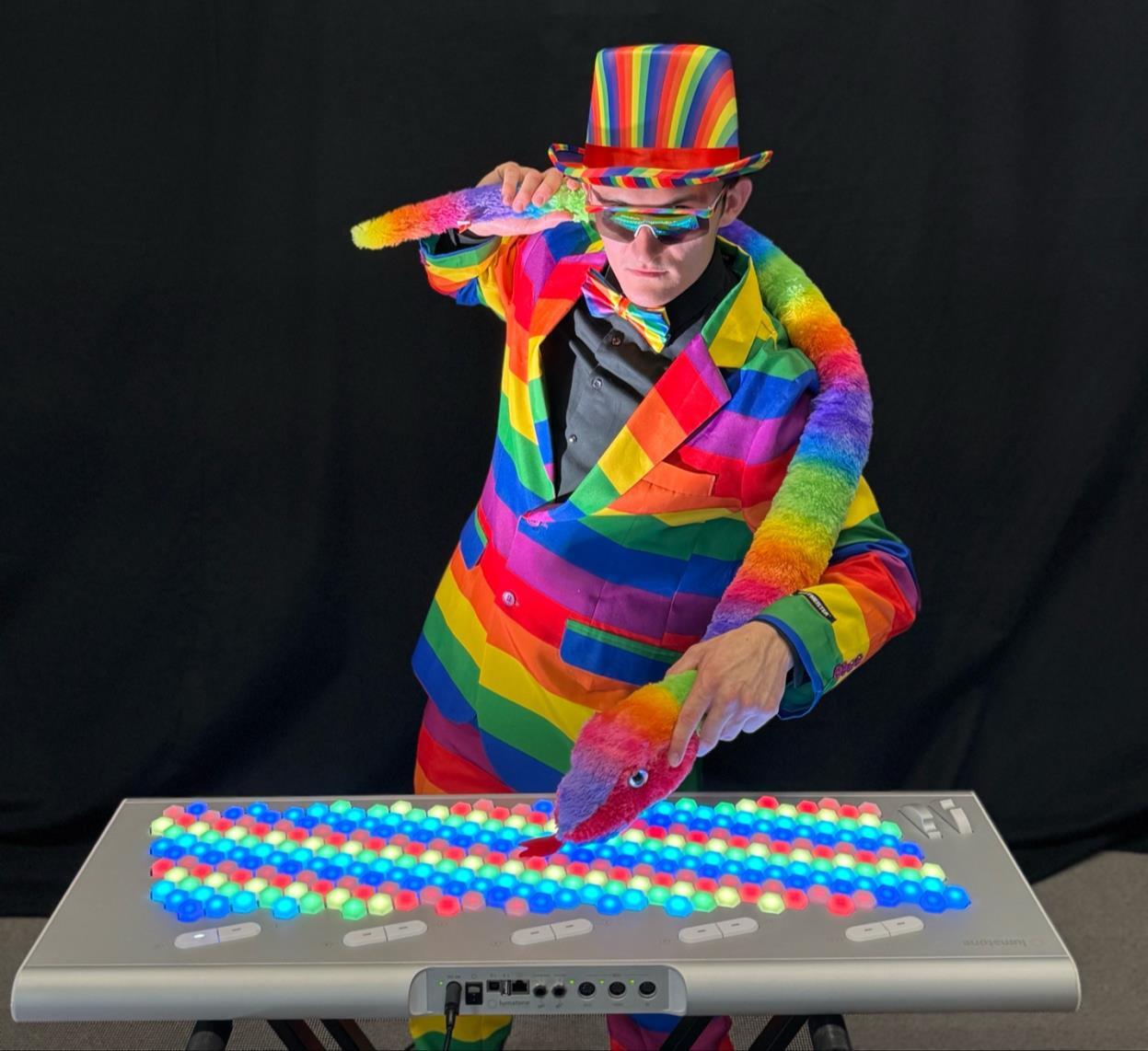
My main performance instrument was the Lumatone, a specialty electronic keyboard that can be programmed with any microtonal scale. I programmed my element scales onto it, and used it to control the sound and lights in real-time. You can see the attached pictures of my rainbow-covered performance persona “Roy G. Biv” shredding on the Lumatone, and you can watch my performance “The Well-Tempered Periodic Table” on YouTube. You can also read more about it on the Ligeti Zentrum Event Page.
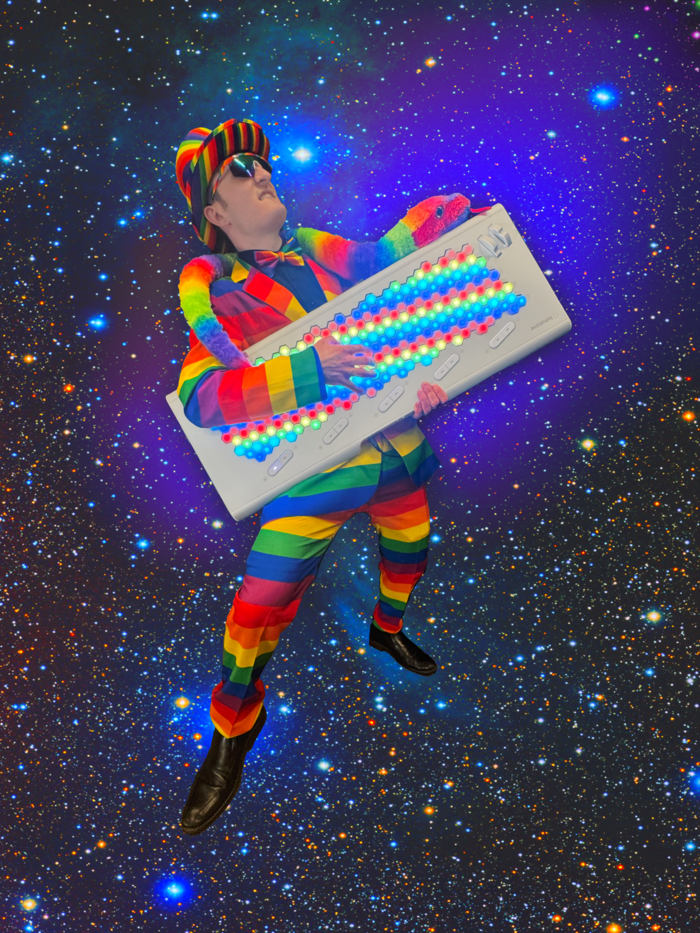
I am excited to continue my summer research and music composition at Stanford this year. This Autumn, I will present the Magical Chemical Drumset at Stanford’s CCRMA Transitions Concert in October, and will travel to perform my new show at the Indiana University Science Fest and a sonification concert at Whitman College in November, as well as at the Atlanta Science Fest in March. I will also be performing my show at Stanford CCRMA in November, and hopefully again in the winter or spring quarters!
I had such a wonderful summer that I am hoping to return to Germany, and to the Ligeti Zentrum in particular. I will already be returning in May 2026 for the International Computer Music Conference (ICMC) in Hamburg. They are piloting a new public-facing outreach series titled “Off-ICMC,” and the Ligeti Zentrum staff plan to incorporate my new
show as one of the major attractions. I am incredibly excited to continue developing the show and return to Hamburg next spring to share it with a wider audience!
I was also able to practice my German speaking while on my research residency. I took a German course at Stanford before my GRIP Summer, which helped me feel more comfortable with common interactions. While my colleagues all spoke English, many of them spoke German as a first language, and they included me in conversations to let me practice my German. My proudest moment of the whole summer was giving complicated metro directions to a stranger, entirely in German. I was also able to take a 3-week German course at the Hamburg Goethe Institut during the summer, which was an intense but wonderful experience. I am now continuing my German studies at Stanford.
My work was featured in an Innovative Hochschule article. I was also (almost) on German Television! A journalist from NDR—the North German radio and broadcasting station—reached out to the Ligeti Zentrum after seeing the advertisement for my performance. She was interested in doing a story on my project for a popular Talk Show called “DAS! Rote Sofa.” I had a phone interview with the journalist who was excited to make a story. Unfortunately, her boss wasn’t as into the idea, and they didn’t end up running the story. Oh well, at least I can say I was (almost) featured on North German Television!
In addition to my time in Hamburg, I was also able to do travel to other places in Germany, including Leipzig, where I heard the final concert of the annual Bach Festival! I also travelled to Portugal for the AudioMostly Conference, where my “Interactive Musical Periodic Table” was awarded the Best Installation Award!
Even though I only spent a few months at the Ligeti Zentrum, I know that I have spawned ideas that will keep me occupied for at least the next several years, collaborations I am excited to pursue, and friendships that I know will last for life.