
William Montgomery: Sacred Games: Sailing Circus and the Greek Mediterranean
William Montgomery: Sacred Games: Sailing Circus and the Greek Mediterranean
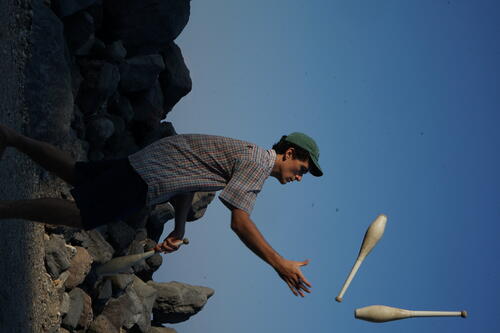
With the invaluable help of The Europe Center and the FUTR grant I was blessed to be able to travel to Greece for a period of seven weeks over this past summer, in a country-spanning personal odyssey that began in Thessaloniki and ended on the island of Nisyros, passing through the Pelion Peninsula, Delphi, Athens, Crete, Rhodes, and elsewhere along the way, chasing what I could find of the sailing circus whose image captured my imagination like few others in the midst of the pandemic years ago and has become something of a recurrent dream and aspiration of my wakefulness in the time since. And I found it, or my own version of it.
After arriving and spending a few days acclimating to the country in Thessaloniki, I joined the circus group I intended to follow in a tiny hamlet at the end of the Pelion peninsula, mythological home of the centaurs (still found in the country seals on local waste bins), being given the port bunk/bench on the inside of the boat and a little storage space on the starboard side for my things, all in one backpack and one plastic bag. And I met the crew: Leon the French captain and mechanic, Mario the Spanish musician and polyglot extraordinaire, Matthew the American percussionist, Kosta the Greek guitarist, and Johanna the Greek actress. And we sailed for a week around the Pagasetic Gulf, arriving in the small seaside towns in the afternoon, resting, performing in small towns by night, rising when we liked, and setting out for the next town by midday. Or not, if we felt like staying. In time, just over the course of that week, I came to know each person on the crew and conducted interviews both about them and their lives and their relationship to performance and circus in general, and how they came to be here doing this wonderful thing.
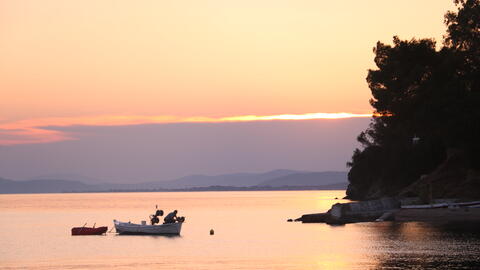
And I might have spent much of the summer like that (it was cheap enough, €25 for lodging and much of the food for a week), had natural disaster not intervened. Leon's workshop at his home in the south of France, and nearly the rest of his house, burned down in the wildfires in the region, destroying many of the things he had worked on for decades as a mechanic, and he had to leave suddenly a week in, just as Kosta, Johanna, and Matthew also finished their trips and moved on, being replaced by three French friends of Leon's. The boat was take to port further down the peninsula, in a town called Milina, and we waited with uncertain indications as to whether we might get a new captain and sail again. For that week, and then on, it is somewhat more my story- I still followed the crew to performances in Milina and neighboring towns that we could now drive to in the van two of the newcomers had come in, helping set up and pack up where I could and taking a great deal more footage- but found myself just as often seeking out my own places to swim, take photos of the beauty of the gulf, meet and speak with the characters we were meeting in town- most notably a noted Greek actor and his family on vacation, and a number of young people who hung around the restaurant/bar adjoining the marina where we'd get water and wash- and even taking a hike up the mountains to a nearby town on one of the final days. And after it all the future of the tour was no more certain, Leon's three-week return figure seemed ever more doubtful, and, I'll confess, measures of tension emerged over my standing in the group- and it was time to move on.
This was not the original group from the article that had sparked my interest- that group, the Sea Clowns, had been forced to postpone their summer trip due to the founder Fred's retirement from sailing, the current leader Alvaro's work on a cooperative farm in Rhodes, and disputes over ownership of the boat with other members in the course of rifts in the group- all of which I would learn more later. The group I had been with was a cousin, Tikitas Circus-Band (named for the boat, Greek roughly for "What are you looking at?"- apparently a somewhat confrontational expression), started by Leon separately and more recently after time with Fried, Alvaro, and others from Sea Clowns. But those original people were still scattered across Greece, closer than they'd ever been, and my taste for what I had come for was not yet sated. So I got in touch with Fred, now in Chania, Crete, and made plans to see him, going to Athens on the way out of longstanding cultural and historical interest, the sense of necessity of doing it in the course of such a long trip to Greece, and because I was able to stay in Alvaro's old apartment there (I was blessed to only need to pay for about two weeks worth of housing the whole trip). And I did, with a brief stop in Delphi along the way, and it was a wonderful time- Alvaro's roommate Eduardo was also a musician and performer, with a prodigious collection of flutes he would use for weddings and other shows, and many of Alvaro's things were still around the house- Sea Clowns stickers, activist posters, sailing memorabilia, performance photos- and with this physical record and having been in contact for nearly a year now, I was getting quite the picture of the man without having ever yet met him face-to-face. I also saw historical sites that had captivated my interest for many years and felt that I was progressively getting firsthand the Greece of the history books- and drawing the contrast with the living, breathing, Greece outside the museums. The classical art set against the Eastern Orthodox stylings of the churches and monasteries made for a particular juxtaposition, if an expected one- I confess that the naturalism of the ancients was more to my taste than the particular unnatural mannerism of the Christian pieces- even as the former were in museums and the latter were in active places of worship, being kissed along with the saints' relics by living people.
I took a 12-hour ferry ride for Crete, making it to Chania harbor and being recognized by Fred without having identified myself physically or otherwise- as he put it, he's just good at that kind of thing. While he was living nearby, in a little town near where part of Zorba the Greek was filmed, he put me up in the harbor in a boat that he was holding onto for a friend of his. Of course, his own story was of interest- being from Alaska, having crossed the United States first as an aspiring musician, and then, after going to Burning Man and falling in with different groups, a circus performer- before starting first the Cyclowns bicycle circus and traveling across Europe, then seeking out the greater ease and flexibility of boats- making for the Sea Clowns (and he told me that he dreams next of taking to hot-air balloons- the Sky Clowns). The man had a quiet charisma, and reserve, what might be mistaken for almost shyness to him, much like Leon- both of these clown/captains tapped into something in their performances superficially very different from their personal selves, a pure performativity which nonetheless did not contrast strangely or seem artificial so much as they did clarify and enrich the people they were the rest of the time. What they do is something that everyone should try in some form.
To that point, my hopes of building on what little performance I've done and taking on some true role in the cast for the performances was frustrated by my tour with Tikitas being cut short- the best that I was able to do was some clowning efforts while we were busking more informally with the guitars on the Volos waterfront, dancing goofily, making faces, falling and springing up, with Mario doing a great rendition of the Benny Hill theme song on guitar and vocals. Leon and Mario were very complimentary of my efforts, I'm glad to say, there and later when I reprised it while hanging out on the boat. When I took TAPS 103, Beginning Improv, last spring, I got the most positive marks from my classmates not for my verbal wit- which I might have expected with how cerebral (and I might flatter myself to say occasionally witty) I can be- but for my physical comedy, my slapstick and pratfalls, which I was glad to contribute here. That I suppose is the better part of my own amateur relationship to performance- a chance to get out of my head and reach people more easily- and I can only hope that I can build on what I was able to explore of it here.
That night I also sang with Mario and played a little guitar, worked on my pin juggling -
which I had started, with difficulty, the very first night with Tikitas - and the next week in
Argalasti, near Milina, sang and danced along with a whole group of both local and our
musicians playing Bob Dylan songs, among others in Greek I didn’t know. And the final time
was my last night in Chania harbor, after I had been meaning all week to take out the guitar
stored on the boat and busk with it on the harbor walkway - I might make gyro money, and worst
case I get the practice. But of course I didn’t get around to it until the last night and last minute,
around midnight, finally taking it out and finding a place with a little foot traffic along the
waterfront, along one of the old Venetian shipyard buildings, with the fishermen and sailors on
the boats in the dock laying out nets and finishing their work for the night, and playing the few
songs I know well on an irregular loop. And I made €2, all from one either British or Australian
tourist, and a can of beer from a man named Marcel, originally from Germany and now living in
Chania, who was preparing to sleep nearby under the building’s shelter on some cardboard but
bid me keep playing - he liked it. I stopped only when my fingers hurt. I want to avoid many
tired generalizations, but I will say that I’ve seen people look less happy than that grizzled old
man, hair gray and wild, sitting there cross-legged as if meditating facing the water in the night, a
beer of his own at his feet.
The final stop was Rhodes to see Alvaro, from Uruguay, the final captain, clown, and
major player in my drama, who had come to feel like the one I had crossed the country to see in
the first place. The whole trip was improvised almost on the spot, my destinations for the day,
transportation, and lodging for the night more than once worked out the day of, and I had only
bought my plane ticket home from Rhodes in Chania, on the boat using Wi-Fi from the nearby
hotel, allowing me five days or so with Alvaro. Again I was blessed to be following such
hospitable people, as I was put up in the home of one of his friends in Rhodes for the few nights I
was there. I had a day to myself among the medieval and Crusader-era castle and battlements,
and the hills in view of Turkey, before finally meeting the man at a gathering at an acrobat school
with friends of his, eating produce from his farm outside of town. He had decided finally to make
a shorter tour than summers part with circus friends from Italy and Spain, and was in town to
then go to nearby Nisyros and prepare the boat, the readying of which, and its casting off, would
be all I could see before my own departure. So it was on to Nisyros, with stops in picturesque
seaside towns of the Dodecanese along the way, and I was put up on my third sailboat of the trip
in Paloi harbor as we met with the Italian, Spanish, and Greek acrobats, fire jugglers, and
musicians of the tour to come. I was glad to help with mending the sail with needle and thread
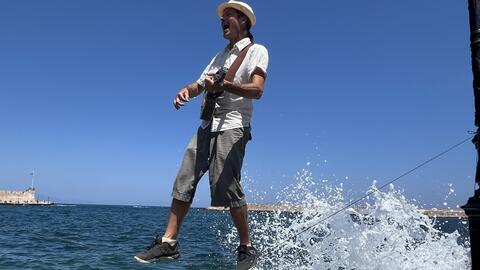
for the trip, but beyond that I was even less the documentarian than before, a splash from a freak
wave in Chania harbor having struck and destroyed my camera(the footage was fine) while I was
shooting Fred playing the ukelele on his tightrope along the water the week before. So in
between borrowing Alvaro’s bicycle to see the nearby ruins of a hotel next to Roman-era hot
springs and swimming on the other side of the seawall I worked on my pin juggling, and while I
hadn’t perfected it I finally got to sustained sequences with them, much of which I was glad to be
able to capture on a camera I borrowed from a friend of Alvaro’s.
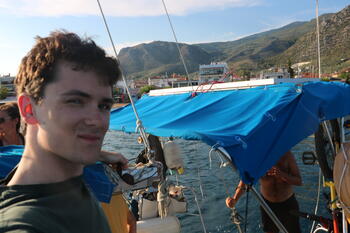
And then came the last night, now with everyone for the coming voyage on the boat - I
think six of us - and then the final day, perhaps the most eventful of all. They had decided to set
out a day earlier than planned, partly in order for Alvaro to each the others, new to sailing, the
ropes. And so I ended with what could, perhaps should, have been the beginning - the circus
setting out for the next island over, on a bright, warm, clear morning and calm seas, many of
those on board learning how to sail for the first time(while I was given the rudder to steer on
Tikitas on my very first day with them, and would help with the anchor and ropes where I could,
I wasn’t taught the underlying principles) - and me on the dock, high and dry, my bags at my
feet, filming them sail out into the water with my phone until the sail was a white speck on the
water and I couldn’t squint against the sunlight any longer. All that remained was to see what I
could of the island before my 2:30 ferry. It’s a volcano, you see, and I hadn’t yet been to the
crater. So I did, and climbed the sulfurous hills and descended into the hydrothermal craters
where I could, before swimming a last time and racing to the port for my ferry. In Rhodes I spent
my best time in the castle and old town there before a final night of epilogue in the same
borrowed apartment(her Albanian roommate was unsurprised that I am half Russian, said he
could see it, and their dog Mortimer was a bit less wary). And the next day it was just a matter of
a bus to the airport, and 36 hours worth of flights, including layovers in Rome(saw the Coliseum
and more) and Bari, Italy, and getting home at last.
The trip had seven distinct chapters, each with their own recurring locations and
characters. It prevented me ever from becoming fully comfortable and fixed in one place(half of
my time was spent on boats, after all), even as I was able to stay long enough with each that they
became true settings, and characters in their own right, and not merely incidental. I have
considered many different means of telling more fully both the story of my trip and the scatteredly connected community that I was there to document and which afforded me only
pieces of its magic or its reality at a time, interspersed both with the practicalities of the
still-evolving lives of its participants(Leon rebuilding his life at home after the fire, Fred having
settled down and now raising a daughter with Nikoleta, also of Sea Clowns, and Alvaro having
taken up the plow), and my own limitations as foreigner and traveler and student and journalist
and documentarian and aspiring artist. I have been in contact with a man who did a successful
documentary on the Cyclowns years ago, and others who might be able to help take my 30+
hours of footage and digest it, hopefully make a documentary out of it(or more likely simply
offer advice to me in doing that). I hope to work material from my time there into a fictional
screenplay, towards which I have already made significant progress. And I should think the
thousands of beautiful photographs from my travels would be of interest to someone. But while
the wholesale philosophical and personal transformation I might have wished for myself from it
all may remain in the future, the trip provided what it had really promised, a glimpse of a
different means of living life, of people who had looked into, around, and finally past the choices
conventional adult reality offered them and reached out for their own brass ring instead, and a
benediction to look into oneself and pursue without reservation life of, by and for oneself and no
other, even if that comes to mean part of oneself will always be found somewhere out there in the audience, and another tossing on the waves.