
Neil Rathi: Classics and Colonization in Athens and London
Neil Rathi: Classics and Colonization in Athens and London
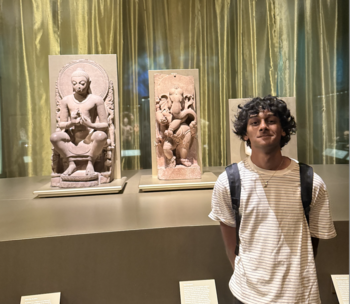
I spent the last few weeks of my summer reading some very old letters in London and looking at some even older rocks in Athens. Thanks to The Europe Center's Fellowship for Undergraduate Travel and Research- along with support from the Classics department's travel grant program- I had the opportunity to conduct primary research for my honors thesis in Classics, which focuses on how Greek philosophy of labor influenced the codification of caste in India by British colonial administrators during the late 19th century. My time in Europe allowed me to understand the core of evidence-based material history, in a way grounded in the historical methodology I studied in the classroom.
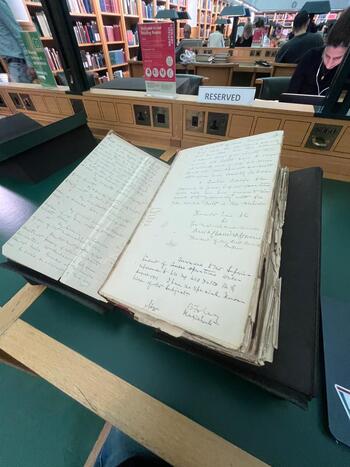
In London, I had access to the India Office Records at the British Library. I spent much of my time there combing through the undigitized personal correspondence and notes of administrators like Herbert Risley, who first established 'formal' caste in his 1901 census of India. The collection in the library is vast- I spent many days just reading through their catalogues- but incredibly dense with information available nowhere else. Risley's letters to other administrators during his creation of the census of Bengal were particularly insightful, providing examples that made real much of my coursework on political theory with Professor Cohen in Classics.
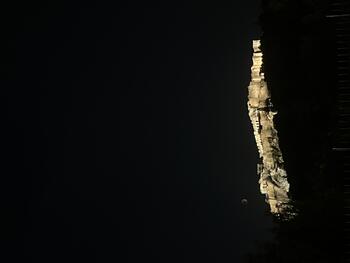
And in Athens, I developed a deeper understanding of the Greek model of labor. As a special reader at the Gennadius library at the American School for Classical Studies, I was able to handle rare, undigitized and out-of-print editions of Aristotle. This was accompanied by my ability to study physical materials and artifacts produced by laborers in ancient Athens: I had the chance to study inscriptions written by artisans in Kerameikos at the Epigraphical Museum, and finally saw the Dipylon amphora at the National Archaeological Museum. Seeing these artifacts under the looming shadow of the Parthenon was an opportunity to understand the lives of laborers in a much more vivid way; to understand what so terrified Le Corbusier when he stood atop the Acropolis.
But even beyond direct contributions to my thesis, traveling to both of these cities in the span of two weeks allowed me to understand the Greek world in substantially more detail than in the classroom. After spending two days at the Acropolis and its museum, I then had the opportunity to see the rest of the marbles on display at the British Museum's Parthenon collection. In London, neoclassical architecture abounds; but in Athens, the ruins of classical architecture still stand. In my junior year, I took two classes on Greek art and its reception with Professor Maxmin in Art History; but in Athens and London, I got to see both the art and its influence come alive.
Similarly, traveling to London and exploring its museums gave me a much deeper sense of the extent to which the British colonial project plundered its subjects- galleries upon galleries of art from South Asia, Africa, and the Caribbean- and how deeply it was influenced by the Empire's reception of the classical world.