
Emilia Cottignoli- An Ecocritical Approach to Late Antiquity
Emilia Cottignoli- An Ecocritical Approach to Late Antiquity
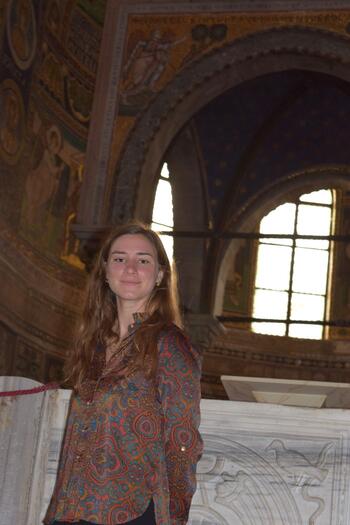
Thanks to the generosity of The Europe Center, this summer I visited several bejeweled, inlaid, and decorated mosaic columns from Late Antiquity across Italy. These in-person visits allowed me to study the columns and their ornament through an eco-relational approach, considering the relationship between the internal, decorated world and external environment, situ, and surroundings. Cultivating an "ecological" methodology has helped me define and refine my dissertation research topic.
This summer I had the opportunity to travel to Sicily, Ravenna, and Naples through the support of the GSGC grant. In Sicily, I visited the Palermo Cathedral (Palermo), Cappella Palatina (Palermo), Martorana (Palermo), Cefalù Cathedral (Cefalù), and the Monreale Cathedrale (Monreale). In Ravenna, I visited the Battistero Neoniano, San Vitale, Cappella Arcivescovile, Battistero Neoniano, Sant' Apollinare in Classe, and Sant' Apollinare Nuovo. In Naples, I visited the Naples Archeological museum which houses inlaid columns relocated from Pompeii.
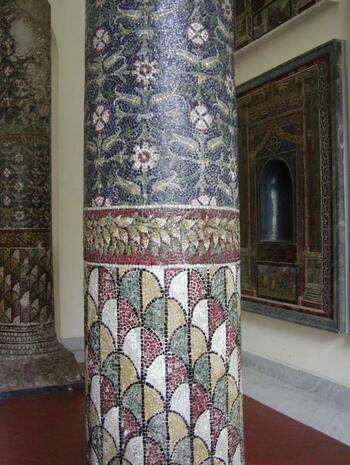
My goal for these visits was to nuance the difference between Late Antique Mediterranean 3D mosaic columns and their 2D representations. These two columnar modalities are not indexical of one another, but operate differently in their spatial realities. While the mosaic representations are certainly architectonic, and indeed function as three-dimensional structures within the diegetic, visual program of the mosaics, their relationship to the beholder distinguishes them from their counterparts in the round.
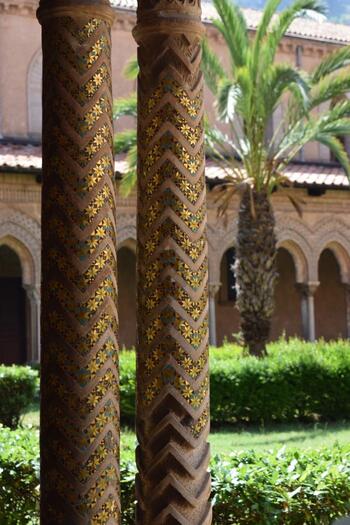
For example, mosaicked columns from Pompeii (first century) were part of the aquatic atmosphere cultivated in a garden nymphaeum, in conversation with the other mosaic maritime vocabulary around them. The Monreale (Sicily) columns can be situated in relation to their garden context, in which they function as dynamic, artificial trees, in conversation with planted palms that grow before them. Twisting forms, motion, and sparkling ornament are not simply pattern, but actively dynamic forces that implicate the viewer in the cloister, drawing their gaze and bodies around the space.

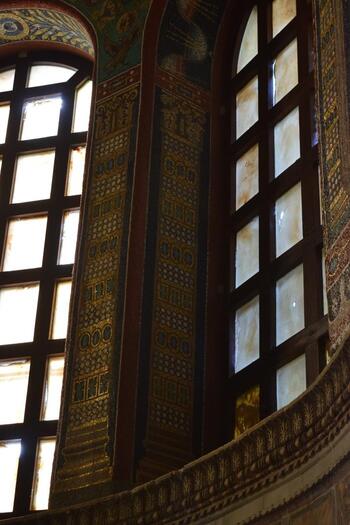
On the other hand, represented columns signify in a different ontological reality, marking borders within their diegetic visual contexts, and architectonically referencing divine structures. For example, the columns tucked away in the window arches of San Vitale perform as framing devices at the threshold of interior and exterior. Positioned on three sides of the window arches, the two dimensional columns on a dimensional surface create the illusion of a real column, seen from multiple angles and perspectives. The 2D decorated column is also found as part of architectural structures, most commonly including that of the heavenly cities, represented as bejeweled buildings with suspended stones.
Thanks to the generous support of The Europe Center, the outcome of these in-person visits is a forthcoming article, titled "Bejeweled Columns as Spatial Bodies," which will be published in an edited volume titled Sparkle, Glitter, Gleam, and Glow by Brill in 2026. If I had not had the chance to visit these momunments/sites/columns in person, it would have been very difficult to make an argument about beholder experience through an ecological perspective.