
Gabriella Armstrong- Archaeological Spatial Analysis of Bronze and Iron Age Settlements in the Adriatic
Gabriella Armstrong- Archaeological Spatial Analysis of Bronze and Iron Age Settlements in the Adriatic

Thanks to The Europe Center, I was able to complete a successful field season for my research project "Archaeological Spatial Analysis of Bronze and Iron Age Settlements in the Adriatic." This project builds on research from summer 2024, which was also generously funded in part by The Europe Center. This summer I traveled to Albania and Kosovo where I joined two separate projects, each focusing on prehistoric occupation in the western Balkans.
My dissertation research analyzes socio-political landscapes in the Mat Valley for the Bronze and Iron Ages (late prehistoric periods), particularly emphasizing the ways in which spatial data and remote sensing methodologies can shed light on social differences in the past. The Mat Valley is a mountain-ringer river valley in central Albania that contains numerous burial mounds (tumuli) which present a diversity of structures and assemblages that suggest particular social distinctions for the Bronze and Iron Ages.
Yet, there has been limited archaeological work on the surrounding landscape to understand how this perceived social difference was actually constituted in daily life. I aim to address this gap through my dissertation studies.
This past summer, I traveled to the Mat Valley where I was able to capture aerial images and document points of interest within two of the five natural passes through the mountains that connect the Mat Valley to surrounding regions. Furthermore, I was able to walk a significant portion of the landscape, identifying natural resources such as fresh water and clay banks, in addition to visiting potential copper ore points identified by the local community. The most rewarding work from this summer in the Mat Valley, however, was once again working with the Burrel Museum, a local museum in the valley that houses a plethora of archaeological assemblages including artifacts from the 1970s and 80s tumuli excavations. These tumuli assemblages are of great importance to my project as they are the best documented archaeological assemblages from the Bronze and Iron Ages for the Mat Valley. These materials had not been touched in decades and I, alongside team members from Project CLAMS (the collaborative research project through which my dissertation work is possible), re-washed and digitally cataloged all of the ceramics, metals, and small finds from these excavations. This is work that we started in 2024 and were able to complete this past field season. This was particularly beneficial work for me as I was able to analyze diagnostic materials from the region that are representative of what I may find in my future survey work.

This past summer The Europe Center also enabled me to travel to Kosovo, a regional proxy I am using to predict settlement patterns in the Mat Valley. I was incredibly fortunate to join RAPID-K (Regional Archaeology in the Peja and Istog Districts - Kosova), an archaeological research project that I have participated in since 2019. With RAPID-K, I assisted in excavations at a Bronze Age settlement and then helped analyze and catalogue artifacts from the season's fieldwork. This was a wonderful full-circle moment as in 2019, my first archaeological experience (quite literally my first day ever in the field) was conducting shovel tests at this same site. It was amazing to be able to return and work with materials that will benefit my studies, while also excavating with the colleagues and mentors who made my path as an archaeologist possible. In Kosovo, I also collected photogrammetric and GPS data with the Atlas of Archaeological Sits in Kosova (AASK). AASK is a collaborative international research initiative seeking to collect and provide high quality geospatial data for archaeological sites in Kosovo to students and researchers through a digital database. AASK has enabled me to become experienced with geospatial data from Kosovo, which is in the same western Balkan landscape as my dissertation research.
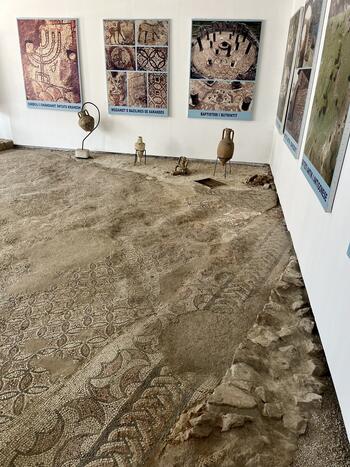
Although I have worked in the Balkans since 2019, I have not been able to visit archaeological sites outside of my main area of work. Thus, this summer I ended my field work by traveling to southern Albania so that I could visit other archaeological sites and museums. This was especially helpful for me as I was able to see variations in assemblages among different locations in Albania, in addition to further immersing myself in Albanian archaeology. The landscape of southern Albania is quite different from the Mat Valley and the north, so it was interesting for me to consider how landscape variation across Albania as a whole may have impacted the social lives of people from thousands of years ago. I am incredibly grateful for The Europe Center and I could not have completed this work without their generous support. Thank you!