
Paige Hill: Comparative Politics of Black Immigrant Assimilation
Paige Hill: Comparative Politics of Black Immigrant Assimilation
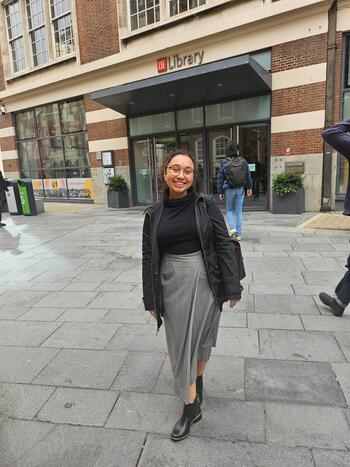
My dissertation is a comparative study of Black immigrants' political behavior in the United States and United Kingdom, both anglophonic countries where many immigrants racialized as Black from English-speaking Caribbean and African countries migrate to. Through social scientific research including quantitative and qualitative methods, I consider the ways in which racial and ethnic politics shape Black immigrants' racial identities and political participation.
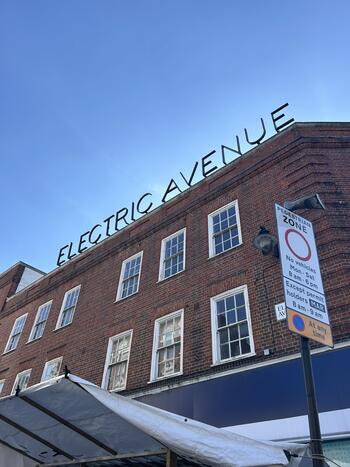
Thanks to the generous funding provided by The Europe Center, I spent six weeks in the United Kingdom conducting archival and qualitative fieldwork to better understand how Black immigrants to the UK develop racial identities and how this racialization process has influenced Black British politics. My time was mostly spent in Brixton, a neighborhood in the South London borough of Lambeth and home to a thriving multi-ethnic Caribbean and African community of both recent and multi-generational immigrant heritage. The ethnographic data collection included attending cultural events throughout October, the UK's Black History Month. These events included special exhibitions and tours at London museums, as well as local programming by community organizations. Some highlights included exploring the historic Brixton Market along Electric Avenue, a Black Trailblazers tour of the National Portrait Gallery, and a series of talks and workshops sponsored by the Lambeth Council and Brixton Library.
I also conducted extensive archival research at: the Black Cultural Archives (BCA) in Brixton; the archive of the London School of Economics (LSE); the School of Oriental and African Studies (SOAS) Special Collections; and the George Padmore Institute Archive. I consulted primary and secondary documents including written first-hand accounts of immigrant experiences, political party internal documents concerning the Black electorate, newspaper articles from the 1950s through 1990s on race relations and immigration policy, and community organization notes and records.

Lastly, I interviewed first and second generation immigrants on question of racial and political identity formation, views on immigration, and other political preferences. This interview data is complemented by analogous and on-going in-depth interviews conducted with Black Americans and Black immigrants to the United States. Overall, my work in London provides evidence for my historical and qualitative chapters on the United Kingdom for my dissertation.
Fieldwork Insights
To summarize my findings, the construction of a Black British identity in the second half of the 20th century was one that was ethnically inclusive, rooted in immigration experiences, and explicitly political. Starting in the 1940s, West Indian immigrants of the Windrush Generation, named for their first major arrival on the Empire Windrush ship in 1948, arrived to the UK in response to explicit calls for Commonwealth citizens to migrate to the "mother country" to support rebuilding efforts following World War II. Migration from the Caribbean increased, along with migration of African and Asian immigrants from the British colonies, which meant that many immigrants at this time entered the United Kingdom as British subjects and citizens, with rights to enter, work, live, and vote.
Desplite legislation curtailing Commonwealth immigration in 1962, 1968, and 1971, multi-generational and multi-ethnic communities of immigrant heritage formed throughout the United Kingdom. Overtime, community organizations, particularly those in London, organized around issues facing these non-white neighborhoods, including discrimination in housing and the workforce, education and health care access, and over-policing. An inclusive "Black" identity began to emerge to capture the experiences of Britons with non-white origins who organized around a common experience. This common experience was a history of British colonization in their home countries and racialization at the new homes in the UK as non-white. Unlike in the United States, where "Black" as a racial category is based on African heritage and hypodescent, particularly among American descendants of enslaved peoples, in the United Kingdom, "Black" came to be a political identity that anyone who was not white could claim.
As Diane Abbott, the first Black woman Member of Parliament, noted in an interview from 1984, "Black means African, Afro-Caribbean and Asian. That is the definition. There is a tendency to say that anybody who thinks they are black are black..." (BCA, Outwrite, 1984). Likewise, documents of the organization Operation Black Vote emphasized that "The definition of Black is a political term. It includes people from South Asia, Africa, and the Caribbean" (Padmore, 1999). Newspaper accounts and political party documents reiterate a similar point of parties attempting to "woo" the Black vote, a growing multi-ethnic group of constituents organized around issues of immigration, racial discrimination, and equitable access.
Another interesting finding was evidence on how much Black politics in the United Kingdom were and are influenced by Black politics in the United States. From the Civil Rights Movement in the 1960s to Black Lives Matter in 2020, prominent Black British politicians and activists were in extensive dialogue with Black American politicians and political movements. Documents from the Labour Party Black Sections show that the Parliamentary Black Caucus, for example, was explicitly modeled off the U.S. Congressional Black Caucus. Contemporary photographic exhibits, such as "A Celebration of Demonstration", show how BLM protests in the UK sought to both stand in solidarity with US victims of police violence and also emphasize that the "UK is not innocent" for its construction of colonial racial categories in the first place, as well as ongoing institutionalized racism in policing, schools, and healthcare.
In the United States, Black immigrants are often assumed to assimilate socially and politically to the existing racial category of Black American, whereas in the United Kingdom, Black identity centers the immigrant experience. The value of a comparative approach in studying Black immigrant political socialization is that it helps us to understand how context shapes the social construction of racial categories, with implications for group behavior and individuals' political preferences in both countries. These findings contribute to our understanding of a trans-Atlantic, diasporic Black political identity in contemporary politics. My next steps will be to continue conducting interviews to analyze administrative and public opinion data in both the United States and the United Kingdom to build out the dissertation book project.