
Nicholas Cullen- Blank Spaces: Environment and Indigeneity in Magna Graecia
Nicholas Cullen- Blank Spaces: Environment and Indigeneity in Magna Graecia
My research is focused primarily on thinking about alterity in the so-called Classical past, and considering the ways in which the agricultural practices and foodways of the "others" of ancient history (especially the endemic populations of Italy and Sicily) were impacted by contact with Greek, Latin, and Punic speaking peoples. This past summer I had the opportunity to participate with two field projects in order to begin collecting soil samples and samples of residues from storage vessels and dining wares in order to better understand diachronic changes in foodways and agricultural practices.
I began my work in Calatifimi-Segesta, a small town in western Sicily which borrows half of its name from the archaeological site where my work takes place, Segesta. The site has a deep history of occupation spanning from the Iron Age to the Medieval period. With the Arizona Sicily Project, directed by professors Emma Blake and Rob Schon from the Uniersity of Arizona, I implemented a number of sampling strategies geared toward gathering data related to the diet of the peoples that have inhabited a Medieval structure as well as an archaic context that we uncovered the previous field season.
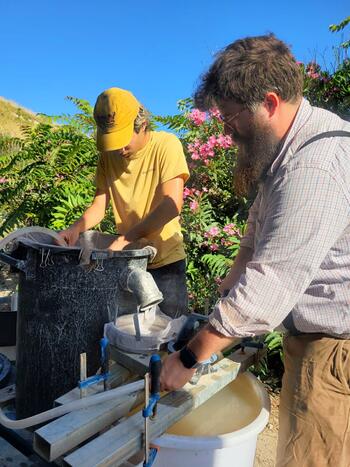
With the students in the field school, we collected and processed nearly 20 soil samples (approximately 200 litres of soil). From these samples we extracted charred macrobotanicals which attest to major food crops, the waste products of crop-processing, and major fuel sources. In addition to the macrobotanical samples, we took 90 microbotanical samples from floor surfaces and artifacts (e.g. vessels and textile implements). The goal of the microbotanical sampling is to understand the ways in which peopl engaged with flora in space and the associations between different plant taxa and artifacts. Both the microbotanical samples and the charred macrobotanicals were shipped back to Stanford for analysis.
After a month of fieldwork at Segesta, I grabbed my gear and traveled to the town of Spezzano Albanese to work at the Early Bronze Age site of Torre Mordillo. Once there, I worked with the Torre Mordillo Archaeological Project, headed by Professor Ilaria Battilorio from Mount Allison Unversity and Dr. Mattia D'Acri from Princeton, on an EBA hut where we implemented the same sampling strategies as those conducted at Segesta. Here we also sampled wattle and daub, a building material made with mud and reeds, to see if microbotanical sampling can elucidate the sorts of reedy plants they are exploited and if these change over time. From Torre Mordillo we processed 56 soil samples for macrobotanicals and 17 microbotanical samples.
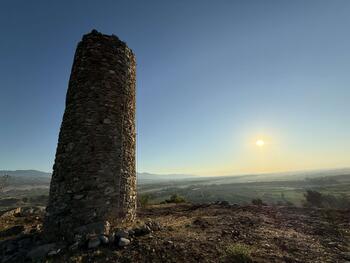
Archaeobotanical research in southern Italy and Sicily is still fairly rare, especially microbotanical sampling, so it is my hope that the samples from this field season will be the beginnings of a regional study that will elucidate the ways in which the environment is implicated in and impacted by the relationships between people. For this reason, I am extremely grateful to The Europe Center for their support.