
Tyler Maxwell (Civil & Environmental Engineering) | A Flexible Pump Volute to Reduce ECMO Blood Damage (RWTH Aachen Cardiovascular Engineering Institute)
Tyler Maxwell (Civil & Environmental Engineering) | A Flexible Pump Volute to Reduce ECMO Blood Damage (RWTH Aachen Cardiovascular Engineering Institute)
This summer I spent three months at the Cardiovascular Engineering group at RWTH Aachen, hosted by Dr. Sebastian Jansen, working on a redesign of a component inside the Rotaflow blood pump used in ECMO, a life-support system for patients whose heart or lungs can't function on their own. My time was split between Stanford, where I built and ran simulations of the pump's internal flow, and Aachen, where I fabricated prototypes and ran hemolysis testing with the CVE team.
Research project
The component I worked on is called the volute, the chamber that channels blood as it leaves the pump's spinning impeller. Volutes are normally rigid, but ECMO pumps rarely operate at a single steady setting. Flow conditions shift constantly, particularly when a patient is being weaned off support or circuit resistance changes, and it's precisely in these "off-design" conditions that a rigid volute tends to produce turbulent, high-shear flow that damages red blood cells. My project explored whether a silicone volute that flexes under the pump's own internal pressure, with no motors or active control, could smooth out that flow enough to meaningfully reduce blood damage.
At Stanford, before heading to Aachen, I ran fluid-structure interaction simulations, coupling flow physics with material deformation, to predict how different silicone stiffnesses and wall thicknesses would behave under pump pressure. That meant learning an entirely new simulation stack (ANSYS CFX, Mechanical, and System Coupling) and working through the numerical instabilities that come with modeling something as thin and compliant as a silicone membrane.
In Aachen, I designed and 3D-printed molds, cast silicone volutes using the lab's equipment, and ran bench tests to check that the real prototype deformed the way my simulations had predicted. I then worked with the lab's hemolysis testing team to compare my compliant volute against a standard rigid one under matched conditions. By the end of the summer we had results on the device which showed measurable reduction in hemolysis with the compliant design. We're now using that data to validate the computational model, which will let us run further design iterations computationally and converge on the geometry that maximizes hemolysis reduction. The summer also set up a real, ongoing collaboration between Stanford and RWTH Aachen, and the project will continue after my return.
Outside the lab
Germany turned out to be a great base for exploring more of Europe. A few of us GRIP students traveled together to Heidelberg, Cologne, and Berlin, and I also made it up to the Nordics, somewhere I'd wanted to visit since childhood. But what stood out most wasn't any single place, it was the people I met along the way. Even in a short three-month stay, I made friendships I expect to keep well beyond this summer.
Photos on the next page:

Figure 1. Experimental Setup of Heart Pump using Mouse Heart. (Because the blood lab is highly sterile environment and phones are usually not allowed, I don’t have much pictures of me in the lab unfortunately).
 Figure 2. With lab director and med students
 Figure 3. Fellow GRIP Students made it to Berlin
 Figure 4. Stanford Friend and I visited Munich and checked out the beer garden
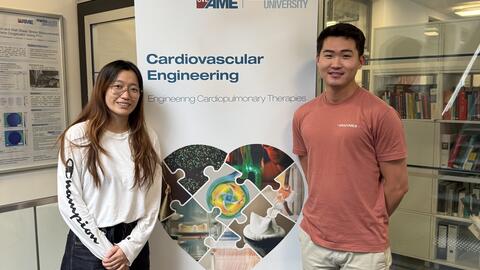
 Figure 5. Poster of the institute