-

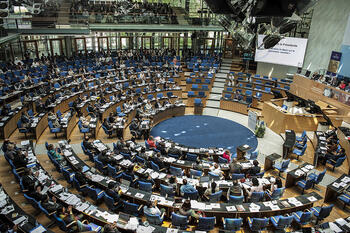
This conference aims to further our understanding of the institutional cultures, funding schemes and power structures underlying transnational institutions, with a particular focus on heritage bureaucracies. We bring together scholars working at the intersection of archaeology, anthropology, sociology and law to offer a broader understanding of the intricacies of multilateral institutions and global civic society in shaping contemporary heritage governance. Speakers will provide ethnographic perspectives on the study of international organizations, such as the UN and EU, in an effort to show the entanglement of political and technical decision-making.

A 2-day international conference organized by Claudia Liuzza and Gertjan Plets.

Speakers:

Brigitta Hauser-Shäublin (Institute of Ethnology, Göttingen University)
Ellen Hertz (Institute of Ethnology, University of Neuchâtel)
Miyako Inoue (Department of Anthropology, Stanford University)
Claudia Liuzza (Department of Anthropology, Stanford University)
Brigit Müller (Ecole des Hautes Etudes en Sciences Sociales, Paris)
Elisabeth Niklason (Department of Archeaology, Stockholm University)
Gertjan Plets (Stanford Archaeology Center, Stanford University)
Cris Shore (Department of Anthropology, The University of Auckland)
Ana Vrdoljak (Department of Law, University of Technology, Sydney)

Co-sponsored by Stanford Archaeology Center, Cantor Arts Center, Department of Anthropology, Center for Russian, East European & Eurasian Studies, Stanford Humanities Center, The Europe Center, France-Stanford Center for Interdisciplinary Studies, The Mediterranean Studies Forum.

Contact: heritagebur@gmail.com
Heritage Bureaucracies Conference Flyer
Download pdf

Stanford Archaeology Center (BLDG 500)
488 Escondido Mall
Stanford Universit

Workshops
Paragraphs

As Christmas celebrations for 2015 wind down, Stanford historian and archaeologist Ian Morris discusses the global reach of different aspects of the Christmas holiday, and compares theories of the relative influence of "soft power" cultural exports and "hard power" military and economic intervention on world societies.

All Publications button
1
Publication Type
Commentary
Publication Date
Journal Publisher
Stratfor
Authors
Ian Morris
-

Image
heritage bureaucracies

This conference aims to further our understanding of the institutional cultures, funding schemes and power structures underlying transnational institutions, with a particular focus on heritage bureaucracies. We bring together scholars working at the intersection of archaeology, anthropology, sociology and law to offer a broader understanding of the intricacies of multilateral institutions and global civic society in shaping contemporary heritage governance. Speakers will provide ethnographic perspectives on the study of international organizations, such as the UN and EU, in an effort to show the entanglement of political and technical decision-making.

A 2-day international conference organized by Claudia Liuzza and Gertjan Plets.

Speakers:

Brigitta Hauser-Shäublin (Institute of Ethnology, Göttingen University)
Ellen Hertz (Institute of Ethnology, University of Neuchâtel)
Miyako Inoue (Department of Anthropology, Stanford University)
Claudia Liuzza (Department of Anthropology, Stanford University)
Brigit Müller (Ecole des Hautes Etudes en Sciences Sociales, Paris)
Elisabeth Niklason (Department of Archeaology, Stockholm University)
Gertjan Plets (Stanford Archaeology Center, Stanford University)
Cris Shore (Department of Anthropology, The University of Auckland)
Ana Vrdoljak (Department of Law, University of Technology, Sydney)

Co-sponsored by Stanford Archaeology Center, Cantor Arts Center, Department of Anthropology, Center for Russian, East European & Eurasian Studies, Stanford Humanities Center, The Europe Center, France-Stanford Center for Interdisciplinary Studies, The Mediterranean Studies Forum.

Contact: heritagebur@gmail.com

Stanford Archaeology Center (BLDG 500)
488 Escondido Mall
Stanford University

Workshops
Paragraphs

"Mental Calisthenics and Self-Reflexive Fiction" is chapter 27 of the The Oxford Handbook of Cognitive Literary Studies, edited by Lisa Zunshine and published by Oxford University Press.

The Oxford Handbook of Cognitive Literary Studies considers, via a variety of methodologies and combinations of interdisciplinary approaches, how the architecture that enables human cognitive processing interacts with cultural and historical contexts. Organized into five parts (Narrative, History, Imagination; Emotions and Empathy; The New Unconscious; Empirical and Qualitative Studies of Literature; and Cognitive Theory and Literary Experience), the volume uses case studies from a wide range of historical periods (from the fourth century BCE to the twenty-first century) and national literary traditions (including South Asian, postcolonial anglophone and francophone, Chinese, Japanese, English, Iranian, Russian, Italian, French, German, and Spanish).

All Publications button
1
Publication Type
Books
Publication Date
Journal Publisher
The Oxford Handbook of Cognitive Literary Studies, edited by Lisa Zunshine
Authors
Joshua Landy
Number
978-0199978069
Paragraphs

"Ethnicity, Insurgency, and Civil War" is chapter 25 of the book The Contemporary Conflict Resolution Reader, edited by Hugh Miall, Tom Woodhouse, Oliver Ramsbotham, and Christopher Mitchell and published by Polity.

Armed conflict may appear to be in long term decline, but the intractability and destructiveness of contemporary conflicts make conflict resolution as urgent and necessary as ever. The Contemporary Conflict Resolution Reader is the first comprehensive survey of the field as it has evolved over the last fifty years, bringing together the seminal writings of its founders with the cutting-edge interventions of today’s leading exponents and practitioners.

All Publications button
1
Publication Type
Books
Publication Date
Journal Publisher
The Contemporary Conflict Resolution Reader, edited by Hugh Miall, Tom Woodhouse, Oliver Ramsbotham, and Christopher Mitchell
Authors
David Laitin
Number
978-0745686769
-

The Russian System of personalized power has been demonstrating an amazing capacity for survival even in the midst of decay. It has defied many predictions and ruined many analytical narratives. Today the Russian authoritarian rule is trying to prolong its life by turning to repressions at home and by containing the West. Russia, kicking over the global chess board with the war in Ukraine, returns to the international scene as a revisionist and revanchist power. The Russian Matrix demise will be painful, and it already has brought about  Russia’s confrontation with the West.  The challenge posed by Russia’s decaying petro –nuclear state is huge, and it is sure to be one of the dominant problems of the twenty-first century.

RSVP

Lilia Shevtsova is a Non-Resident Fellow at the Brookings Institution (Washington), and an Associate Fellow at the Russia-Eurasia Program, Chatham House - The Royal Institute of International Affairs (London). She is the member of the boards of the Institute for Humanities (Vienna), the Finnish Centre for Excellence in Russian Studies (Helsinki), the Liberal Mission Foundation, and the New Eurasia Foundation (Moscow); a member of the International Forum for Democratic Studies’ Research Council(Washington); a member of the Editorial Boards of the journals: “American Interest,”“Journal of Democracy,” and “New Eastern Europe.“ Shevtsova was Senior Associate at the Carnegie Endowment for International Peace (Washington) and the Moscow Carnegie Center, founding chair of the Davos World Economic Forum Council on Russia’s Future, and a member of the Council on Terrorism. “Foreign Policy” magazine included Shevtsova in the list of 100 Global Public Intellectuals. She was a participant at the Bilderberg Club meetings; served as Chair of the Program on Eurasia and Eastern Europe, SSRC (Washington) and member of the Social Council for Central and Eastern European Studies. She contributes to global leading media, including: Foreign Policy, FT, Washington Post, Le Monde, Monde Diplomatique, Die Zeit, Fokus, El Pais, American Interest, Survival, Journal of Democracy, Diplomaatia. 

Shevtsova is author of twenty books, including Yeltsin’s Russia: Myths and Reality; Putin’s Russia; Russia –Lost in Transition: The Yeltsin and Putin Legacies; Lonely Power (Why Russia Has Failed to Become the West and Why the West Is Weary of Russia), Russia: Change or Decay (in co-authorship with Andrew Wood), Crisis: Russia and the West in the Time of Trouble.

 
Lectures
-
This is the second meeting of the workshop series on Civility, Cruelty, Truth. A one-day event hosted by the Stanford Humanities Center, the workshop will explore the genealogies, promises, and limits of civic virtue—at the heart of which is the city, the classical polis, itself— as a universal ideal. European in its moral contours, constituted by a deep fascination with the rule of law, borders, and security, at once coercive and oblique in whom it excludes and includes, how it punishes and protects, the city held out the promise of a humane center for ethical and sovereign life, one upon which anticolonial struggles against European empires too were first conceived and mounted. This workshop will examine the ambiguous foundations and resolutions of that vision in Asia, Europe, and the fatal waters in between; a vision that has come to be marked today by extreme violence and tragic displacements, and which now presses new questions against the very limit of modern political imagination.
 
Faculty Organizer: Aishwary Kumar (Department of History)
Student Assistant: Ahoo Najafian (Department of Religious Studies)
 
Schedule (coming soon)
 

Co-sponsored by the Department of History, Department of Religious Studies, The Europe Center, The France- Stanford Center for interdisciplinary Studies, Program in Global Justice, McCoy Family Center for Ethics in Society, Stanford Global Studies, School of Humanities and Sciences, Stanford Humanities Center, Center for South Asia


Stanford Humanities Center
424 Santa Teresa St.
 

Conferences

"Rabbit-Proof Fence" is a 2002 film based on the book Follow the Rabbit-Proof Fence by Doris Pilkington Garimara. It concerns the author's mother, and two other young mixed-race Aboriginal girls, who ran away from the Moore River Native Settlement, north of Perth, in order to return to their Aboriginal families, after being placed there in 1931. The film follows the girls as they trek/walk for nine weeks along 1,500 miles of the Australian rabbit-proof fence to return to their community at Jigalong while being tracked by a white authority figure and a black tracker.

The film will be moderated by The Europe Center faculty affiliate Krish Seetah, Assistant Professor of Anthropology and Director of the ‘Mauritian Archaeology and Cultural Heritage’ (MACH) project, which studies European Imperialism and colonial activity.

"Rabbit-Proof Fence" is the last film in the annual SGS Summer Film Festival running from June 17th to August 26th.  This year's festival features films from around the world that focus on the topic of “Imagining Empire: A Global Retrospective” and offers a flexible lens with which to look at both historical and contemporary geopolitical and socioeconomic contexts.  For more information on the film festival, please visit: https://sgs.stanford.edu/sgs.stanford.edu/2015-film-festival.

The Geology Corner (Bldg. 320), Room 105
450 Serra Mall

Main Quad, Building 50
450 Serra Mall
Stanford University
Stanford, CA 94305-2034


(650) 723-3421
0
Associate Professor of Anthropology
Sykes Family Director of the Emmett Interdisciplinary Program in Environment and Resources (E-IPER)
krish_-_headshot_3_-_krish_seetah.jpg

Krish Seetah's research covers a range of issues relating to colonialism and colonization. Prof. Seetah is the director of Stanford's ‘Mauritian Archaeology and Cultural Heritage’ (MACH) project, which studies European Imperialism and colonial activity. Much of his work uses bioarchaeological materials, with a strong emphasis on human-environmental interactions. He is keen to use the long duree perspective to help contextualize the most recent phase of globalization witnessed in the IOW, and study both the impacts of imperialism on ecology, identity and the development of nationhood following mass diaspora.

His teaching focuses on osteoarchaeology, human-animal relationships, the the Indian Ocean World. Recent publications include a monograph titled ‘Humans, Animals and the Craft of Slaughter in Archaeo-Historic Society (Cambridge University Press), and an edited volume ‘Connecting Continents: Archaeology and History in the Indian Ocean’ (Ohio University Press), which won the 2019 Society for American Archaeology Book Prize in the Scholarly category. Seetah gained his Ph.D. in Archaeology from the University of Cambridge, holds two MSc degrees, the first in Ecology and a second in Osteoarchaeology, with a BA in Biology. He has held visiting fellowships at Cambridge University, UK, the Scientific Research Center, Slovenia, and was an ERC Research Fellow at Reading University, UK.

Affiliated faculty at The Europe Center
CV
Assistant Professor of Anthropology Moderator
Film Screenings
-

This event has been cancelled. We will update our website once the new date has been determined.

Encina Hall, C148
616 Jane Stanford Way
Stanford, CA 94305

0
Olivier Nomellini Senior Fellow at the Freeman Spogli Institute for International Studies
Director of the Ford Dorsey Master's in International Policy
Research Affiliate at The Europe Center
Professor by Courtesy, Department of Political Science
yff-2021-14290_6500x4500_square.jpg

Francis Fukuyama is the Olivier Nomellini Senior Fellow at Stanford University's Freeman Spogli Institute for International Studies (FSI), and a faculty member of FSI's Center on Democracy, Development and the Rule of Law (CDDRL). He is also Director of Stanford's Ford Dorsey Master's in International Policy, and a professor (by courtesy) of Political Science.

Dr. Fukuyama has written widely on issues in development and international politics. His 1992 book, The End of History and the Last Man, has appeared in over twenty foreign editions. His book In the Realm of the Last Man: A Memoir will be published in fall 2026.

Francis Fukuyama received his B.A. from Cornell University in classics, and his Ph.D. from Harvard in Political Science. He was a member of the Political Science Department of the RAND Corporation, and of the Policy Planning Staff of the US Department of State. From 1996-2000 he was Omer L. and Nancy Hirst Professor of Public Policy at the School of Public Policy at George Mason University, and from 2001-2010 he was Bernard L. Schwartz Professor of International Political Economy at the Paul H. Nitze School of Advanced International Studies, Johns Hopkins University. He served as a member of the President’s Council on Bioethics from 2001-2004. He is editor-in-chief of American Purpose, an online journal.

Dr. Fukuyama holds honorary doctorates from Connecticut College, Doane College, Doshisha University (Japan), Kansai University (Japan), Aarhus University (Denmark), the Pardee Rand Graduate School, and Adam Mickiewicz University (Poland). He is a non-resident fellow at the Carnegie Endowment for International Peace. He is a member of the Board of Trustees of the Rand Corporation, the Board of Trustees of Freedom House, and the Board of the Volcker Alliance. He is a fellow of the National Academy for Public Administration, a member of the American Political Science Association, and of the Council on Foreign Relations. He is married to Laura Holmgren and has three children.

(October 2025)

CV
Date Label
Olivier Nomellini Senior Fellow at the Freeman Spogli Institute for International Studies (FSI); Resident in FSI's Center on Democracy, Development, and the Rule of Law; Professor, by courtesy, of Political Science Speaker Stanford University
Seminars
Subscribe to Asia-Pacific