


Barbara Tornquist-Plewa
Encina Hall
616 Serra Street
Stanford, CA 94305
0
barbara.tornquist-plewa@slav.lu.se
Professor of Central and Eastern European Studies and Director of the Centre for European Studies at Lund University, Sweden and Anna Lindh Fellow at The Europe Center
Barbara Törnquist-Plewa is professor of Central and Eastern European Studies and director of the Centre for European Studies at Lund University, Lund, Sweden. Her research interest include nationalism, collective memory, myth and symbols in Central and Eastern Europe (with focus on Poland, Belarus and Ukraine) as well cultural integration in Europe. She has been involved in and coordinated a number of research projects on these issues. Currently she leads a large international research network called “In Search for Transcultural Memory in Europe” financed by the EU (COST-programme) and the research project “Remembering Ethnic Cleansing and Lost Cultural Diversity in Eastern European Cities”. She is also Lund University’s coordinator for International Research Training Group (Greifswald – Lund – Tartu) “Baltic Borderlands”, funded by the German Research Foundation (DFG).
Professor Törnquist-Plewa's publications include monographs The Wheel of Polish Fortune : Myths in Polish Collective Consciousness during the First Years of Solidarity, (1992) and Belarus: Language and Nationalism in Borderlands (in Swedish), (2001) and a number of articles and book chapters, the most recent one "Coming to Terms with anti-Semitism in Poland", European Cultural Memory Post-89, 2013 inv.30 in European Studies Series, Amsterdam: Rodopi. She contributed to and edited 14 collections of essays, the recent entitled Cultural Transformations after Communism. Central and Eastern Europe in Focus (2011) and Painful Pasts and Useful Memories. Remembering and Forgetting in Europe, (2012).
Can a scholar change society’s collective memory? Jan Gross’ Writings and Holocaust Memory in Poland
-
The most heated historical debates in post-Communist Poland have been provoked by two books, Neighbors from 2000 and Fear from 2008. The author of these books, Jan T. Gross, challenged the Poles’ view of themselves as solely innocent victims of German Nazism, showing that anti-Semitism could and did lead Poles to kill Jews, both during and after the war. In her presentation, Barbara Törnquist-Plewa scrutinizes the Polish reactions to these books, analyses the rhetoric in Gross’ writings and discusses his role as “mnemonic actor” in Poland. She points out that the case of Gross raises the general question of the role of historical scholarship in society.
Barbara Törnquist-Plewa is professor of Central and Eastern European Studies and director of the Centre for European Studies at Lund University, Sweden. She leads the international research network “In Search for Transcultural Memory in Europe” financed by the EU. Her research focus is nationalism, collective memory, myth and symbols in Central and Eastern Europe as well cultural integration in Europe. She publishes extensively on these subjects. She recently contributed to and edited two collections of essays entitled Cultural Transformations after Communism. Central and Eastern Europe in Focus (2011) and Painful Pasts and Useful Memories. Remembering and Forgetting in Europe (2012).
Co-sponsored by the Department of History, the Taube Center for Jewish Studies and the Center for Russian, East European and Eurasian Studies
Building 200 (History Corner)
Room 307
Barbara Tornquist-Plewa
Encina Hall
616 Serra Street
Stanford, CA 94305
0
barbara.tornquist-plewa@slav.lu.se
Professor of Central and Eastern European Studies and Director of the Centre for European Studies at Lund University, Sweden and Anna Lindh Fellow at The Europe Center
Barbara Törnquist-Plewa is professor of Central and Eastern European Studies and director of the Centre for European Studies at Lund University, Lund, Sweden. Her research interest include nationalism, collective memory, myth and symbols in Central and Eastern Europe (with focus on Poland, Belarus and Ukraine) as well cultural integration in Europe. She has been involved in and coordinated a number of research projects on these issues. Currently she leads a large international research network called “In Search for Transcultural Memory in Europe” financed by the EU (COST-programme) and the research project “Remembering Ethnic Cleansing and Lost Cultural Diversity in Eastern European Cities”. She is also Lund University’s coordinator for International Research Training Group (Greifswald – Lund – Tartu) “Baltic Borderlands”, funded by the German Research Foundation (DFG).
Professor Törnquist-Plewa's publications include monographs The Wheel of Polish Fortune : Myths in Polish Collective Consciousness during the First Years of Solidarity, (1992) and Belarus: Language and Nationalism in Borderlands (in Swedish), (2001) and a number of articles and book chapters, the most recent one "Coming to Terms with anti-Semitism in Poland", European Cultural Memory Post-89, 2013 inv.30 in European Studies Series, Amsterdam: Rodopi. She contributed to and edited 14 collections of essays, the recent entitled Cultural Transformations after Communism. Central and Eastern Europe in Focus (2011) and Painful Pasts and Useful Memories. Remembering and Forgetting in Europe, (2012).
Norman M. Naimark
CISAC
Stanford University
Encina Hall, C235
Stanford, CA 94305-6165
0
naimark@stanford.edu
Senior Fellow, by courtesy, at the Freeman Spogli Institute for International Studies
Robert & Florence McDonnell Professor of East European Studies
Professor of History
Professor, by courtesy, of German Studies
Senior Fellow at the Hoover Institution
Norman M. Naimark is the Robert and Florence McDonnell Professor of East European Studies, a Professor of History and (by courtesy) of German Studies, and Senior Fellow of the Hoover Institution and (by courtesy) of the Freeman-Spogli Institute for International Studies. Norman formerly served as the Sakurako and William Fisher Family Director of the Stanford Global Studies Division, the Burke Family Director of the Bing Overseas Studies Program, the Convener of the European Forum (predecessor to The Europe Center), Chair of the History Department, and the Director of Stanford’s Center for Russian, East European, and Eurasian Studies.
Norman earned his Ph.D. in History from Stanford University in 1972 and before returning to join the faculty in 1988, he was a professor of history at Boston University and a fellow of the Russian Research Center at Harvard. He also held the visiting Catherine Wasserman Davis Chair of Slavic Studies at Wellesley College. He has been awarded the Officer's Cross of the Order of Merit of the Federal Republic of Germany (1996), the Richard W. Lyman Award for outstanding faculty volunteer service (1995), and the Dean's Teaching Award from Stanford University for 1991-92 and 2002-3.
Norman is interested in modern Eastern European and Russian history and his research focuses on Soviet policies and actions in Europe after World War II and on genocide and ethnic cleansing in the twentieth century. His published monographs on these topics include The History of the "Proletariat": The Emergence of Marxism in the Kingdom of Poland, 1870–1887 (1979, Columbia University Press), Terrorists and Social Democrats: The Russian Revolutionary Movement under Alexander III (1983, Harvard University Press), The Russians in Germany: The History of The Soviet Zone of Occupation, 1945–1949 (1995, Harvard University Press), The Establishment of Communist Regimes in Eastern Europe (1998, Westview Press), Fires of Hatred: Ethnic Cleansing In 20th Century Europe (2001, Harvard University Press), Stalin's Genocides (2010, Princeton University Press), and Genocide: A World History (2016, Oxford University Press). Naimark’s latest book, Stalin and the Fate of Europe: The Postwar Struggle for Sovereignty (Harvard 2019), explores seven case studies that illuminate Soviet policy in Europe and European attempts to build new, independent countries after World War II.
Affiliated faculty at The Europe Center
Affiliated faculty at the Center on Democracy, Development and the Rule of Law
Hide publication sections
Off
Seminars
The Taste of Ashes: The Afterlife of Totalitarianism in Eastern Europe
-
* NOTE: The venue has been changed to the Barnes/McDowell Rooms at the Fisher Conference Center in the Arrillaga Alumni Center.
Professor Marci Shore will be speaking on the topic of her recent book, The Taste of Ashes: The Afterlife of Totalitarianism in Easten Europe. The collapse of communism opened the archives, illuminating the tragedy of twentieth-century Eastern Europe: there were moments in which no decisions were innocent, in which all possible choices caused suffering. The Taste of Ashes is an account of the darker side of the revolutions of 1989, when the ghost of communism--no longer Marx’s “specter to come"--became a haunting presence of the past.
Marci Shore is associate professor of history at Yale University. She is the translator of Michał Głowiński's The Black Seasons and the author of Caviar and Ashes: A Warsaw Generation's Life and Death in Marxism, 1918-1968. Currently she is at work on a book project titled “Phenomenological Encounters: Scenes from Central Europe,” an examination of the history of phenomenology and existentialism in East-Central Europe.
Co-sponsored by the Center for Russian, East European and Eurasian Studies, Taube Center for Jewish Studies and the Department of History.
NOTE NEW VENUE:
The Barnes/McDowell Rooms
Fisher Conference Center
Arrillaga Alumni Center
Marci Shore
Associate Professor of History
Speaker
Yale University
Seminars
Crime and Punishment in Early Modern Russia
Paragraphs
This is a magisterial new account of the day-to-day practice of Russian criminal justice in the seventeenth and early eighteenth centuries. Nancy Kollmann contrasts Russian written law with its pragmatic application by local judges, arguing that this combination of formal law and legal institutions with informal, flexible practice contributed to the country's social and political stability. She also places Russian developments in the broader context of early modern European state-building strategies of governance and legal practice. She compares Russia's rituals of execution to the 'spectacles of suffering' of contemporary European capital punishment and uncovers the dramatic ways in which even the tsar himself, complying with Moscow's ideologies of legitimacy, bent to the moral economy of the crowd in moments of uprising. Throughout, the book assesses how criminal legal practice used violence strategically, administering horrific punishments in some cases and in others accommodating with local communities and popular concepts of justice.
All Publications button
1
Publication Type
Books
Publication Date
Journal Publisher
Cambridge University Press
Number
978-1107025134

Five foreign policy questions for Obama and Romney
News Type
Q&As
Date
Paragraphs
President Obama and Mitt Romney meet for their third debate to discuss foreign policy on Monday, when moderator Bob Schieffer is sure to ask them about last month's terrorist attack in Libya and the nuclear capabilities of Iran.
In anticipation of the final match between the presidential candidates, researchers from five centers at Stanford’s Freeman Spogli Institute for International Studies ask the additional questions they want answered and explain what voters should keep in mind.
What can we learn from the Arab Spring about how to balance our values and our interests when people in authoritarian regimes rise up to demand freedom?
What to listen for: First, the candidates should address whether they believe the U.S. has a moral obligation to support other peoples’ aspirations for freedom and democracy. Second, they need to say how we should respond when longtime allies like Egypt’s Hosni Mubarak confront movements for democratic change.
And that leads to more specific questions pertaining to Arab states that the candidates need to answer: What price have we paid in terms of our moral standing in the region by tacitly accepting the savage repression by the monarchy in Bahrain of that country's movement for democracy and human rights? How much would they risk in terms of our strategic relationship with Bahrain and Saudi Arabia by denouncing and seeking to restrain this repression? What human rights and humanitarian obligations do we have in the Syrian crisis? And do we have a national interest in taking more concrete steps to assist the Syrian resistance? On the other hand, how can we assist the resistance in a way that does not empower Islamist extremists or draw us into another regional war?
Look for how the candidates will wrestle with difficult trade-offs, and whether either will rise above the partisan debate to recognize the enduring bipartisan commitment in the Congress to supporting democratic development abroad. And watch for some sign of where they stand on the spectrum between “idealism” and “realism” in American foreign policy. Will they see that pressing Arab states to move in the direction of democracy, and supporting other efforts around the world to build and sustain democracy, is positioning the United States on “the right side of history”?
~Larry Diamond, director of the Center on Democracy, Development, and the Rule of Law
What do you consider to be the greatest threats our country faces, and how would you address them in an environment of profound partisan divisions and tightly constrained budgets?
What to listen for: History teaches that some of the most effective presidential administrations understand America's external challenges but also recognize the interdependence between America's place in the world and its domestic situation.
Accordingly, Americans should expect their president to be deeply knowledgeable about the United States and its larger global context, but also possessed of the vision and determination to build the country's domestic strength.
The president should understand the threats posed by nuclear proliferation and terrorist organizations. The president should be ready to lead in managing the complex risks Americans face from potential pandemics, global warming, possible cyber attacks on a vulnerable infrastructure, and failing states.
Just as important, the president needs to be capable of leading an often-polarized legislative process and effectively addressing fiscal challenges such as the looming sequestration of budgets for the Department of Defense and other key agencies. The president needs to recognize that America's place in the world is at risk when the vast bulk of middle class students are performing at levels comparable to students in Estonia, Latvia and Bulgaria, and needs to be capable of engaging American citizens fully in addressing these shared domestic and international challenges.
~Mariano-Florentino Cuéllar, co-director of the Center for International Security and Cooperation
Should our government help American farmers cope with climate impacts on food production, and should this assistance be extended to other countries – particularly poor countries – whose food production is also threatened by climate variability and climate change?
What to listen for: Most representatives in Congress would like to eliminate government handouts, and many would also like to turn away from any discussion of climate change. Yet this year, U.S. taxpayers are set to pay up to $20 billion to farmers for crop insurance after extreme drought and heat conditions damaged yields in the Midwest.
With the 2012 farm bill stalled in Congress, the candidates need to be clear about whether they support government subsidized crop insurance for American farmers. They should also articulate their views on climate threats to food production in the U.S. and abroad.
Without a substantial crop insurance program, American farmers will face serious risks of income losses and loan defaults. And without foreign assistance for climate adaptation, the number of people going hungry could well exceed 15 percent of the world's population.
~Rosamond L. Naylor, director of the Center on Food Security and the Environment
What is your vision for the United States’ future relationship with Europe?
What to listen for: Between the end of World War II and the end of the Cold War, it was the United States and Europe that ensured world peace. But in recent years, it seems that “Europe” and “European” have become pejoratives in American political discourse. There’s been an uneasiness over whether we’re still friends and whether we still need each other. But of course we do.
Europe and the European Union share with the United States of America the most fundamental values, such as individual freedom, freedom of speech, freedom to live and work where you choose. There’s a shared respect of basic human rights. There are big differences with the Chinese, and big differences with the Russians. When you look around, it’s really the U.S. and Europe together with robust democracies such as Canada and Australia that have the strongest sense of shared values.
So the candidates should talk about what they would do as president to make sure those values are preserved and protected and how they would make the cooperation between the U.S. and Europe more effective and substantive as the world is confronting so many challenges like international terrorism, cyber security threats, human rights abuses, underdevelopment and bad governance.
~Amir Eshel, director of The Europe Center
Historical and territorial issues are bedeviling relations in East Asia, particularly among Japan, China, South Korea, and Southeast Asian countries. What should the United States do to try to reduce tensions and resolve these issues?
What to listen for: Far from easing as time passes, unresolved historical, territorial, and maritime issues in East Asia have worsened over the past few years. There have been naval clashes, major demonstrations, assaults on individuals, economic boycotts, and harsh diplomatic exchanges. If the present trend continues, military clashes – possibly involving American allies – are possible.
All of the issues are rooted in history. Many stem from Imperial Japan’s aggression a century ago, and some derive from China’s more assertive behavior toward its neighbors as it continues its dramatic economic and military growth. But almost all of problems are related in some way or another to decisions that the United States took—or did not take—in its leadership of the postwar settlement with Japan.
The United States’ response to the worsening situation so far has been to declare a strategic “rebalancing” toward East Asia, aimed largely at maintaining its military presence in the region during a time of increasing fiscal constraint at home. Meanwhile, the historic roots of the controversies go unaddressed.
The United States should no longer assume that the regional tensions will ease by themselves and rely on its military presence to manage the situation. It should conduct a major policy review, aimed at using its influence creatively and to the maximum to resolve the historical issues that threaten peace in the present day.
~David Straub, associate director of the Korea Studies Program at the Walter H. Shorentein Asia-Pacific Research Center
Compiled by Adam Gorlick.
Hero Image

All News button
1
A Bridge between East and West? Czechoslovakia's Road to the Soviet Bloc
-
Although Czechoslovak politicians in exile frequently proclaimed towards the end of the Second World War an ambition for their country to mediate between the U.S.S.R. and the Western powers, their deeds and utterances, imprinted in Soviet, Czech and other archival materials, testify to something else. With their faith in the West fatally shaken by Munich 1938, which was only amplified by the U.S. failure to liberate Prague in May 1945, they relied on a Soviet security guarantee against any further German aggression and on Stalin's promises of non-interference in internal Czechoslovak affairs. However, numerous concessions to the Soviet wishes and a growing domestic power of the Czechoslovak Communists undermined this cardboard castle that in the atmosphere of the growing East-West confrontation finally collapsed in February 1948.
Co-sponsored by the Center for Russian, East European, and Eurasian Studies (CREEES) and the Department of History
Building 200 (History Corner),
Room 307
Vit Smetana
Encina Hall
616 Serra Street, C205-4
Stanford, CA 94305
0
vsmetana@stanford.edu
Visiting Scholar, The Europe Center
Vit Smetana is a senior research fellow at the Institute of Contemporary History – Academy of Sciences of the Czech Republic, and also teaches modern international history at the Faculty of Social Sciences, Charles University in Prague. His professional interest lies primarily in the policies of the great powers towards Czechoslovakia and Central Europe in the late 1930s and throughout the 1940s. His research during his stay at Stanford focuses on the topic “The Czech, Slovak and other Central European exiles in the Second World War and beyond”.
Dr. Smetana is the author of In the Shadow of Munich. British Policy towards Czechoslovakia from the Endorsement to the Renunciation of the Munich Agreement (1938-1942) (2008) and co-author of Draze zaplacená svoboda. Osvobození Československa 1944-45 (Dearly Paid Freedom. The Liberation of Czechoslovakia 1944-45) in two volumes (2009). He also edited the Czech version of the Robert F. Kennedy memoir of the Cuban Missle Crisis, Thirteen Days (1999).
Seminars
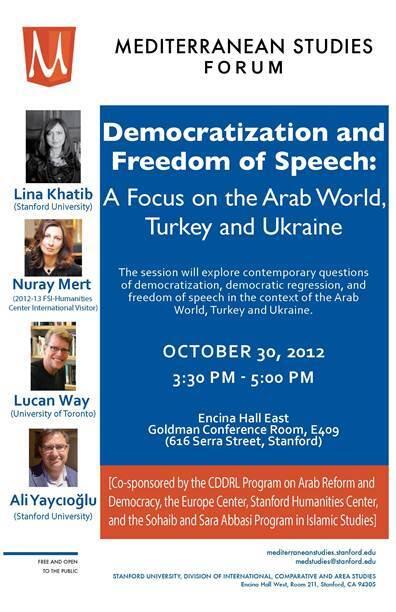
Democratization and Freedom of Speech: A Focus on Turkey, Arab World, and Ukraine
-
Co-sponsored by CDDRL Program on Arab Reform and Democracy, the Europe Center, Stanford Humanities Center, and the Abbasi Program in Islamic Studies
Image
Richard and Rhoda Goldman Conference Room
Nuray Mert
FSI-Humanities Center International Visitor
Panelist
Lina Khatib
Program Manager for the Program on Arab Reform and Democracy
Panelist
CDDRL
Lucan Way
Associate Professor of Political Science
Panelist
University of Toronto
Ali Yaycioğlu
Assistant Professor of Middle East History
Moderator
Stanford
Panel Discussions
Democratization and Freedom of Speech: A Focus on Turkey, Arab World, and Ukraine
-
Co-sponsored by the Abbasi Program on Islamic Studies, CDDRL Program on Arab Reform and Democracy, the Europe Center, Stanford Humanities Center, the Mediterranean Studies Forum, and the Center for Russian, East European and Eurasian Studies.
Reuben W. Hills Conference Room
Nuray Mert
2012-13 FSI-Humanities International Visitor
Speaker
Lina Khatib
Speaker
Lucan Way
Speaker
Ali Yaycioğlu
Speaker
Panel Discussions