Authors
News Type
News
Date
Paragraphs

In 2015, Volodymyr Zelenskyy was at the height of a successful career as an entertainer. Though trained as a lawyer at the Kryvyi Rih Institute of Economics in Eastern Ukraine, the then 37 year old Zelenskyy was a successful comedian and public personality. As the star of the popular TV show, Servant of the People, he played a local history teacher who inadvertently becomes the president of Ukraine following a viral video rant about corruption.

No one watching comedic President Zelenskyy then could have possibly imagined the real-life plot twist that would follow. In an incredible act of life imitating art, in April 2019, Volodymyr Zelenskyy once again stood on stage in front of a cheering crowd, but this time as the actual president of Ukraine.

He won in a landslide election against incumbent president Petro Poroshenko on a platform of systemic change and progress using an almost exclusively virtual campaign. Speaking from his headquarters on election night, he affirmed the exuberance and hope of his supporters: “I can say as a citizen of Ukraine to all countries of the post-Soviet Union: Look at us — everything is possible.”

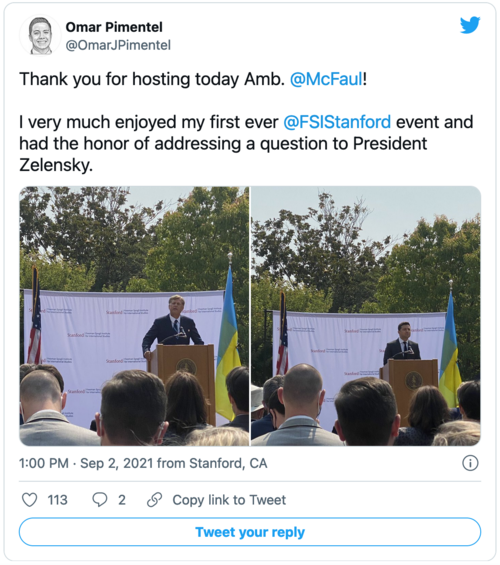
This same message shaped the theme of President Zelenskyy’s remarks at his historic address from the Freeman Spogli Institute for International Studies (FSI) at Stanford University on September 2. The first Ukrainian president to ever visit California, President Zelenskyy, First Lady Olena Zelenska and their delegation joined a group of FSI faculty members led by FSI Director Michael McFaul at an outdoor event held in the Encina Courtyard.

In his remarks, Zelenskyy drew inspiration from Steve Jobs’ famous "How to Live Before You Die" commencement address given at Stanford in 2005.

"This is one of the most famous speeches ever given at Stanford,” he said. “It's about believing in dreams and overcoming the impossible. This is the same as my story. I am just a common guy from a common family from a common industrial town in Eastern Ukraine. Yet here I am today at Stanford, because everything is possible."

He continued, “It is the same for Ukraine. Many people look at us and think that it will be impossible to achieve the goals we hope for. But we know that our critics are wrong. The people of our country love democracy and freedom and will not let threats take those things away. We know that anything is possible."

Looking to the future, Zelenskyy outlined the steps his administration is undertaking to bring increased digitization to Ukraine. These efforts include launching fully electronic passports, moving business and legal services online and expanding the scope of e-goverance. The hope is that this meld of new technology will help curb corruption while simultaneously creating more equitable opportunities and better access to public services for more Ukranians.

Speaking on the ambitious scope of these plans, the president acknowledged, “There will be resistance to the changes and innovations that we are going to make.” Nonetheless, he remains committed to the work ahead of strengthening democratic institutions in Ukraine and building on the progress that has already been made.  “We do not have a ‘Ukrainian Dream,’ yet,” he said. “But we have a ‘Ukrainian Goal’ and a ‘Ukrainian Mission’ to make the future we want for our country.” An edited recording of his remarks is below.

Keeping with Stanford tradition, Zelenskyy took questions from the audience after his prepared remarks. A variety of students and Stanford community members from Russia, Burma, Belarus and beyond had the opportunity to engage the president on a range of issues including U.S.-Ukraine relations, armament sales abroad and concerns over Russian aggression in Crimea and influence Eastern Ukraine. Of particular meaning was Zelensky’s affirmation and support for the democratic movement in Belarus led by Svaitlana Tsikhanouskaya, whom FSI hosted earlier this summer at a faculty roundtable.

Image
Tweet from Franak Viačorka

Students and faculty alike were appreciative of the president’s candor and good nature in addressing difficult topics.

Image
Tweet from Rose Gottemoeller
Image
Tweet from Graham Webster
Image
Tweet from Me Me Khant
Image
Tweet from Omar Pimentel

Following the formal remarks, President Zelenskyy and First Lady Zelenska had an opportunity to meet with Stanford President Marc Tessier-Lavigne in the Memorial Church Courtyard. Prior to leaving, the First Lady also sat down with leaders and students from Stanford's Office of Accessible Education (OAE), an area of interest she would like to support and better develop in Ukraine.

For FSI, the president’s visit was another affirmation of the special connection between Ukraine and the Stanford community. Since 2016, the Center on Democracy, Development and the Rule of Law has hosted the Ukrainian Emerging Leaders Program, which provides a 10-month academic training fellowship in support of mid-career practitioners working actively as policy-makers, legal professionals, entrepreneurs and leaders of civil society organizations in Ukraine.

Speaking to this shared history in his opening introductions, FSI Director Michael McFaul emphasized the crucial need for ongoing support and intellectual investment into Ukraine. “The fight for democracy and independence in Ukraine is one of the most important causes in the world today,” he affirmed. “Not just for Ukrainians, but for all who cherish the ideals of democracy, liberty and sovereignty.”

To President Zelenskyy, McFaul extended a future invitation: “You are always welcome back, either as president or in retirement as a professor.”

“With the classes you offer, I will think about it,” Zelenskyy replied with a smile.

Read More

Sviatlana Tsikhanouskaya discusses the future of democracy in Belarus with a roundtable of Stanford scholars.
News

Belarusian Leader Sviatlana Tsikhanouskaya Meets with Stanford Scholars for Roundtable on Democracy in Belarus

Democratic leader Sviatlana Tsikhanouskaya and her delegation joined an interdisciplinary panel of Stanford scholars and members of the Belarusian community to discuss the future of democracy in Belarus.
Belarusian Leader Sviatlana Tsikhanouskaya Meets with Stanford Scholars for Roundtable on Democracy in Belarus
Hero Image
President Volodymyr Zelenskyy of Ukraine speaks at the Freeman Spogli Institute for International Studies
Rod Searcey
All News button
1
Subtitle

President Zelenskyy outlined the steps his administration is undertaking to bring increased digitization to Ukraine, curb corruption and create more equitable access to public services for more Ukrainians.
-

* Please note all CISAC events are scheduled using the Pacific Time Zone.


Seminar Recording:  https://youtu.be/Mwjn39S48rE


About the Event: NATO Secretary General Stoltenberg will speak about how the transatlantic alliance is adapting to change in this turbulent period.  President Biden has clearly signaled that he is resolved to reach out to the NATO allies, working to repair the trans-Atlantic bond. To strengthen the bond between America and Europe and prepare the alliance for the future, the Secretary General has launched the NATO 2030 initiative.  This includes proposals on how NATO can better harness technology and innovation, tackle the security implications of climate change, and help make our societies more resilient. While NATO must continue to deter and defend against Russia, it is also keeping channels open to Moscow. The rise of China presents both challenges and opportunities that NATO has started to address. And missions in Afghanistan and Iraq are on the cusp of change, with decisions underway about what role NATO will play in the future. All in all, an exciting time to hear from NATO’s Secretary General.

This event is co-sponsored with The Europe Center.


About the Speaker: 

Jens Stoltenberg became NATO Secretary General in October 2014, following a distinguished international and domestic career. As a former Prime Minister of Norway and UN Special Envoy, Mr. Stoltenberg has been a strong supporter of greater global and transatlantic cooperation. Mr. Stoltenberg’s mandate as NATO Secretary General has been extended until the end of September 2022.

Under Mr. Stoltenberg’s leadership, NATO has responded to a more challenging security environment by implementing the biggest reinforcement of its collective defence since the Cold War, increasing the readiness of its forces and deploying combat troops in the eastern part of the Alliance. He believes in credible deterrence and defence while maintaining dialogue with Russia. He has also advocated for increased defence spending and better burden sharing within the Alliance, and a greater focus on innovation. NATO has also stepped up its efforts in the fight against terrorism. He strongly supports a partnership approach, with cooperation between NATO and the European Union reaching unprecedented levels.

Before coming to NATO, he was the UN Special Envoy on Climate Change from 2013 to 2014. He has also chaired UN High-level Panels on climate financing and the coherence between development, humanitarian assistance and environmental policies.

As Prime Minister of Norway, Mr. Stoltenberg increased the defence spending and transformed the Norwegian armed forces with new high-end capabilities and investments. He also signed an agreement with Russia on establishing maritime borders in the Barents and Polar Sea, ending a 30-years dispute.

Mr. Stoltenberg was also Prime Minister during the deadly terrorist attacks, which killed 77 people in Oslo and Utøya on 22 July 2011, urging in response, “more democracy, more openness, and more humanity, but never naïvete”.

Mr Stoltenberg holds a postgraduate degree in Economics from the University of Oslo. After graduating in 1987, he held a research post at the National Statistical Institute of Norway, before embarking on a career in Norwegian politics.

  • 2005-2013: Prime Minister of Norway
  • 2002-2014: Leader of the Norwegian Labor Party
  • 2000-2001: Prime Minister of Norway
  • 1996-1997: Minister of Finance
  • 1993-1996: Minister of Industry and Energy
  • 1991-2014: Member of Parliament
  • 1990-1991: State Secretary at the Ministry of the Environment
  • 1985-1989: Leader of the Norwegian Labour Youth

Jens Stoltenberg was born in Oslo on 16 March 1959. He is married to Ingrid Schulerud. They have two grown-up children.

Virtual Seminar

Jens Stoltenberg Secretary General NATO
Seminars
-

In this live webinar, Torin Jones (Stanford) will speak with Camilla Hawthorne (UC Santa Cruz) and Angelica Pesarini (NYU Florence) about the Black Lives Matter movement in Italy, focusing on ethnographic methods and ongoing questions related to the histories of Italian colonialism, immigration, and the Black Mediterranean.

ADMISSION: FREE AND OPEN TO THE PUBLIC. RSVP: https://stanforduniversity.qualtrics.com/jfe/form/SV_9FYoKW3Iu8RGq4l


Co-sponsored by The Center for Global Ethnography, the Department of Anthropology, and The Europe Center.

Zoom Webinar

Camilla Hawthorne, UC Santa Cruz
Torin Jones, Stanford
Angelica Pesarini, NYU Florence
Workshops
Paragraphs

Time is the backdrop of historical inquiry, yet it is much more than a featureless setting for events. Different temporalities interact dynamically; sometimes they coexist tensely, sometimes they clash violently. In this innovative volume, editors Dan Edelstein, Stefanos Geroulanos, and Natasha Wheatley challenge how we interpret history by focusing on the nexus of two concepts—“power” and “time”—as they manifest in a wide variety of case studies. Analyzing history, culture, politics, technology, law, art, and science, this engaging book shows how power is constituted through the shaping of temporal regimes in historically specific ways. Power and Time includes seventeen essays on human rights; sovereignty; Islamic, European, Chinese, and Indian history; slavery; capitalism; revolution; the Supreme Court; the Anthropocene; and even the Manson Family. Power and Time will be an agenda-setting volume, highlighting the work of some of the world’s most respected and original contemporary historians and posing fundamental questions for the craft of history.

All Publications button
1
Publication Type
Books
Publication Date
Journal Publisher
University of Chicago Press
Authors
Dan Edelstein
-

Seminar Recording: https://youtu.be/BGjRsO0fKds


About this Event: Germany plays a key role in shaping European and Western policy toward Russia.  Berlin is a leading voice within the European Union on Russian issues, and Chancellor Angela Merkel co-chairs with the French president the "Normandy" effort that seeks to broker a setttlement between Ukraine and Russia to the conflict in Donbas.  Emily Haber, the German ambassador to the United States, will join us for a conversation on how Berlin sees the Russian challenge and how the West should respond.


About the Speaker: Emily Margarethe Haber has been German Ambassador to the United States since June 2018. 

Immediately prior to this, Haber, a career foreign service officer, was deployed to the Federal Ministry of the Interior, serving as State Secretary overseeing security and migration at the height of the refugee crisis in Europe. In this capacity, she worked closely with the US administration on topics ranging from the fight against international terrorism to global cyberattacks and cybersecurity. In 2009, she was appointed Political Director and, in 2011, State Secretary at the Foreign Office, the first woman to hold either post. 

Emily Haber is married to Hansjörg Haber. The couple has two sons. 

Emily Margarethe Haber German Ambassador to the United States
Seminars
-

This event is now full and we are unable to take any further reservations. However, if you would like to be added to the waitlist, please email us at sj1874@stanford.edu.

Image
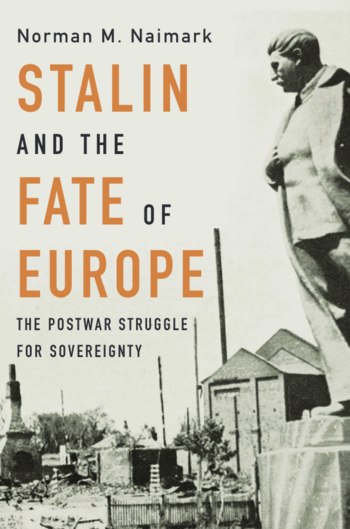
Norman M. Naimark book cover


The Cold War division of Europe was not inevitable―the acclaimed author of Stalin’s Genocides shows how postwar Europeans fought to determine their own destinies.

Was the division of Europe after World War II inevitable? In this powerful reassessment of the postwar order in Europe, Norman Naimark suggests that Joseph Stalin was far more open to a settlement on the continent than we have thought. Through revealing case studies from Poland and Yugoslavia to Denmark and Albania, Naimark recasts the early Cold War by focusing on Europeans’ fight to determine their future.

As nations devastated by war began rebuilding, Soviet intentions loomed large. Stalin’s armies controlled most of the eastern half of the continent, and in France and Italy, communist parties were serious political forces. Yet Naimark reveals a surprisingly flexible Stalin, who initially had no intention of dividing Europe. During a window of opportunity from 1945 to 1948, leaders across the political spectrum, including Juho Kusti Paasikivi of Finland, Wladyslaw Gomulka of Poland, and Karl Renner of Austria, pushed back against outside pressures. For some, this meant struggling against Soviet dominance. For others, it meant enlisting the Americans to support their aims.

The first frost of Cold War could be felt in the tense patrolling of zones of occupation in Germany, but not until 1948, with the coup in Czechoslovakia and the Berlin Blockade, did the familiar polarization set in. The split did not become irreversible until the formal division of Germany and establishment of NATO in 1949. In illuminating how European leaders deftly managed national interests in the face of dominating powers, Stalin and the Fate of Europe reveals the real potential of an alternative trajectory for the continent.


Norman Naimark


Norman M. Naimark received his A.B., M.A. and Ph.D (1972) from Stanford University. He spent fifteen years as Professor at Boston University and Research Fellow at the Russian Research Center at Harvard before returning to Stanford in 1988. He is presently Robert and Florence McDonnell Professor of East European Studies in the History Department at Stanford University, and is Senior Fellow at the Hoover Institution and the Freeman-Spogli Institute. Earlier he served as Chair of the Department of History, Burke Family Director of the Bing Overseas Studies Program, and Fisher Director of Stanford Global Studies.

A selection of his books include The Russians in Germany: A History of the Soviet Zone of Germany (Harvard 1995); Fires of Hatred; Ethnic Cleansing in 20th Century Europe (Harvard 2001); Stalin’s Genocides (Princeton 2010), Genocide: A World History (Oxford 2017), and, most recently Stalin and the Fate of Europe: The Struggle for Sovereignty (Harvard 2019).

Naimark has been awarded the Officer’s Cross First Class of the German Federal Republic. He twice received the Dean’s Award for Outstanding Teaching at Stanford. He also received the Award for Distinguished Contributions to Slavic, East European, and Eurasian Studies from ASEEES in 2011-12.


Discussants:

David Holloway is the Raymond A. Spruance Professor in International History, Professor of Political Science, and Senior Fellow at FSI, Emeritus. He received his BA, MA, and PhD from the University of Cambridge. He has been co-director of CISAC (1991-1997) and director of FSI (1998-2003). He is the author of Stalin and the Bomb: the Soviet Union and Atomic Energy, 1939-1956 (Yale U. P., 1994) among other works.

Robert Rakove is Lecturer in International Relations. He received his PhD from the University of Virginia and is the author of Kennedy, Johnson, and the Nonaligned World.  Rakove studies U.S. foreign policy, particularly in the Cold War era.

Amir Weiner is Associate Professor of Soviet History and the director of the Center for Russian, East European and Eurasian Studies.


Co-sponsored by the Center for Russian, East European and Eurasian Studies, and the Center for International Security and Cooperation.

CISAC
Stanford University
Encina Hall, C235
Stanford, CA 94305-6165

(650) 723-6927 (650) 725-0597
0
Senior Fellow, by courtesy, at the Freeman Spogli Institute for International Studies
Robert & Florence McDonnell Professor of East European Studies
Professor of History
Professor, by courtesy, of German Studies
Senior Fellow at the Hoover Institution
Naimark,_Norman.jpg MS, PhD

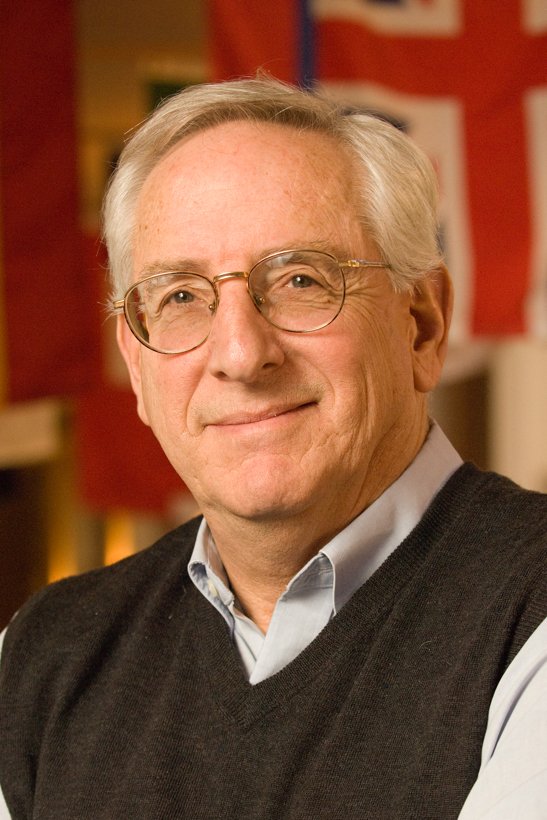
Norman M. Naimark is the Robert and Florence McDonnell Professor of East European Studies, a Professor of History and (by courtesy) of German Studies, and Senior Fellow of the Hoover Institution and (by courtesy) of the Freeman-Spogli Institute for International Studies. Norman formerly served as the Sakurako and William Fisher Family Director of the Stanford Global Studies Division, the Burke Family Director of the Bing Overseas Studies Program, the Convener of the European Forum (predecessor to The Europe Center), Chair of the History Department, and the Director of Stanford’s Center for Russian, East European, and Eurasian Studies.

Norman earned his Ph.D. in History from Stanford University in 1972 and before returning to join the faculty in 1988, he was a professor of history at Boston University and a fellow of the Russian Research Center at Harvard. He also held the visiting Catherine Wasserman Davis Chair of Slavic Studies at Wellesley College. He has been awarded the Officer's Cross of the Order of Merit of the Federal Republic of Germany (1996), the Richard W. Lyman Award for outstanding faculty volunteer service (1995), and the Dean's Teaching Award from Stanford University for 1991-92 and 2002-3.

Norman is interested in modern Eastern European and Russian history and his research focuses on Soviet policies and actions in Europe after World War II and on genocide and ethnic cleansing in the twentieth century. His published monographs on these topics include The History of the "Proletariat": The Emergence of Marxism in the Kingdom of Poland, 1870–1887 (1979, Columbia University Press), Terrorists and Social Democrats: The Russian Revolutionary Movement under Alexander III (1983, Harvard University Press), The Russians in Germany: The History of The Soviet Zone of Occupation, 1945–1949 (1995, Harvard University Press), The Establishment of Communist Regimes in Eastern Europe (1998, Westview Press), Fires of Hatred: Ethnic Cleansing In 20th Century Europe (2001, Harvard University Press), Stalin's Genocides (2010, Princeton University Press), and Genocide: A World History (2016, Oxford University Press). Naimark’s latest book, Stalin and the Fate of Europe: The Postwar Struggle for Sovereignty (Harvard 2019), explores seven case studies that illuminate Soviet policy in Europe and European attempts to build new, independent countries after World War II.


Affiliated faculty at The Europe Center
Affiliated faculty at the Center on Democracy, Development and the Rule of Law

CISAC
Stanford University
Encina Hall, E214
Stanford, CA 94305-6165

(650) 723-1737 (650) 723-0089
0
Senior Fellow Emeritus at the Freeman Spogli Institute of International Studies
Raymond A. Spruance Professor of International History
0820stanford-davidholloway-238-edit.jpg PhD

David Holloway is the Raymond A. Spruance Professor of International History, a professor of political science, and an FSI senior fellow. He was co-director of CISAC from 1991 to 1997, and director of FSI from 1998 to 2003. His research focuses on the international history of nuclear weapons, on science and technology in the Soviet Union, and on the relationship between international history and international relations theory. His book Stalin and the Bomb: The Soviet Union and Atomic Energy, 1939-1956 (Yale University Press, 1994) was chosen by the New York Times Book Review as one of the 11 best books of 1994, and it won the Vucinich and Shulman prizes of the American Association for the Advancement of Slavic Studies. It has been translated into seven languages, most recently into Chinese. The Chinese translation is due to be published later in 2018. Holloway also wrote The Soviet Union and the Arms Race (1983) and co-authored The Reagan Strategic Defense Initiative: Technical, Political and Arms Control Assessment (1984). He has contributed to the Bulletin of the Atomic Scientists, Foreign Affairs, and other scholarly journals.

Since joining the Stanford faculty in 1986 -- first as a professor of political science and later (in 1996) as a professor of history as well -- Holloway has served as chair and co-chair of the International Relations Program (1989-1991), and as associate dean in the School of Humanities and Sciences (1997-1998). Before coming to Stanford, he taught at the University of Lancaster (1967-1970) and the University of Edinburgh (1970-1986). Born in Dublin, Ireland, he received his undergraduate degree in modern languages and literature, and his PhD in social and political sciences, both from Cambridge University.

Faculty member at the Center for International Security and Cooperation
Affiliated faculty at the Center on Democracy, Development, and the Rule of Law
Affiliated faculty at The Europe Center
CV
Date Label
Discussant
Robert Rakove Discussant

Building 200, Room 336
Stanford, CA 94305-2024

(650) 723-3527 (650) 725-0597
0
Associate Professor of History
amir_weiner.jpg PhD

Amir Weiner's research concerns Soviet history with an emphasis on the interaction between totalitarian politics, ideology, nationality, and society. He is the author of Making Sense of War, Landscaping the Human Garden and numerous articles and edited volumes on the impact of World War II on the Soviet polity, the social history of WWII and Soviet frontier politics. His forthcoming book, The KGB: Ruthless Sword, Imperfect Shield, will be published by Yale University Press in 2021. He is currently working on a collective autobiography of KGB officers titled Coffee with the KGB: Conversations with Soviet Security Officers. Professor Weiner has taught courses on modern Russian history; the Second World War; Totalitarianism; War and Society in Modern Europe; Modern Ukrainian History; and History and Memory.


Affiliated faculty at The Europe Center
CV
Discussant
Panel Discussions
Paragraphs

The Cold War division of Europe was not inevitable―the acclaimed author of Stalin’s Genocides shows how postwar Europeans fought to determine their own destinies.

Was the division of Europe after World War II inevitable? In this powerful reassessment of the postwar order in Europe, Norman Naimark suggests that Joseph Stalin was far more open to a settlement on the continent than we have thought. Through revealing case studies from Poland and Yugoslavia to Denmark and Albania, Naimark recasts the early Cold War by focusing on Europeans’ fight to determine their future.

As nations devastated by war began rebuilding, Soviet intentions loomed large. Stalin’s armies controlled most of the eastern half of the continent, and in France and Italy, communist parties were serious political forces. Yet Naimark reveals a surprisingly flexible Stalin, who initially had no intention of dividing Europe. During a window of opportunity from 1945 to 1948, leaders across the political spectrum, including Juho Kusti Paasikivi of Finland, Wladyslaw Gomulka of Poland, and Karl Renner of Austria, pushed back against outside pressures. For some, this meant struggling against Soviet dominance. For others, it meant enlisting the Americans to support their aims.

The first frost of Cold War could be felt in the tense patrolling of zones of occupation in Germany, but not until 1948, with the coup in Czechoslovakia and the Berlin Blockade, did the familiar polarization set in. The split did not become irreversible until the formal division of Germany and establishment of NATO in 1949. In illuminating how European leaders deftly managed national interests in the face of dominating powers, Stalin and the Fate of Europe reveals the real potential of an alternative trajectory for the continent.

Wall Street Journal Review

All Publications button
1
Publication Type
Books
Publication Date
Journal Publisher
Belknap/Harvard
Authors
Norman M. Naimark
Authors
Steven Pifer
News Type
Commentary
Date
Paragraphs

This piece originally appeared in The National Interest.

Significant progress has been made in improving the defense situation in the Baltic states since 2014, but NATO can take some relatively modest steps to further enhance its deterrence and defense posture in the region, according to a report by Michael O’Hanlon and Christopher Skaluba, which was based on an Atlantic Council study visit to Lithuania. The Atlantic Council was kind enough to include me on the trek, which began in Lithuania’s capital, Vilnius, and included visits to troops in the field and the port of Klaipeda. I largely concur with Mike and Chris’s comments and supplement them below with several additional observations.

First, one can understand the preoccupation of Lithuania’s senior political and military leadership with the country’s security situation. Lithuania has had a difficult history with the Soviet Union and Russia. Some in Vilnius believe that Moscow regards the Baltic states as “temporarily lost territory.”

A Russian military invasion of the Baltic states is not a high probability. However, the Lithuanians cannot ignore a small probability, especially in light of the Kremlin’s recent rhetoric, the Russian military’s ongoing modernization of its conventional forces and exercise pattern of the past five years, and Russia’s use of military force to seize Crimea and conduct a conflict in Donbas.

When the Lithuanian Ministry of National Defense (MNOD) looks around its neighborhood, it can see specific reasons for concern. Russia is upgrading its military presence in the Kaliningrad exclave on Lithuania’s southwestern border. The MNOD now counts Kaliningrad as hosting some twenty thousand Russian military personnel, including a naval infantry unit and substantial anti-access, area denial capabilities, such as advanced surface-to-air missiles. The Lithuanians assess that the Russian military could mount a large ground attack from Belarus, to the east of Lithuania (the border is less than twenty miles from downtown Vilnius). These forces are backed by an additional 120,000 personnel in Russia’s Western Military District, including a tank army. Russia has substantial air assets in the region as well as warships in the Baltic Sea.

For its part, Lithuania can muster fourteen thousand soldiers and sailors (four thousand of whom are conscripts serving just nine months). They are backed up by five thousand volunteers, similar to the U.S. National Guard. Under NATO’s enhanced forward presence program, a German-led NATO battlegroup adds 1,300 troops, mainly from Germany, the Netherlands and the Czech Republic. In addition, NATO member air forces rotate small fighter squadrons into Lithuania to provide air policing for the Baltic states.

Second, Lithuania has a logical plan to enhance its defense capabilities. The MNOD is making good use of its defense dollars (Lithuania now meets NATO’s two percent of gross domestic product goal, having tripled its defense expenditures over the past six years). Eschewing shiny objects such as F-16 jets, the MNOD focuses on upgrading the capabilities of its two primary ground units, a mechanized brigade and a recently-established motorized brigade. The main procurement programs of the past three years have purchased infantry fighting vehicles, self propelled artillery and short-range surface-to-air missiles to equip the brigades.

In the event of war, the forces in Lithuania would likely fight a defensive holding action while awaiting NATO reinforcements. The MNOD and Ministry of Transport are working together to enhance the country’s ability to flow in NATO forces, including by upgrading the rollon/roll-off capacity at the port of Klaipeda and building a European standard gauge railroad line from Poland to the main base of Lithuania’s mechanized brigade. The railroad line, which o obviates the need to change the railroad gauge at the Polish-Lithuanian border, a cumbersome process involving changing out the wheels of railcars, ultimately will be extended north to Latvia and Estonia.

Third, the Lithuanians value NATO’s enhanced forward presence in the form of the NATO battlegroup. The battlegroup is fully integrated into Lithuania’s Iron Wolf Brigade, and in wartime would come under the tactical control of the brigade. The rotational NATO force is based with and trains side-by-side with major elements of that brigade.

One potential question is, if Russian forces were to cross the border and the Iron Wolf Brigade deployed, then how quickly would the NATO battlegroup take the field with it? The latter would need a NATO command to do so, and likely also national authorizations from Berlin, The Hague and Prague. Hopefully, those authorizations would be transmitted early as a crisis developed so that the NATO battlegroup could deploy immediately. It adds significantly to Lithuanian combat capabilities, including by providing the only armor unit in the country.

Fourth, as pleased as Vilnius is to have a NATO military presence, the Lithuanians very much would like to add a U.S. component to it. With a U.S. armored brigade combat team deployed in Poland on a rotational basis, the U.S. military has the assets to consider periodically rotating an armored company to Lithuania (and to Latvia and Estonia). These rotations would be useful military exercises in case there is a crisis that requires a reinforcement move from Poland to Lithuania through the Suwalki Gap.

Lithuania is moving in the right direction in bolstering its defense capabilities, with prudent steps taken over the past six years and sensible plans for the future. As Mike and Chris point out, modest steps by NATO and, I would argue, the United States could significantly add to the Alliance’s deterrence and defense posture in the Baltics.


Hero Image
steven pifer 0
All News button
1
Authors
Steven Pifer
News Type
Commentary
Date
Paragraphs

On Tuesday [June 4], the House Subcommittee on Strategic Forces debated the draft Fiscal Year 2020 National Defense Authorization Act.

It voted out, on party lines, language that prohibits deployment of a low-yield warhead on the Trident D5 submarine-launched ballistic missile.  That makes sense:  The rationale for the warhead is dubious, and the weapon likely would never be selected for use.

Read the rest at The Hill


Hero Image
steven pifer 0
All News button
1

Encina Hall
616 Jane Stanford Way
Stanford, CA  94305
 

0
Visiting Postdoctoral Scholar at The Europe Center, 2019-2020
tinka_schubert.jpg

Tinka Schubert is a Postdoctoral Research Fellow at the Social and Organizational Analysis Research Group (http://www.analisisocial.org/index.php/en/) at the University Rovira i Virgili and member of the Community of Researchers on Excellence for All (http://creaub.info/) at the University of Barcelona, Spain. She earned her PhD in Sociology at the University of Barcelona in 2015 with the first dissertation on gender violence prevention in Spanish universities, embedded in the broader research agenda on preventive socialization of gender violence developed by CREA. In the frame of her doctoral thesis she has been a visiting scholar at the Harvard School of Public Health to broaden her agenda with the public health perspective as well as at the Graduate Center at the City University New York to focus on the role of social movements in the prevention of violence against women. She has further served as a Lecturer at the Universidad Loyola Andalucía and was awarded a Juan de la Cierva Postdoctoral Research Fellowship at the University Rovira i Virgili. Tinka Schubert is Co-Editor of the International and Multidisciplinary Journal of Social Sciences.

At The Europe Center, Tinka is working with Professor Norman Naimark on the mass rapes by the Soviet Army on women in the Eastern territories at the end of World War II to research the implications of silencing this part of our history for the understanding of violence against women in present times.

Subscribe to Russia and Eurasia