Date
Paragraphs

By 

Europe is benefiting from tough, painful economic reforms in the wake of the 2008 downturn, according to the leader of the European Union.

"Europe had to evolve dramatically because reality forced it to," said José Manuel Barroso, president of the European Commission, in a May 1 talk on campus. "This change came about with the economic and financial crisis initiated with the collapse of the Lehman Brothers back in 2008, and that has caused me many sleepless nights."

The title of Barroso's presentation was "Global Europe, from the Atlantic to the Pacific." The event was co-sponsored by Stanford's Freeman Spogli Institute for International Studies, the Europe Center and the Center for Russia, East European and Eurasian Studies. The European Commission is the executive body of the European Union.

Barroso acknowledged that the financial meltdown hit Europe especially hard, given the "serious flaws" in the way some countries were running their economies, living beyond their means and lacking the competitiveness required in a globalized world.

The crisis revealed, he added, the "economic interdependence inside Europe," and the fact that the 28-member union did not have the capability to handle large-scale financial emergencies or prevent unsound policies on the part of member nations like Greece.

"So we had to adapt and reform as we have done many times in the European Union," Barroso said.

Economic reforms, regulations

And so, the European Union adopted a more extensive system of economic and budgetary governance to ensure member states stick to their financial commitments and become more competitive. Today, each country sends their national budget to the EU headquarters in Brussels before approving it at the national level, he said.

Barroso added that the EU created a "European stability mechanism," or safety net, worth about $1 trillion to help member states adopt key reforms and assist them in times of crisis. There are also more detailed banking regulations that give the EU more authority over national banks.

"Now the control is exercised at European level through the European Central Bank and there are common rules for banks so that we avoid having to use taxpayers' money to rescue them," he said.

Barroso dismissed criticism that the EU moves too slowly, saying that is inevitable in a system that depends on the will of national governments and citizens to work together rather than coercion.

Still, high unemployment persists in Europe, especially among the young, he said. But he is hopeful about Europe's prospects in the long run.

He added, "We have now returned to growth after some painful but necessary reforms."

Upheaval in Ukraine

With the situation in Ukraine worsening by the day, Barroso said that Europe "stands ready" to support that country in becoming a democratic, prosperous and independent country. He described the Ukrainian crisis as the "biggest threat to Europe's stability and security since the fall of the Berlin Wall."

He said the people of Ukraine expressed a "clear wish to take their future into their own hands and come closer to the European Union" through an agreement that would have given them political association and economic integration.

"Instead of accepting the sovereign choices of Ukraine, Russia decided to interfere, to destabilize and to occupy part of the territory of a neighboring country in a gesture that we hoped was long buried in history books," said Barroso.

He noted, "Europe cannot accept nor condone this type of behavior." Russia's aggression will carry political, diplomatic and economic costs, he said, adding that the issue looms larger than Europe, the United States or even the G7.

"It should concern the rest of the world as well, as it is a direct threat to international law and to international peace," he said.

Barroso served as the prime minister of Portugal from 2002 to 2004. He has been the president of the European Commission for the past 10 years.

All News button
1
-

Mark von Hagen teaches the history of Eastern Europe and Russia, with a focus on Ukrainian-Russian relations, at Arizona State University, after teaching 24 years at Columbia University, where he also chaired the history department and directed the Harriman Institute.  At the Harriman Institute, he developed Ukrainian studies in the humanities and social sciences.  He was elected President of the International Association for Ukrainian Studies in 2002 and presided over the Congress in Donetsk in 2005.  He also served as President of the Association for Slavic, East European and Eurasian Studies (2009).  During his New York years, he was a member of the Council on Foreign Relations, and remains a member of the Advisory Board for Europe and Asia at Human Rights Watch.  He has worked with historians, archivists, and educators in independent Ukraine and with diaspora institutions.  He has served on the advisory board of the European University in Minsk (in exile in Vilnius, Lithuania), to the Open Society Institute; on the Board of Directors of the National Council for Eurasian and East European Research, and the International Fellowship Committee of the Social Science Research Council.
 

Ambassador Vlad Lupan has been the Ambassador, Permanent Representative of the Republic of Moldova to the United Nations, in New York, since January 2012, where he is focusing on development issues, rule of law and human rights, and conflict resolution. He has held a variety of diplomatic posts since 1996 till 2008, last one being Head of Political-Military Cooperation Department and was a negotiator on Transnistrian conflict settlement. He also worked with OSCE field Missions in in Georgia, Albania and Croatia. In 2008 Mr. Lupan joined the civil society, and became a member of the advisory board to the Ministry of Defense. During this time he was also the host of the “Euro-Atlantic Dictionary” radio talk show. In 2010 he became the Foreign Policy Advisor to the Acting President of the Republic of Moldova, and was later elected as a Member of the Parliament. 

Educated at the State University of Moldova and at the National School of Political Science and Public Administration in Bucharest, Romania, Ambassador Lupan earned his international relations degree, and later a master’s degree in journalism and public communications from the Free Independent Moldovan University in Chisinau.  Ambassador Lupan has published mainly in Romanian, though he also published in Russian or English, on foreign and domestic politics issues, including international security matters, Security Sector Reform, Transnistrian conflict settlement and European Union Eastern Partnership.
 

Dr. Yaroslav Prytula is an Associate Professor at the Department of International Economic Analysis and Finance at Lviv Ivan Franko National University (LIFNU) and a Professor at the Lviv Business School of the Ukrainian Catholic University in Lviv, Ukraine. Previously he served as an Academic Secretary of LIFNU and a Vice-Dean of the Faculty of International Relations at LIFNU. He is a member of the Supervisory Board of Lviv Ivan Franko National University. His scholarly interests are in macroeconomic modelling, quantitative methods in social science and higher education in transitional societies. His current research is related to socio-economic regional development in Ukraine. During 2001 he spent a semester in The George Washington University Elliott School of International Affairs under William and Helen Petrach scholarship and continued his research during 2003-04 in The George Washington University Research Program in Social and Organizational Learning under the U.S. Department of State funded Junior Faculty Development Program. During 2004-07 he was a fellow of the Open Society Institute Academic Fellowship Program. During 2007-09 Yaroslav was a fellow of the Global Policy Fellowship Program of the Institute for Higher Education Policy (Washington, DC). In 2011 Dr. Prytula was a visiting scholar at the George Mason University under the University Administration Support Program funded by the Carnegie Corporation of New York and administered by the International Research and Exchanges Board (IREX). Currently Dr. Prytula is a Fulbright Research Scholar at the George Washington University School of Business. Dr. Prytula was awarded his PhD in Mathematical Analysis from LIFNU in 2000. He graduated from the Faculty of Mechanics and Mathematics of LIFNU.  Yaroslav Prytula has received numerous awards and scholarships.


Presented by the Center for Russian, East European and Eurasian Studies, and co-sponsored by The Europe Center and the Stanford Humanities Center.

Levinthal Hall

Mark von Hagen Professor of History Speaker Arizona State University
Ambassador Vlad Lupan Permanent Representative of the Republic of Moldova to the UN Speaker
Yaroslav Prytula Associate Professor Speaker Lviv Ivan Franko National University
Robert Crews Associate Professor of History Moderator Stanford University
Panel Discussions
News Type
News
Date
Paragraphs

From the November 2013 public protests in Kiev to Russia’s military intervention in Crimea, FSI scholars have been monitoring developments throughout the region. Since stepping down last month as Washington’s ambassador to Moscow, Michael McFaul has returned to Stanford where he continues to analyze the unfolding crisis. Follow McFaul, Kathryn Stoner, Norman Naimark and Gail Lapidus as the FSI senior fellows share their expertise and insights into the situation.


Article: In a New York Times op-ed, Michael McFaul writes that Ukraine "must succeed as a democracy," and Russia's "current regime must be isolated." (March 24, 2014)


Article: Michael McFaul says no U.S. president has ever succeeded in deterring Soviet military intervention in Eastern Europe over the last 70 years.  (March 20, 2014)


Audio: Michael McFaul discusses sanctions on Russia following Crimea vote for secession. (March 17, 2014)


Article: Stephen Krasner on why the United States has "no good options with regard to Crimea." (March 14, 2014)


Article: Michael McFaul says diplomatic pressure unlikely to sway Russia. (March 7, 2014)


Article: Kathryn Stoner argues that America and Europe should clearly articulate what Ukraine means to the West and consider some economic sanctions. (March 4, 2014)


Video: Michael McFaul calls Putin’s latest remarks “ominous” in NBC interview. (March 4, 2014) 


Audio: Michael McFaul joins KQED’s Forum to discuss Russia's military intervention in Ukraine and what the U.S. should do in response. (March 4, 2014)


Article: Kathryn Stoner tells Reuters that Russia’s claim of attacks on ethnic Russians in Crimea is “a lie.” (March 4, 2014)


Audio: Gail Lapidus joins the BBC to discuss Putin's political and military strategy. (March 4, 2014; Interview begins at 6:14)


Video: Michael McFaul discusses the volatile political situation in Ukraine and German Chancellor Angela Merkel’s comments that Putin is out of touch with reality on MSNBC. (March 3, 2014)


Article: In a piece for Foreign Affairs, Kathryn Stoner discusses Russia’s invasion of Ukraine as a show of force by Russian President Vladimir Putin to re-establish the country as a superpower. (March 2, 2014)


Article: Norman Naimark argues that the Ukrainian crisis reflects a deep desire among many people in that country for a more democratic, pro-Western government and economy. (Feb. 26, 2014)


Audio: In an interview on KQED’s Forum, Kathryn Stoner analyzes the political turmoil surrounding President Viktor Yanukovych’s refusal to sign an economic agreement with the European Union. (Dec. 11, 2013)

Hero Image
RTX196HW logo
An anti-government protester waves the national flag from the top of a statue during clashes with riot police in the Independence Square in Kiev February 20, 2014.
Reuters
All News button
1
Authors
News Type
News
Date
Paragraphs

The world’s leading economic policymakers are “on the right track” to ensure a global financial upturn, the chief of the International Monetary Fund told a Stanford audience on Tuesday.

But she warned the recovery will be derailed without the creation of more jobs, better education systems and a way to shrink the gap between rich and poor. And she cautioned against the potential pitfalls of untested exchanges and digital currencies such as Bitcoin.

“We are on the right track, but we need to ask – the right track to where? And the right track to what growth?” said Christine Lagarde, the IMF’s managing director. “Will it be solid, sustainable, and balanced – or will it be fragile, erratic, and unbalanced? To answer this question, we need to look at the patterns of economic activity in the years ahead, and especially the role of technology and innovation in driving us forward.”

Lagarde’s visit to Stanford was co-sponsored by the Freeman Spogli Institute for International Studies and the Stanford Institute for Economic Policy Research. In addition to delivering public remarks at FSI’s Bechtel Conference Center, Lagarde met privately with faculty and students during the day.

Just returning from the G-20 summit in Sydney, Lagarde said she is optimistic that the world’s economic leaders are committed to taking the steps that will guard against another large-scale financial collapse. She said the G-20 members agreed to complete a set of financial reforms by the end of this year, a move that will make the “financial sector safer and less likely to cause crisis.”

She said the member countries and their central banks have also agreed to better cooperate and be more transparent in their policymaking.

But she’s worried that unless more sustainable jobs are created, economic disparities will increase. And that, she said, will “harm the pace and sustainability of growth over the long term.”

As technology has helped create a more interconnected world, it is playing an increasing role in the economic landscape. Machines have made our lives easier. Artificial intelligence has led to cars that can drive themselves, robots that can do things in place of humans and smartphones that are more powerful than the first supercomputers.

But so far, there’s been no measure of how new technology has increased productivity.

“We certainly need to keep an eye on this,” she said. “One of the biggest worries is how this technological innovation affects jobs. Put simply: will machines leave workers behind?”

She said technology creates “huge rewards for the extraordinary visionaries at the top, and huge anxieties for workers at the bottom.”

Lagarde said it is up to educators to better prepare the next generation of workers.

“Educational systems are not keeping pace with changing technology and the ever-evolving world of work,” she said. “We need to change what people learn, how people learn, when people learn, and even why people learn. We must go beyond the traditional model of students sitting in classrooms, following instructions and memorizing material. Computers can do that.”

Instead, humans must “outclass computers” in cognitive, interpersonal and sophisticated coding skills, she said.

“Think of creative jobs, caring jobs, jobs that entail great craftsmanship – imagination,” she said. “And given the rate and pace of change, we will need the ability to constantly adapt and change through lifelong learning.”

She called on institutions such as Stanford to play a key role in the process.

“Stanford’s model of education was innovative from the very first day—co-educational, non-denominational, and always practical, focusing on the formation of cultured and useful citizens,” she said. “Stanford was ahead of its time back then. I know that it will continue to be ahead of its time as we venture into the exciting period ahead.”

But that exciting period carries with it uncertainty and risk.

Asked about the role that emerging digital currencies such as Bitcoin could have on the evolving economy, Lagarde was skeptical, calling it a “shaky and wobbly” system.

The currency’s trading website went offline this week, spooking investors and calling into question Bitcoin’s future.

“It’s a glamorous, sexy attractive new system,” she said. “But a monetary system is a public good. It has to be supervised and sufficiently regulated so it is accountable. At this point in time, I think Bitcoin is outside that perimeter of both supervision and regulation.”

Lagarde is the 11th managing director of the IMF, and the first woman to lead the 188-country organization. Since she took over the organization in 2011, she has played a role in the world’s most pressing financial matters, working on solutions to a sluggish global economy and the debt crises in Europe.

The IMF gives both policy advice and financing to countries in difficult economic situations. It also helps developing countries reduce poverty and become more economically stable. 

The organization is now poised to assist Ukraine, which is at risk of running out of money to pay its bills in the midst of a political crisis. The country is struggling to cobble together a temporary government in the wake of President Viktor Yanukovych leaving Kiev and being removed from power.

But until a provisional government is formed, the country cannot technically ask for help. When it does, Lagarde said the IMF will send “technical assistance.”

“We are ready to engage,” she said.

Hero Image
lagarde logo
Christine Lagarde, head of the IMF, expressed optimism about the global economy during a talk at Stanford on Feb. 25, 2014.
Rod Searcey
All News button
1

Encina Hall
616 Serra Street
Stanford, CA 94305

0
Professor of Central and Eastern European Studies and Director of the Centre for European Studies at Lund University, Sweden and Anna Lindh Fellow at The Europe Center

Barbara Törnquist-Plewa is professor of Central and Eastern European Studies and director of the Centre for European Studies at Lund University, Lund, Sweden.  Her research interest include nationalism, collective memory, myth and symbols in Central and Eastern Europe (with focus on Poland, Belarus and Ukraine) as well cultural integration in Europe.  She has been involved in and coordinated a number of research projects on these issues.  Currently she leads a large international research network called “In Search for Transcultural Memory in Europe” financed by the EU (COST-programme) and the research project “Remembering Ethnic Cleansing and Lost Cultural Diversity in Eastern European Cities”.  She is also Lund University’s coordinator for International Research Training Group (Greifswald – Lund – Tartu) “Baltic Borderlands”, funded by the German Research Foundation (DFG).

Professor Törnquist-Plewa's publications include monographs The Wheel of Polish Fortune : Myths in Polish Collective Consciousness during the First Years of Solidarity, (1992) and Belarus: Language and Nationalism in Borderlands (in Swedish), (2001) and a number of articles and book chapters, the most recent one "Coming to Terms with anti-Semitism in Poland", European Cultural Memory Post-89, 2013 inv.30 in European Studies Series, Amsterdam: Rodopi. She contributed to and edited 14 collections of essays, the recent entitled Cultural Transformations after Communism. Central and Eastern Europe in Focus (2011) and Painful Pasts and Useful Memories. Remembering and Forgetting in Europe, (2012).

-

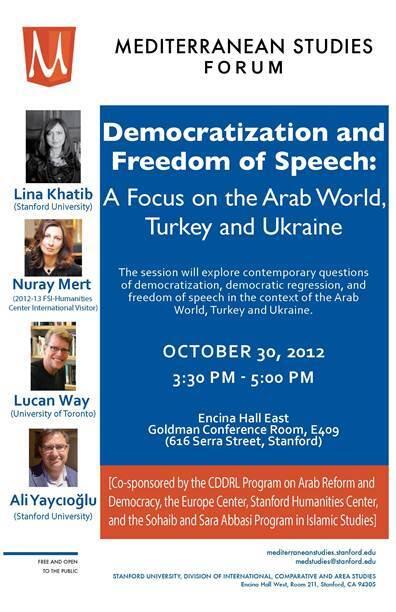
Co-sponsored by CDDRL Program on Arab Reform and Democracy, the Europe Center, Stanford Humanities Center, and the Abbasi Program in Islamic Studies

More info: http://www.stanford.edu/group/mediterranean/cgi-bin/web/2012/08/democratization-and-freedom-of-speech-a-focus-on-turkey-arab-world-and-ukraine/

Image

Richard and Rhoda Goldman Conference Room

Nuray Mert FSI-Humanities Center International Visitor Panelist
Lina Khatib Program Manager for the Program on Arab Reform and Democracy Panelist CDDRL
Lucan Way Associate Professor of Political Science Panelist University of Toronto
Ali Yaycioğlu Assistant Professor of Middle East History Moderator Stanford
Panel Discussions
-

Co-sponsored by the Abbasi Program on Islamic Studies, CDDRL Program on Arab Reform and Democracy, the Europe Center, Stanford Humanities Center, the Mediterranean Studies Forum, and the Center for Russian, East European and Eurasian Studies.

Reuben W. Hills Conference Room

Nuray Mert 2012-13 FSI-Humanities International Visitor Speaker
Lina Khatib Speaker
Lucan Way Speaker
Ali Yaycioğlu Speaker
Panel Discussions
News Type
News
Date
Paragraphs

Steven Pifer, former United States Ambassador to Ukraine and senior fellow and director of the Arms Control Initiative at Brookings, offers his insight into the current status of nuclear arms control and the issues impacting future prospects for negotiation in a presentation posted on the Brookings Institute website

Steven Pifer’s career as a Foreign Service officer centered around Europe, the former Soviet Union and arms control. In addition to Kyiv, he has had postings in London, Moscow, Geneva and Warsaw as well as on the National Security Council. Ambassador Pifer is currently a Visiting Fellow at the Brookings Institution, focusing on Ukraine and Russia issues. He is a frequent invited expert speaker at The Europe Center. 

All News button
1
-

This talk will address a primary foreign policy challenge for independent Ukraine which has been to strike a proper balance between its relations with the West and those with Russia.  Today, democratic backsliding is upsetting the balance, which will undermine President Yanukovych’s ability to achieve his professed foreign policy aims.


Steven Pifer
is a senior fellow at the Brookings Institution’s Center on the United States and Europe and director of the Brookings Arms Control Initiative.  He focuses on nuclear arms control, Russia and Ukraine.  He has offered commentary on these issues on CNN, Fox News, BBC, National Public Radio and VOA, and his articles have run in the International Herald Tribune, New York Times, Washington Post and Moscow Times, among others.

A retired Foreign Service officer, his more than 25 years with the State Department focused on U.S. relations with the former Soviet Union and Europe, as well as arms control and security issues.  He served as deputy assistant secretary of state in the Bureau of European and Eurasian Affairs with responsibilities for Russia and Ukraine (2001-2004), U.S. ambassador to Ukraine (1998-2000), and special assistant to the president and senior director for Russia, Ukraine and Eurasia on the National Security Council (1996-1997).

His publications include “Ukraine’s Perilous Balancing Act,” Current History (March 2012), “NATO, Nuclear Weapons and Arms Control,” Brookings Arms Control Series (July 2011); “The Next Round:  The United States and Nuclear Arms Reductions After New START,” Brookings Arms Control Series (November 2010); “Ukraine’s Geopolitical Choice, 2009,” Eurasian Geography and Economics (July 2009); and “Reversing the Decline:  An Agenda for U.S.-Russian Relations in 2009,” Brookings Foreign Policy Paper (January 2009).

Ambassador Pifer is a 1976 graduate of Stanford University with a B.A. in Economics.  He is a member of the Council on Foreign Relations. 


Co-sponsored by the Center for Russian, East European, and Eurasian Studies

Reuben W. Hills Conference Room

Steve Pifer Senior Fellow at the Brookings Institution’s Center on the United States and Europe and Director of the Brookings Arms Control Initiative Speaker
Seminars
Subscribe to Ukraine