
 FSI researchers consider international development from a variety of angles. They analyze ideas such as how public action and good governance are cornerstones of economic prosperity in Mexico and how investments in high school education will improve China’s economy.
They are looking at novel technological interventions to improve rural livelihoods, like the development implications of solar power-generated crop growing in Northern Benin.
FSI academics also assess which political processes yield better access to public services, particularly in developing countries. With a focus on health care, researchers have studied the political incentives to embrace UNICEF’s child survival efforts and how a well-run anti-alcohol policy in Russia affected mortality rates.
FSI’s work on international development also includes training the next generation of leaders through pre- and post-doctoral fellowships as well as the Draper Hills Summer Fellows Program.


The Future of Mobility? Challenges in the Interplay between Technology, Science and Politics
Austrian Ministry for Mobility, Innovation and Technology Vienna
Roland Benedikter
Speaker
Seminars
Too-Systemic-To-Fail: What Option Markets Teach Us About Government Guarantees For The Financial Sector
-
In this second seminar of the Europe Center's "European and Global Economic Crisis Series", Professor Hanno Lustig will discuss how a conspicuous amount of risk is missing from the price of financial sector crash insurance during the 2007-2009 crisis and that the difference in costs of put options for individual banks, and puts on the financial sector index, increases fourfold from its pre-crisis level. He provides evidence that a collective government guarantee for the financial sector lowers index put prices far more than those of individual banks, explaining the divergence. By embedding a bailout in the standard option pricing model, observed put spread dynamics is closely replicated. During the crisis, the spread responds acutely to government intervention announcements.
CISAC Conference Room
Hanno Lustig
Associate Professor of Finance at UCLA Anderson School of Management and Visiting Associate Professor
Speaker
UC Berkeley Haas School of Business
Seminars
Democracy and Reconciliation: Jerusalem conference and launch of The Europe Center
News Type
News
Date
Paragraphs
In the midst of the “Arab Spring”, and President Obama’s push for Palestinian-Israeli peace, The Europe Center (TEC) and the Van Leer Jerusalem Institute hosted a May 18-19 conference on “Democracy in Adversity and Diversity” in Jerusalem, the first of a sequence of conferences in TEC’s collaborative project on Reconciliation.
The conference gathered leading analysts of democratization and civil conflict, including FSI’s Francis Fukuyama, Stephen D. Krasner, and Kathryn Stoner. During two days of conference sessions, scholars and analysts from Europe, the United States, and the Middle East compared historical and contemporary cross-border and civil society cleavages with the goal to promote informed policy.
Co-organizers Kathryn Stoner-Weiss (FSI) and Michael Karayanni (The Hebrew University) convened colleagues to address policy challenges including:
- What has been and what should be democracy?
- How do we translate democratic theory into practical governance?
- How do we manage diversity in contemporary democracies?
- What is the relationship between democracy and development?
- How do we anticipate and respond to transitions and movements towards democracy?
Experts in liberal, secular, and fundamentalist political thought in Arab, Palestinian, Christian, Jewish, and Muslim policies proposed answers and areas for further study. Insights included the following:
- European and Israeli voters are increasingly electing far right nationalists, while Arab populations are calling for democracy.
- The deepest rifts are not between but within societies. In Europe, Israel, and in the Hamas-Fatah Palestinian National Authority, far-right populist, ultra-orthodox, and fundamentalist parties appeal to anti-democratic world-views. The result is hardening rhetoric that damages civil society and overwhelms the capacity for reasoned debate and resolution. Leaders compete with the minority far-right and in so doing compete for the narrow populist constituency rather than focusing on the greater interest of society.
Next steps include publications, scholar exchange, and a second international conference, “History and Memory: Global and Local Dimensions” (Stanford 2012), which aims to examine the interplay between history and memory, and how to overcome foundational narratives without requiring amnesia.
All News button
1
Stanford Scholar Roland Benedikter wins Klaus Reichert Award in Karlsruhe, Germany
News Type
News
Date
Paragraphs
Europe Center scholar Dr. Roland Benedikter (47), has been honored with the 2012 Klaus Reichert Award for Medical Philosophy. This award, given by the Center for Medical Philosophy in Karlsruhe, Germany, was bestowed on Benedikter in recognition of his outstanding merits for medical ethics, for advancing the debate on avant-garde issues at the interplay between contemporary politics, sociology, ethics and medicine, and for his efforts to re-humanize the contemporary thought and international debate about the future of the human being in times of "transhumanism" and "hyper-technologization". The award is the most highly regarded academic award of this genre in Germany.
The award ceremony will be held on October 6, 2012 in Karlsruhe. In his award speech "What future for the human being: Humanism or Transhumanism? Aspects at the interplay between technology, politics and ethics", Benedikter will give an overview of the current "global systemic shift", its trend towards a "neuromorphosis" of global culture (two notions co-coined by him) and the future of the human being in the age of "transhumanism" and invasive new technologies. Benedikter will in particular elucidate the contemporary relation between macro-philosophical trends that will dominate the years ahead in the advanced international thought on the interplay between medicine and society.
Benedikter shares the award with his long time collaborator Prof. James Giordano, director of the Center on Neurotechnology at the Potomac Institute for Policy Studies, Washington DC.
All News button
1
Democratization and Freedom of Speech: A Focus on Turkey, Arab World, and Ukraine
-
Co-sponsored by CDDRL Program on Arab Reform and Democracy, the Europe Center, Stanford Humanities Center, and the Abbasi Program in Islamic Studies
Image
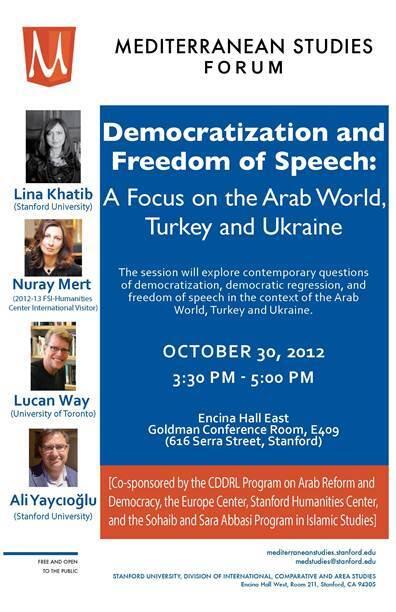
Richard and Rhoda Goldman Conference Room
Nuray Mert
FSI-Humanities Center International Visitor
Panelist
Lina Khatib
Program Manager for the Program on Arab Reform and Democracy
Panelist
CDDRL
Lucan Way
Associate Professor of Political Science
Panelist
University of Toronto
Ali Yaycioğlu
Assistant Professor of Middle East History
Moderator
Stanford
Panel Discussions
Towards a Theory of Policy Timing
Paragraphs
The paper presents a theory of policy timing that relies on uncertainty and transaction costs to explain the optimal timing and duration of policy reforms. Delaying reforms resolves some uncertainty by gaining valuable information and saves transaction costs. Implementing reforms without waiting increases welfare by adjusting domestic policies to changed market parameters. Optimal policy timing is found by balancing the trade-off between delaying reforms and implementing reforms without waiting. Our theory offers an explanation of why countries differ with respect to the length of their policy reforms, and why applied studies often judge agricultural policies to be inefficient when actually they may not be.
All Publications button
1
Publication Type
Journal Articles
Publication Date
Journal Publisher
Australian Journal of Agricultural and Resource Economics
A Focus on contemporary Greece
News Type
News
Date
Paragraphs
The Europe Center puts a focus on Greece, and the concern for its fiscal vitality, vulnerable citizens, potentially fragile democratic institutions, and its role in the EU and global economy. In this latest essay, Ruby Gropas offers her insight on the contemporary Greek situation with special research focus on the place of popular protest in democratic dissent, and examples of civil society filling in for the incapacity of political institutions.
Resilient citizens in times of crisis
Resilience involves the capacity to deal with change and to recover. It is the potential of a system, of organisations or individuals to adapt to changing circumstances in the face of risk and adversity. Just as importantly, it is the ability to recover after a disaster or a crisis. As such, it is both about resisting shocks and using such events to trigger renewal, innovation and address the ensuing challenges and difficulties through creative solutions.
It has been increasingly evident over the past couple of years that Europe is undergoing its deepest existentialist crisis since the project of European integration kicked off in the early 1950s. The crisis is deep and does not only concern Greece, Spain, Portugal, Italy or Ireland. It goes well beyond the confines of the Eurozone and presents a resilience challenge that has to be addressed well and truly at the European level. It is just as important however that this resilience challenge is also met at the local, societal level.
Crises are transformative; along with the risk of deterioration and disintegration, they also offer an opportunity for growth. The challenge that is therefore posed by the current crisis is not only how much we can expect the European system to be able to absorb before it transforms into something fundamentally different, but also who will be the driving force of change or the game changer in these conditions? Identifying the factors that will be able to drive change and demonstrate resilience to the crisis is necessary for the EU and it is even more fundamental for Greece.
As the crisis has been unraveling in Greece, the focus has been on the negative effects it has been having on citizens’ life, on the country’s public services, on the welfare state, on the political system and on expectations for the future. Without a shadow of a doubt, these negative effects have been tragic and painful. In a country of approximately 10.1 million people, 350,000 jobs have been lost in the past year alone. Unemployment has risen over 23% in the general population, while youth unemployment in particular has soared to over 52%. GDP has declined by 20%, and austerity measures have wrung the middle class dry. In Athens, there was up to 60% fall in revenue for businesses directly associated with the Indignados sit–ins and the consecutive riots during 2011-2012; the commercial centre of Athens has become increasingly derelict, shops are closing, buildings on main streets are no longer repairing their facades from the damages incurred in weekly demonstrations. Suicide rates have increased, along with violent criminality and homelessness, while soup kitchens have made their appearance again - and the lines are growing longer every day. Public hospitals are lacking in many cases even the most basic supplies while public schools and universities are preparing for a tough academic year ahead expecting to have even less of a possibility to afford the heating bills than they did last year.
There exists a sense of pervasive breakdown. There is a feeling of disorientation and lost identity that comes with the collapse of the assumptions people lived by until just a couple of years ago and the expectations they had for their future. The grim picture does not end here. Young Greeks are emigrating in increasing numbers as this crisis’ harshest toll has been on their dreams of a better tomorrow in their home country that until recently appeared consolidated within what the EU jargon referred to as ‘core Europe’. Greece’s democratic institutions are being systematically undermined: the media are more often than not mouthpieces of the political parties; the judiciary is distrusted and degraded; the Parliament and the party system are discredited.
Yet in all this, encouraging signs must be sought out, emphasized and supported. They are necessary if the resilience challenge is to be met.
The Greek state with all its failures, weaknesses and mishaps is retreating, and as it retreats it is leaving a number of voids. Rather than see this as a zero-sum game, it can be seized as an opportunity by new forms of civil society. Greek civil society has traditionally been significantly under-developed, poorly organized with limited influence and even more limited independence. Yet it is maybe this sector that has the widest scope for independent action at present. As the state and private sectors are being hammered by the economic and political crises the country is undergoing, the non-governmental and not-for-profit sectors that have been long under-performing, have perhaps the best opportunity to be creative and offer novel solutions and be a true agent of change in the present conjuncture of circumstances.
As economic conditions have severely deteriorated, there has been an unprecedented mushrooming of initiatives and efforts to cater to the needs of society’s most vulnerable groups. Radio stations have paired up with supermarket chains and civil society organizations to collect donations and contributions in kind; medical networks such as ‘Medecins du Monde’ and ‘Medecins Sans Frontiers’ have dynamically responded to the health needs of migrant minorities and homeless citizens particularly in downtown Athens; voluntarism has bounced back (the Athens 2004 Olympic Games had constituted a unique eruption of voluntarism that fizzled out shortly after the games ended) and is becoming the last level of support that many humanitarian and philanthropic NGOs can count on given that the state has not only frozen all funding to NGOs but has also cut back on basic social services. New networks bringing together young Greeks rely on the internet and social media platforms to mobilize citizens in environmental protection initiatives. Similarly, media outlets and artists are mobilized to support events aimed at promoting human rights, tolerance, and respect for cultural and religious diversity in a vibrant effort to fight back against the electoral rise of the neo-nazi Golden Dawn party.
Tuesday, July 24th marked the 38th anniversary of the restoration of democracy in Greece after a seven-year military dictatorship (1967-1974). If this anniversary constitutes an opportunity to reflect on why the post-dictatorship era, known as the metapolitefsi, is ending in such socio-political anxiety and anger, it should also be approached as a milestone from which to spark a fundamental shift in public mentality in Greece and for citizens to express their democratic resilience.
As has been often argued, social innovation tends to thrive in the most challenging, unsettled times and seemingly restrictive conditions. In effect, in times of crises, the ability of citizens to develop resilience is fundamental for their country’s democratic life. This social activism may become the platform upon which Greek civil society can develop and strengthen its credibility as a socially responsible sector that will seize this momentum to contribute dynamically and creatively to addressing the weaknesses that characterize democracy in Greece. The scope for action is wide: multiculturalism, religious diversity, racism and xenophobia, gender equality, anti-discrimination, protection of the most vulnerable and marginalized sections of society, protection of the environment, governmental accountability are but a few of the core sectors that urgently need to be addressed.
Ruby has presented at the Europe Center, and is Research Fellow at the Hellenic Foundation for European and Foreign Policy (ELIAMEP) and Lecturer at the Democritus University
of Thrace.
of Thrace.
All News button
1
The Euro Gamble: Noble Visions, Obstinate Nation-States
-
Note: The RSVP deadline has been extended to Oct. 12th
Good politics does not for good economics make, especially not in a sub-optimal currency area. Ten years into the euro, the skeptics were proven right. Instead of forcing all members into fiscal discipline and domestic reform, the common currency did neither; indeed it encouraged profligacy and business-as-usual. Now, the Eurozone has become a transfer and debt union. Europe, whose growth has been slowing for 40 years, will not regain competitiveness under the new dispensation.
This seminar is part of the European and Global Economic Crisis Series.
Josef Joffe
Editor of "Die Zeit" in Hamburg, Distinguished Fellow at FSI, and the Marc and Anita Abramowitz Fellow at the Hoover Institution
Speaker
Seminars
Ends of Enlightenment
-
Seminar presentation on John Bender's new book, "Ends of Enlightenment." In his book, Professor Bender explores three realms of eighteenth-century European innovation that remain active in the twenty-first century: the realist novel, philosophical thought, and the physical sciences, especially human anatomy.
Commentary will be provided by William B. Warner, Professor of English, University of California at Santa Barbara.
Books will be available for sale at this event by the Stanford Bookstore.
Co-sponsored by the Department of Comparative Literature, Department of English and the Division of Literatures, Cultures, and Languages.
CISAC Conference Room
John Bender
424 Santa Teresa Street
Humanities Center
Stanford, CA 94305-4015
0
bender@stanford.edu
Jean G. and Morris M. Doyle Professor of Interdisciplinary Studies
Professor of English
Professor of Comparative Literature
John Bender is Jean G. and Morris M. Doyle Professor in Interdisciplinary Studies, Professor of English and Comparative Literature, and Affiliated Faculty of the The Europe Center. His research and teaching focus on the 18th century in England and France. His special concerns include the relationship of literature to visual arts, to philosophy and science, as well as to the sociology of literature and critical theory.
Bender is the author of Spenser and Literary Pictorialism (1972), Imagining the Penitentiary: Fiction and the Architecture of Mind in 18th-Century England (1987), which received the Gottschalk Prize of the American Society for 18th-Century Studies, The Culture of Diagram (2010)--as co-author with Michael Marrinan—and Ends of Enlightenment (2012).
Affiliated faculty at The Europe Center
William B. Warner
Professor of English
Commentator
UC Santa Barbara
Seminars