Democracy
-

ABOUT THE TOPIC: While the overall record of compliance with interstate territorial agreement since 1815 is quite high, Europe experienced a disproportionate share of treaty failures compared to other regions of the world. In Europe, treaties were frequently made and frequently broken; everywhere else, the dominant pattern has been for treaties to be rarely made and rarely broken. I argue that this pattern arose due to multilateral and hierarchical nature of border settlements in Europe, which was heavily influenced by the region’s great powers. Although great powers often imposed treaty terms on other states, enforcement was, at best, inconsistent and, at worst, actively undermined by their own actions. Using a new data set on interstate territorial conflicts and agreements, I show that the fates of border settlements in Europe were highly interdependent and vulnerable to contagion, either failing or succeeding en masse. By contrast, in other regions, where border settlements tended to be bilaterally determined, treaty failures were less likely to cluster in time. In addition to their implications for the study of treaty compliance and conflict contagion, these results speak to the promise and dangers of externally-imposed peace agreements.

ABOUT THE SPEAKER: Kenneth A. Schultz is professor of political science at Stanford University and an affiliated faculty member at CISAC. His research examines international conflict and conflict resolution, with a particular focus on the domestic political influences on foreign policy choices. His most recent work deals with the origins and resolution of territorial conflicts between states. He is the author of Democracy and Coercive Diplomacy (Cambridge University Press, 2001), World Politics: Interests, Interactions, and Institutions (with David Lake and Jeffry Frieden, Norton, 2013), as well as numerous articles in peer-reviewed scholarly journals. He was the recipient the 2003 Karl Deutsch Award, given by the International Studies Association, and a Dean’s Award for Excellence in Teaching, given by Stanford’s School of Humanities and Sciences.

CISAC Conference Room

Kenneth Schultz Professor of Political Science, Stanford; CISAC Affiliated Faculty Member Speaker
Seminars
Paragraphs

This article is framed by the 900-plus year old debate on the importance of academic freedom for democracy and human progress outlined by Karran. In particular, it discusses some contemporary threats to academic freedom in relation to the role of researchers and research institutes in the public policy process. Using a series of recent case studies of attempts to interfere with the publication of research findings in key sensitive policy areas of genetically modified foodstuffs, climate change, and agriculture, it is argued that while academic freedom plays a crucial role in relation to the development of public policies, it is currently under threat. This matter is discussed within a framework that allows the understanding of the relationship between researchers and the intervening State, the corporate and non-government sectors with economic or social interests in any particular intervention, the media, and citizens. We apply the framework to recent cases in several controversial areas of policy that illustrate problems that have arisen. Moreover, we hypothesise that the problems have become more acute since the start of the era of privatisation and new public management with research agendas and targets often being increasingly set by policymakers. Finally, we draw some conclusions about the role of researchers and institutes in relation to agricultural and rural matters in modern democracies, arguing that freedom of speech and expression is an essential element in the policy role of researchers. At the root of this is the intensifying debate between representative and participatory democracy.

All Publications button
1
Publication Type
Journal Articles
Publication Date
Journal Publisher
Sociologia Ruralis
Authors
Klaus Mittenzwei
Authors
Roland Hsu
News Type
News
Date
Paragraphs

The Europe Center was pleased to host Catherine Ashton, High Representative of the Union for Foreign Affairs & Security Policy and Vice President of the European Commission (HRVP), at Stanford University on May 7th.  HRVP Ashton’s address to a capacity audience of Stanford senior scholars is part of the Europe Center’s program focused on European and EU regional and global relations.  The event co-sponsors - the Center for Russian, East European and Eurasian Studies, the Hoover Institution, and the  - speaks to the esteem and the interest that multiple partners share in engaging the European Union’s highest foreign policy official.

The Europe Center’s director Amir Eshel opened the session, followed by President Gerhard Casper, director and senior fellow at the Freeman Spogli Institute for International Studies, who delivered a formal introduction of Ashton.  HRVP Ashton spoke at length and in considerable detail on the mission of the office of EU High Representative, and addressed a number of the critical foreign policy challenges that we face today. 

Three pillars of EU foreign policy
In her talk, Lady Ashton highlighted three pillars of EU foreign policy:

  1. Europe assumes primary responsibility for bringing and safeguarding peace in its “neighborhood”.  Ashton proposed that the European Union – in terms of its status as a foreign policy actor – should be judged by the record of its mission to foster post-conflict resolution, and promote long-term stability and growth throughout its own member states, and in neighboring regions of North Africa, the Eastern Mediterranean and Middle East, and Eastern and Baltic regions of former Soviet societies.
  2. European Union foreign policy should promote what Ashton termed “Deep Democracy”.  This includes reformed and transparent judiciary, police, and representative governing institutions that safeguard the well-being and individual emancipation of citizens, and women’s and human rights.
  3. European Union international relations prioritize effective and long-term cooperative missions with “strategic partners” beginning with the United States, as well as Russia and China.  Ashton emphasized that the EU also prioritizes long-term relations and strategic missions with regional and supra-national institutions beginning with the United Nations, and including the African Union, ASEAN, and the Arab League.

“Deep Democracy”: the long-term challenge
Of special note was Ashton’s significant elaboration on the priority for “deep democracy”.  When asked about the case of Mali, and what the vision was for what comes after the current French and European military intervention, she emphasized the following points of policy and tactics.

  • The EU views the military engagement against Jihadist forces in Mali, within a larger regional view of the “Sahel Arc”.  The EU is deeply engaged in the “Arab Awakening” movements – and the attendant security, political, and civil crises in each country of the region, and in terms of displaced populations across borders. 
  • In the case of Mali, the office of the EU High Representative invited the country’s leadership to Brussels for close coordination of policy. 
  • The EU foreign policy has been set to closely support the Malian government’s own road map for peace, territorial sovereignty, internal cohesion, and development.
  • In remote districts of northern Mali, residents have seen little evidence of the value of government.  The EU foreign policy of engagement in Mali includes programs to deliver primary health care (i.e. immunization and women’s reproductive health) and infrastructure (i.e. transportation and employment in local economic initiatives) to demonstrate the efficacy and value of state institutions.
  • The decision to commit troops from Europe to foreign soil remains, Ashton emphatically stated, the responsibility of the individual sovereign states, and of their democratically elected representatives who, in making such commitments, are ultimately responsible to their citizens.
  • Individual European nations are invited to meet with the governments and civil society leaders of countries undergoing transformations, to tell their distinct histories of democratic development.

Ashton delivered her insights in response to questions from the audience on a number of topics, including the growing magnitude of displaced regional refugees, EU-US military cooperation, and the support and criticism of the EU within European nations.  

Please visit the European Union website to learn more about HRVP Catherine Ashton.


All News button
1
Paragraphs

In-conflict state building generates unbalanced civil-military relations in the host state due to an inevitable civil-military gap. Building civilian institutions cannot match the trajectory of progress in building military institutions. The civil-military imbalance creates structural risks to the democratization of the state. This article explains the civil-military gap and its risks, examines Iraq and in particular Afghanistan, and presents steps on how to make unbalanced civil-military relations conducive to democratization by shaping the political role of the military.

All Publications button
1
Publication Type
Journal Articles
Publication Date
Journal Publisher
PRISM, National Defense University Press
Authors
Christian Bayer Tygesen
-

The Europe Center invites you to attend this special event with opening remarks by co-hosts Amir Eshel, Abbas Milani, and Tobias Wolff

All interested faculty and students from all fields are invited to to join us for this open discussion. Thoughts and comments are welcome from all angles of analysis and about the myriad contexts and consequences of the years of the Rushdie affair: historical and present-day religion and its intersection with politics, the poetics of Rushdie’s new book, principles of free speech, authorial ethics and responsibility, international law, extra-juridical and political protections and persecutions, and the way the conflict was brought to a close with models and challenges for post-conflict reconciliation.

Co-sponsored by the Stanford Initiative for Religious and Ethnic Understanding and Coexistence, supported by the President’s Fund, The Center for the Comparative Study of Race and Ethnicity, the Religious Studies Department, and the Taube Center for Jewish Studies

Oberndorf Event Center at the Knight Management Center, North Building, 3rd floor
655 Knight Way

Dept of German Studies
Building 260, Room 204
Stanford University
Stanford, CA 94305-2030

(650) 723-0413 (650) 725-8421
0
Edward Clark Crossett Professor of Humanistic Studies
Professor of Comparative Literature
Professor of German Studies
Eshel.jpg MA, PhD

Amir Eshel is Edward Clark Crossett Professor of Humanistic Studies. He is Professor of German Studies and Comparative Literature and as of 2019 Director of Comparative Literature and its graduate program. His Stanford affiliations include The Taube Center for Jewish Studies, Modern Thought & Literature, and The Europe Center at Stanford University’s Freeman Spogli Institute for International Studies. He is also the faculty director of Stanford’s research group on The Contemporary and of the Poetic Media Lab at Stanford’s Center for Spatial and Textual Analysis (CESTA). His research focuses on contemporary literature and the arts as they touch on philosophy, specifically on memory, history, political thought, and ethics.

Amir Eshel is the author of Poetic Thinking Today (Stanford University Press, 2019); German translation at Suhrkamp Verlag, 2020). Previous books include Futurity: Contemporary Literature and the Quest for the Past (The University of Chicago Press in 2013). The German version of the book, Zukünftigkeit: Die zeitgenössische Literatur und die Vergangenheit, appeared in 2012 with Suhrkamp Verlag. Together with Rachel Seelig, he co-edited The German-Hebrew Dialogue: Studies of Encounter and Exchange (2018). In 2014, he co-edited with Ulrich Baer a book of essays on Hannah Arendt, Hannah Arendt: zwischen den Disziplinen; and also co-edited a book of essays on Barbara Honigmann with Yfaat Weiss, Kurz hinter der Wahrheit und dicht neben der Lüge (2013).

Earlier scholarship includes the books Zeit der Zäsur: Jüdische Lyriker im Angesicht der Shoah (1999), and Das Ungesagte Schreiben: Israelische Prosa und das Problem der Palästinensischen Flucht und Vertreibung (2006). Amir Eshel has also published essays on Franz Kafka, Hannah Arendt, Paul Celan, Dani Karavan, Gerhard Richter, W.G. Sebald, Günter Grass, Alexander Kluge, Barbara Honigmann, Durs Grünbein, Dan Pagis, S. Yizhar, and Yoram Kaniyuk.

Amir Eshel’s poetry includes a 2018 book with the artist Gerhard Richter, Zeichnungen/רישומים, a work which brings together 25 drawings by Richter from the clycle 40 Tage and Eshel’s bi-lingual poetry in Hebrew and German. In 2020, Mossad Bialik brings his Hebrew poetry collection בין מדבר למדבר, Between Deserts.

Amir Eshel is a recipient of fellowships from the Alexander von Humboldt and the Friedrich Ebert foundations and received the Award for Distinguished Teaching from the School of Humanities and Sciences.

Affiliated faculty of The Europe Center
Affiliated faculty of The Taube Center for Jewish Studies
Faculty Director of The Contemporary Research Group
Faculty Director of the Poetic Media Lab
CV
Amir Eshel Director of The Europe Center at FSI Stanford and Professor of German Studies and Comparative Literature; CISAC Affiliated Faculty Member Speaker
Tobias Wolff The Ward W. and Priscilla B. Woods Professor of English; professor, Creative Writing program Speaker
Abbas Milani Hamid and Christina Moghadam Director of Iranian Studies; Visiting Professor in the department of Political Science; Co-director of the Iran Democracy Project; CDDRL Affiliated Faculty Speaker
Conferences
Authors
Roland Hsu
News Type
News
Date
Paragraphs

In the midst of the “Arab Spring”, and President Obama’s push for Palestinian-Israeli peace, The Europe Center (TEC) and the Van Leer Jerusalem Institute hosted a May 18-19 conference on “Democracy in Adversity and Diversity” in Jerusalem, the first of a sequence of conferences in TEC’s collaborative project on Reconciliation.

The conference gathered leading analysts of democratization and civil conflict, including FSI’s Francis Fukuyama, Stephen D. Krasner, and Kathryn Stoner.  During two days of conference sessions, scholars and analysts from Europe, the United States, and the Middle East compared historical and contemporary cross-border and civil society cleavages with the goal to promote informed policy.

Co-organizers Kathryn Stoner-Weiss (FSI) and Michael Karayanni (The Hebrew University) convened colleagues to address policy challenges including:

  • What has been and what should be democracy?
  • How do we translate democratic theory into practical governance?
  • How do we manage diversity in contemporary democracies?
  • What is the relationship between democracy and development?
  • How do we anticipate and respond to transitions and movements towards democracy?

Experts in liberal, secular, and fundamentalist political thought in Arab, Palestinian, Christian, Jewish, and Muslim policies proposed answers and areas for further study.  Insights included the following:

  • European and Israeli voters are increasingly electing far right nationalists, while Arab populations are calling for democracy. 
  • The deepest rifts are not between but within societies.  In Europe, Israel, and in the Hamas-Fatah Palestinian National Authority, far-right populist, ultra-orthodox, and fundamentalist parties appeal to anti-democratic world-views.  The result is hardening rhetoric that damages civil society and overwhelms the capacity for reasoned debate and resolution. Leaders compete with the minority far-right and in so doing compete for the narrow populist constituency rather than focusing on the greater interest of society.

Next steps include publications, scholar exchange, and a second international conference, “History and Memory: Global and Local Dimensions” (Stanford 2012), which aims to examine the interplay between history and memory, and how to overcome foundational narratives without requiring amnesia.

All News button
1
-

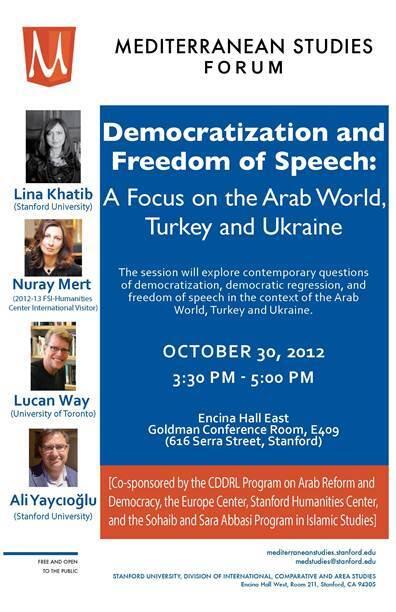
Co-sponsored by CDDRL Program on Arab Reform and Democracy, the Europe Center, Stanford Humanities Center, and the Abbasi Program in Islamic Studies

More info: http://www.stanford.edu/group/mediterranean/cgi-bin/web/2012/08/democratization-and-freedom-of-speech-a-focus-on-turkey-arab-world-and-ukraine/

Image

Richard and Rhoda Goldman Conference Room

Nuray Mert FSI-Humanities Center International Visitor Panelist
Lina Khatib Program Manager for the Program on Arab Reform and Democracy Panelist CDDRL
Lucan Way Associate Professor of Political Science Panelist University of Toronto
Ali Yaycioğlu Assistant Professor of Middle East History Moderator Stanford
Panel Discussions
-

Co-sponsored by the Abbasi Program on Islamic Studies, CDDRL Program on Arab Reform and Democracy, the Europe Center, Stanford Humanities Center, the Mediterranean Studies Forum, and the Center for Russian, East European and Eurasian Studies.

Reuben W. Hills Conference Room

Nuray Mert 2012-13 FSI-Humanities International Visitor Speaker
Lina Khatib Speaker
Lucan Way Speaker
Ali Yaycioğlu Speaker
Panel Discussions
Authors
Joan Ramon Resina
News Type
News
Date
Paragraphs

With Spain as the current hotspot in the European financial crisis, it is easy to lose sight of the broader features of the Spanish predicament, which, I submit, was political and cultural before it emerged as financial. One reason for the dramatic escalation of the risk premium on Spanish bonds is the government’s low credibility - itself the consequence of a heady mix of self-contradiction, lack of transparency, and downright lying. On November 20, 2011, after years of corrosive opposition, Mariano Rajoy rose to the presidency of the government on assurances that he understood the crisis and knew how to handle it.  He now feels trapped in a situation he cannot control, not least because much of the damage is of his own party’s making. To be sure, the socialists contributed mightily to the public debt, exacerbated it by denying the crisis when it was already in evidence, and worst of all, did not act to control the housing bubble, which left in its wake banks filled with toxic assets and a severe credit crunch. But at the root of the housing and mortgage bubble were the dangerous liaisons between the banking system and regional governments such as those in  Madrid and Valencia, that have long been steeped in the Partido Popular’s reckless politics and corrupt practices (epitomized by Bankia’s lurid ambitions and costly rescue.)

The banking crisis is dragging down the Spanish economy and bringing the country’s financial structure into uncharted territory. This is a seemingly paradoxical outcome for a country that a few years back boasted a positive balance and a higher growth rate than its neighbors. What happened to upend the triumphant rhetoric of presidents Aznar and Zapatero? To a certain extent the markets appear to have overreacted, and their knee-jerk response to rising debt caused in part by investors’ demand for higher interest on Spanish bonds threatens to bring about a self-fulfilling prophecy. Before the market developed these jitters however, Spain’s public debt was in fact lower than Germany’s, even as the latter functions as the basis against which the financial risk of other countries is measured. In the last week of June 2012, the distance between Spain's and Germany's debt risk was 504 basis points, while that between the US and Germany was only 13. In relation to GDP however, Spain’s public debt remains significantly lower than that of the U.S. At the end of 2011, Spain’s public debt was 68.5% of its GDP, while the US’s was 110.2%.  In spite of this, the US continues to have no trouble financing its debt, and the American dollar has been rising in recent months and continues to be regarded as a safe haven, while the euro is at risk.

Why all the fuss about Spain? The answer lies in a combination of causes.  In the first place, there is the big hole punched into Spanish banks by the large-scale default on loans irresponsibly pushed on overly optimistic borrowers; and then there is the unlikelihood of an economic recovery vigorous enough to guarantee the debt’s financing. Saddled with debt, subjected to salary cuts, and adrift in a dwindling job market, Spanish consumers will hardly be able to fuel a meaningful recovery for some time.  At present, the combined debt ofSaish families is nearly 100% of national GDP. Corporate debt is even larger. And it is not the private sector alone that is stuck. The loss of confidence also affects the Bank of Spain. For a long time the country’s central banking authority turned a blind eye to the bad lending practices of private institutions, and so it shares the blame for the illusion of an ever-expanding and ever-appreciating housing sector. When the fantasy receded, thousands of families, as well as the owners of small and middle-sized companies, were left stranded in a financial desert; and once the economy actually began to shrink, the government increasingly lost its ability to finance the debt.

Is Spain at risk of leaving the Eurozone? While this cannot be ruled out, it is unlikely. The possibility of going back to the peseta is precluded by the fact that foreign, mostly German and Chinese, investors, whose money helped pump up the housing bubble, now make up the bulk of Spain’s creditors. They will hardly sit by and allow Spain to devalue its way out of the mess. Although he dragged his feet, Rajoy has finally applied to Brussels for rescue funds and will submit to European oversight.  The proposed solution will undoubtedly involve further dismantling of services, salary cuts, and higher unemployment.  This is a bitter pill that will test Spain’s already shaky social cohesion. Rajoy will dispense it because he has no alternative, or rather because the alternative—letting the sick banks fail instead of nationalizing their losses—is not acceptable to the financial markets. Adding to the markets’ nervousness is the fact that Rajoy has proven to be singularly maladroit at administering the medicine.  This is where politics and culture come into the picture.

Spain’s troubles go back to the origin of its current regime in the late 1970s. They are rooted in a faulty transition that was expected to convert a country without democratic traditions into a full-fledged western democracy. But today all of Spain’s core institutions have fallen into disrepute: after years of covering its scandals, the monarchy has finally disgraced itself irreparably; the Supreme Court is affected by corruption at its core; the president of Madrid's regional government (a militant and vocal member of the extreme right wing of the Partido Popular) is calling for the dissolution of the Constitutional Court (i.e. for a return to undisguised authoritarian rule); and the tone of the debates in Congress could hardly fall to a lower level. Spanish democracy is ailing, but for anyone who has observed it with attention since its inception, the confirmation of what was once merely an inkling can hardly be cause for surprise.

In the 1970s, Spain’s bid for democratic legitimacy and admission to the European Community required the restoration of Basque and Catalan self-government, which Franco had suppressed. At the time, the provision of institutional guarantees for these nationalities was seen as a requirement of justice meant to correct decades of persecution. The Basque Country and the semi-Basque region of Navarre emerged from the transition with an important privilege. They collect their own taxes. From this revenue they transfer an amount to Madrid and use the rest as they see fit. Fiscal independence in the hands of a responsible government led to a clear improvement in the Basque standard of living and, and, not incidentally, to a certain insulation from the current crisis. Catalonia, with a larger economy, was denied that privilege. In fact the opposite occurred: its economy was made hostage to a state that, under the pretext of redistribution, severely impaired its growth and development.  Since Franco’s death, Catalonia’s leading position within Spain and its capacity to compete globally (it still accounts for 25% of all Spanish exports) have been eroded through an unfair fiscal burden and hostile decisions in matters of territorial development. Year after year, Spain’s government has defaulted on the execution of public works approved for Catalonia in the former's budget, thus retarding the latter's modernization and straining its finances to the breaking point.  Rajoy’s government will not even honor the state’s appropriations for Catalonia mandated by current fiscal law. In a display of cynical reason, the central Spanish government now blames regional governments for Spain’s public debt, obscuring the fact that the combined debt of the 17 autonomous communities is only 16% of the total, while that of the central government accounts for 76%. The remaining 8% is municipal debt. By shifting the responsibility for the crisis to the regional governments, Rajoy is patently using the current emergency as an opportunity to dismantle the structure of regional autonomy enshrined in Spain's current constitution.  The result of course would be to abrogate the limited degree of self-government that Spain only grudgingly conceded to Catalonia in the former's hour of democratic need.

As usual, propaganda is based on plausibility. It is true that Spain’s system of regional governments is costly, and a revision is long overdue. Most autonomous communities were invented ad hoc by the central government for the purpose of generalizing the autonomy principle and dissolving Catalonia’s historic claim to autonomy within a so-called “autonomous common regime” that as popularized at the time as “coffee for all.”  While history required the articulation of a state with two or three autonomous regions based on tangible cultural differences, Madrid’s politicians created 17 “autonomous communities” by administrative fiat. And since Madrid was unwilling to slim down the state’s bureaucracy, parallel administrations were created, adding to the cost of government. Since the beginning, the unwieldy system of “autonomous governments” was financed through the transfer of funds from the most productive to the least productive regions with a regularity and volume that ended up crippling the donors. These have been, with predictable monotony, the regions on the Mediterranean seaboard that possess a distinct culture and language: Catalonia, Valencia, and the Balearic Islands. So striking is the fiscal imbalance that for decades Spanish governments have refused to publicize the figures, even though this refusal constitutes the violation of a standing congressional order to make them available. But how the cookie crumbles is made evident by the president of Extremadura’s admission that a new fiscal deal for Catalonia would be catastrophic for his region. Catalonia suffers from a political paradox. As a “wealthy region” in a “poor country,” it never benefited from the European structural and cohesion funds of which Spain was the largest recipient, but instead became a net contributor on a level higher than France. Economists calculate that the Catalan fiscal deficit, that is, the percentage by which taxation exceeds allocations, rests anywhere between 8 and 10% of Catalonia’s GDP (roughly $20 billion annually for a region of 7,000,000 people.) Over time, the magnitude of such siphoning of resources impacts an economy, leading to obsolescent infrastructure, the impoverishment of the service sector, the deterioration of the educational system, and the inevitable loss of competitiveness. Catalonia’s public debt in 2011 was $52 billion, approximately 20.7% of the Catalan GDP. Two and a half years of a balanced fiscal relation with the rest of Spain would have sufficed to mop up all Catalan public debt.

Spain’s troubles were political before they became financial, but politicians will not resolve them. The country needs to be further integrated into the European structure through a common fiscal policy and a commonly regulated banking system; more importantly however, Spain needs to be politically accountable to Brussels and meet European standards of justice and democratic procedure.  This would do much to bring about economic rationality. A country on the brink of default cannot afford to build unprofitable fast-speed trains to provincial destinations, boondoggle expressways in a radial system stemming from Madrid, or airports without air traffic.  Nor should it insist on an extravagant freight train route that requires drilling through the thick of the Pyrenees instead of building a cheaper and commercially sensible coastal itinerary, a plan that, without Brussels' better judgement, the Spanish government would have rejected for the ostensible purpose of isolating Barcelona’s harbor, the busiest in Spain.  The senseless megalomania and castigation of specific territories cannot be explained along traditional ideological lines — such projects have been developed by socialists and conservatives alike — but by long-term cultural continuities. The recent bout of megalomania was buoyed by billions in structural funds, while the territorial grievances, notorious to anyone who is conversant with Spanish history, went on as before, shielded by Spain’s membership in the core Western institutions.

Spain would gain much from trading sovereignty for rationality, and from being forced to invest for economic rather than merely symbolic payoff. A dishonored monarchy, a politicized justice, and a corrupt party system are as much toxic assets as those the banks hold, and if intervention is inevitable, the discipline mandated from outside ought to touch the country to the quick. If and when Brussels decides to put the Iberian house in order, it ought to recognize which administrations have practiced fiscal restraint and are capable, under good governance, of meeting European standards. Spain could well be the last ditch of the European monetary union and of the political union itself. But timely political reform in Spain could be the last opportunity not only to keep the country within the EU but also to hold it together as a meaningful political project.

All News button
1
Subscribe to Democracy