News Type
Q&As
Date
Paragraphs

President Obama and Mitt Romney meet for their third debate to discuss foreign policy on Monday, when moderator Bob Schieffer is sure to ask them about last month's terrorist attack in Libya and the nuclear capabilities of Iran.

In anticipation of the final match between the presidential candidates, researchers from five centers at Stanford’s Freeman Spogli Institute for International Studies ask the additional questions they want answered and explain what voters should keep in mind.


What can we learn from the Arab Spring about how to balance our values and our interests when people in authoritarian regimes rise up to demand freedom?  

What to listen for: First, the candidates should address whether they believe the U.S. has a moral obligation to support other peoples’ aspirations for freedom and democracy. Second, they need to say how we should respond when longtime allies like Egypt’s Hosni Mubarak confront movements for democratic change.

And that leads to more specific questions pertaining to Arab states that the candidates need to answer: What price have we paid in terms of our moral standing in the region by tacitly accepting the savage repression by the monarchy in Bahrain of that country's movement for democracy and human rights?  How much would they risk in terms of our strategic relationship with Bahrain and Saudi Arabia by denouncing and seeking to restrain this repression? What human rights and humanitarian obligations do we have in the Syrian crisis?  And do we have a national interest in taking more concrete steps to assist the Syrian resistance?  On the other hand, how can we assist the resistance in a way that does not empower Islamist extremists or draw us into another regional war?  

Look for how the candidates will wrestle with difficult trade-offs, and whether either will rise above the partisan debate to recognize the enduring bipartisan commitment in the Congress to supporting democratic development abroad.  And watch for some sign of where they stand on the spectrum between “idealism” and “realism” in American foreign policy.  Will they see that pressing Arab states to move in the direction of democracy, and supporting other efforts around the world to build and sustain democracy, is positioning the United States on “the right side of history”?

~Larry Diamond, director of the Center on Democracy, Development, and the Rule of Law


What do you consider to be the greatest threats our country faces, and how would you address them in an environment of profound partisan divisions and tightly constrained budgets? 

What to listen for: History teaches that some of the most effective presidential administrations understand America's external challenges but also recognize the interdependence between America's place in the world and its domestic situation.

Accordingly, Americans should expect their president to be deeply knowledgeable about the United States and its larger global context, but also possessed of the vision and determination to build the country's domestic strength.

The president should understand the threats posed by nuclear proliferation and terrorist organizations. The president should be ready to lead in managing the complex risks Americans face from potential pandemics, global warming, possible cyber attacks on a vulnerable infrastructure, and failing states.

Just as important, the president needs to be capable of leading an often-polarized legislative process and effectively addressing fiscal challenges such as the looming sequestration of budgets for the Department of Defense and other key agencies. The president needs to recognize that America's place in the world is at risk when the vast bulk of middle class students are performing at levels comparable to students in Estonia, Latvia and Bulgaria, and needs to be capable of engaging American citizens fully in addressing these shared domestic and international challenges.

~Mariano-Florentino Cuéllar, co-director of the Center for International Security and Cooperation


Should our government help American farmers cope with climate impacts on food production, and should this assistance be extended to other countries – particularly poor countries – whose food production is also threatened by climate variability and climate change?

What to listen for: Most representatives in Congress would like to eliminate government handouts, and many would also like to turn away from any discussion of climate change. Yet this year, U.S. taxpayers are set to pay up to $20 billion to farmers for crop insurance after extreme drought and heat conditions damaged yields in the Midwest.

With the 2012 farm bill stalled in Congress, the candidates need to be clear about whether they support government subsidized crop insurance for American farmers. They should also articulate their views on climate threats to food production in the U.S. and abroad.

Without a substantial crop insurance program, American farmers will face serious risks of income losses and loan defaults. And without foreign assistance for climate adaptation, the number of people going hungry could well exceed 15 percent of the world's population. 

~Rosamond L. Naylor, director of the Center on Food Security and the Environment


What is your vision for the United States’ future relationship with Europe? 

What to listen for: Between the end of World War II and the end of the Cold War, it was the United States and Europe that ensured world peace. But in recent years, it seems that “Europe” and “European” have become pejoratives in American political discourse. There’s been an uneasiness over whether we’re still friends and whether we still need each other. But of course we do.

Europe and the European Union share with the United States of America the most fundamental values, such as individual freedom, freedom of speech, freedom to live and work where you choose. There’s a shared respect of basic human rights. There are big differences with the Chinese, and big differences with the Russians. When you look around, it’s really the U.S. and Europe together with robust democracies such as Canada and Australia that have the strongest sense of shared values.

So the candidates should talk about what they would do as president to make sure those values are preserved and protected and how they would make the cooperation between the U.S. and Europe more effective and substantive as the world is confronting so many challenges like international terrorism, cyber security threats, human rights abuses, underdevelopment and bad governance.

~Amir Eshel, director of The Europe Center


Historical and territorial issues are bedeviling relations in East Asia, particularly among Japan, China, South Korea, and Southeast Asian countries. What should the United States do to try to reduce tensions and resolve these issues?

What to listen for: Far from easing as time passes, unresolved historical, territorial, and maritime issues in East Asia have worsened over the past few years. There have been naval clashes, major demonstrations, assaults on individuals, economic boycotts, and harsh diplomatic exchanges. If the present trend continues, military clashes – possibly involving American allies – are possible.

All of the issues are rooted in history. Many stem from Imperial Japan’s aggression a century ago, and some derive from China’s more assertive behavior toward its neighbors as it continues its dramatic economic and military growth. But almost all of problems are related in some way or another to decisions that the United States took—or did not take—in its leadership of the postwar settlement with Japan.

The United States’ response to the worsening situation so far has been to declare a strategic “rebalancing” toward East Asia, aimed largely at maintaining its military presence in the region during a time of increasing fiscal constraint at home. Meanwhile, the historic roots of the controversies go unaddressed.

The United States should no longer assume that the regional tensions will ease by themselves and rely on its military presence to manage the situation. It should conduct a major policy review, aimed at using its influence creatively and to the maximum to resolve the historical issues that threaten peace in the present day.

~David Straub, associate director of the Korea Studies Program at the Walter H. Shorentein Asia-Pacific Research Center


Compiled by Adam Gorlick.

Hero Image
debatepic
President Obama and Mitt Romney speak during the second presidential debate on Oct. 16, 2012. Their third and final debate will focus on foreign policy. | Reuters
All News button
1
-

As part of The Europe Center's ongoing lecture series "Europe Now", Stanford professor Margaret Cohen will bring to light documentary narratives by dive pioneers of the 1920s-1950's (Beebe, Hass, Taillez, Diolé), and why these documentarians turn to a poetic imagery of marvels and enchantments to express aspects of human perception. 

Professor Cohen is Professor of Comparative Literature

Co-sponsored by The Stanford Humanities Center

Levinthal Hall

107 Pigott Hall
Stanford, CA 94305-2031

(650) 724-0106
0
Andrew B. Hammond Professor in French Language, Literature, and Civilization
Professor of Comparative Literature
Professor of English
Professor, by courtesy, of French and Italian
cohen_web_profile_0.jpg PhD

Margaret Cohen is the Andrew B. Hammond Professor of French Language, Literature and Civilization at Stanford University, where she is appointed in English and directs the Center for the Study of Novel. Her current fields of research include the novel and narrative as well as interdisciplinary oceanic studies. In her most recent book, The Novel and the Sea (2010), she revealed the impact of the ship’s log and the history of writing about work at sea on the development of the modern novel. The Novel and the Sea received the Louis R. Gottschalk Prize from the American Society for Eighteenth-Century Studies, the George and Barbara Perkins Prize from the International Society for the Study of the Narrative, and an honorable mention from the American Comparative Literature Association.

In The Sentimental Education of the Novel (1999), co-winner of the MLA’s 2000 Aldo and Jeanne Scaglione Prize for French and Francophone Studies, she recovered forgotten sentimental fiction by women writers important to the emergence of French realism. Other books include Profane Illumination: Walter Benjamin and the Paris of Surrealist Revolution (1993), as well as co-edited collections, most recently The Aesthetics of the Undersea (2019) with Killian Quigley, and a Norton critical edition of Flaubert’s Madame Bovary (2004). Professor Cohen has been awarded fellowships from the Fulbright Commission, the ACLS, NYU’s International Center for Advanced Studies, the NEH, the John Carter Brown Library’s Alexander O. Vietor Memorial Fund, the Stanford Humanities Center, and the Guggenheim Foundation. Current projects include a book on the history of underwater film and editingThe Age of Empire for the six-volume A Cultural History of the Sea (Bloomsbury), for which she is general editor as well.

Affiliated faculty at The Europe Center
Margaret Cohen Professor of Comparative Literature, and research affiliate Speaker The Europe Center
Seminars
-

Although Czechoslovak politicians in exile frequently proclaimed towards the end of the Second World War an ambition for their country to mediate between the U.S.S.R. and the Western powers, their deeds and utterances, imprinted in Soviet, Czech and other archival materials, testify to something else.  With their faith in the West fatally shaken by Munich 1938, which was only amplified by the U.S. failure to liberate Prague in May 1945, they relied on a Soviet security guarantee against any further German aggression and on Stalin's promises of non-interference in internal Czechoslovak affairs. However, numerous concessions to the Soviet wishes and a growing domestic power of the Czechoslovak Communists undermined this cardboard castle that in the atmosphere of the growing East-West confrontation finally collapsed in February 1948.

Co-sponsored by the Center for Russian, East European, and Eurasian Studies (CREEES) and the Department of History

Building 200 (History Corner),
Room 307

Encina Hall
616 Serra Street, C205-4
Stanford, CA 94305

0
Visiting Scholar, The Europe Center
Smetana_3x4_Fotka.jpg

Vit Smetana is a senior research fellow at the Institute of Contemporary History – Academy of Sciences of the Czech Republic, and also teaches modern international history at the Faculty of Social Sciences, Charles University in Prague.  His professional interest lies primarily in the policies of the great powers towards Czechoslovakia and Central Europe in the late 1930s and throughout the 1940s. His research during his stay at Stanford focuses on the topic “The Czech, Slovak and other Central European exiles in the Second World War and beyond”.

Dr. Smetana is the author of In the Shadow of Munich. British Policy towards Czechoslovakia from the Endorsement to the Renunciation of the Munich Agreement (1938-1942) (2008) and co-author of Draze zaplacená svoboda. Osvobození Československa 1944-45  (Dearly Paid Freedom. The Liberation of Czechoslovakia 1944-45) in two volumes (2009).  He also edited  the Czech version of the Robert F. Kennedy memoir of the Cuban Missle Crisis, Thirteen Days (1999).

Vit Smetana Senior Research Fellow at the Institute of Contemporary History – Academy of Sciences of the Czech Republic, and Visiting Scholar at The Europe Center Speaker
Seminars
-

In this second seminar of the Europe Center's "European and Global Economic Crisis Series", Professor Hanno Lustig will discuss how a conspicuous amount of risk is missing from the price of financial sector crash insurance during the 2007-2009 crisis and that the difference in costs of put options for individual banks, and puts on the financial sector index, increases fourfold from its pre-crisis level. He provides evidence that a collective government guarantee for the financial sector lowers index put prices far more than those of individual banks, explaining the divergence. By embedding a bailout in the standard option pricing model, observed put spread dynamics is closely replicated. During the crisis, the spread responds acutely to government intervention announcements.

CISAC Conference Room

Hanno Lustig Associate Professor of Finance at UCLA Anderson School of Management and Visiting Associate Professor Speaker UC Berkeley Haas School of Business
Seminars
Paragraphs

The debt crisis is clear: Smaller areas can be managed better than large nations. Therefore they should be autonomous - under the umbrella of the European Union.

All Publications button
1
Publication Type
Commentary
Publication Date
Journal Publisher
Financial Times Germany
Authors
News Type
News
Date
Paragraphs

Europe Center scholar Dr. Roland Benedikter (47), has been honored with the 2012 Klaus Reichert Award for Medical Philosophy. This award, given by the Center for Medical Philosophy in Karlsruhe, Germany, was bestowed on Benedikter in recognition of his outstanding merits for medical ethics, for advancing the debate on avant-garde issues at the interplay between contemporary politics, sociology, ethics and medicine, and for his efforts to re-humanize the contemporary thought and international debate about the future of the human being in times of "transhumanism" and "hyper-technologization". The award is the most highly regarded academic award of this genre in Germany.

The award ceremony will be held on October 6, 2012 in Karlsruhe. In his award speech "What future for the human being: Humanism or Transhumanism? Aspects at the interplay between technology, politics and ethics", Benedikter will give an overview of the current "global systemic shift", its trend towards a "neuromorphosis" of global culture (two notions co-coined by him) and the future of the human being in the age of "transhumanism" and invasive new technologies. Benedikter will in particular elucidate the contemporary relation between macro-philosophical trends that will dominate the years ahead in the advanced international thought on the interplay between medicine and society.

Benedikter shares the award with his long time collaborator Prof. James Giordano, director of the Center on Neurotechnology at the Potomac Institute for Policy Studies, Washington DC.

All News button
1
-

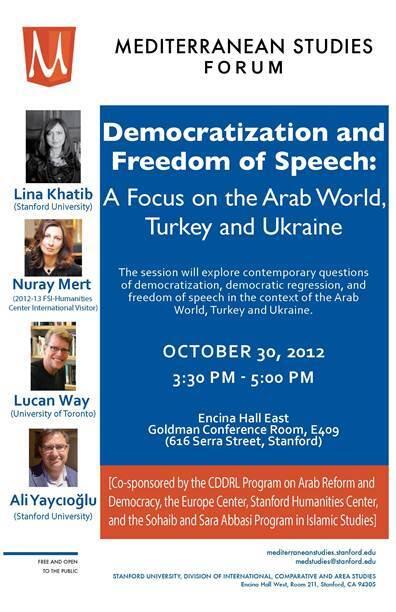
Co-sponsored by CDDRL Program on Arab Reform and Democracy, the Europe Center, Stanford Humanities Center, and the Abbasi Program in Islamic Studies

More info: http://www.stanford.edu/group/mediterranean/cgi-bin/web/2012/08/democratization-and-freedom-of-speech-a-focus-on-turkey-arab-world-and-ukraine/

Image

Richard and Rhoda Goldman Conference Room

Nuray Mert FSI-Humanities Center International Visitor Panelist
Lina Khatib Program Manager for the Program on Arab Reform and Democracy Panelist CDDRL
Lucan Way Associate Professor of Political Science Panelist University of Toronto
Ali Yaycioğlu Assistant Professor of Middle East History Moderator Stanford
Panel Discussions
Subscribe to Europe