Authors
News Type
News
Date
Paragraphs

Milada Anna Vachudova of the University of North Carolina at Chapel Hill presented on “Europe in the Face of War and America’s Authoritarian Turn” during a Rethinking European Development and Security (REDS) seminar, co-sponsored by the Center on Democracy, Development and the Rule of Law (CDDRL) and The Europe Center (TEC). Drawing on research coauthored with Nadiia Koval of the European Policy Institute in Kyiv, Vachudova examined how Russia’s war in Ukraine, democratic backsliding within the European Union, and changing U.S. foreign policy are reshaping Europe’s geopolitical role.

Vachudova began by arguing that Ukraine’s resistance to Russia’s full-scale invasion is also a defense of European democracy, national sovereignty, and the security of EU and NATO members. She situated this claim within a broader account of the EU’s power. Historically, the union has exerted influence through its democratic norms, economic integration, market access, and enlargement rather than military force alone. Yet she rejected the idea that Europe must choose between defending liberal values and pursuing geopolitical interests. Military capabilities, she suggested, can complement the EU’s normative and economic strengths.

That potential has long been undermined by political expediency. Vachudova pointed to Europe’s pre-2022 dependence on Russian energy and continued economic engagement with Moscow, as well as the challenge posed by authoritarian-minded political parties within the EU. These vulnerabilities illustrated the costs of prioritizing short-term economic interests over democratic commitments and long-term security.

Russia’s February 2022 invasion nevertheless prompted an unusually rapid European response. EU institutions, particularly the European Commission, moved to assist Ukrainian refugees, expand market access, impose sanctions, provide financial and military assistance, and revive enlargement. Vachudova emphasized that this early institutional leadership occurred amid an absence of traditional French-German leadership. It also coincided with the emergence of ad hoc coalitions and a shift in influence toward northern and eastern European states, whose governments have often taken a more urgent view of the Russian threat.

However, translating this initial momentum into sustained military capacity has proven difficult. Increased defense spending, including in Germany and Poland, has not eliminated obstacles to coordination, implementation, and collective action. The EU must contend with powerful veto players even as uncertainty about the United States raises questions about Europe's ability to defend Ukraine and itself.

Vachudova characterized the current U.S. trajectory as an “authoritarian turn,” arguing that the Trump administration’s approach to Russia and Ukraine has eroded transatlantic trust. In her assessment, perceived American unreliability carries significant security, reputational, and economic costs, including growing doubts among allies about dependence on U.S.-made weapons systems.

Despite these challenges, Vachudova identified reasons for cautious optimism. External threats can catalyze European integration, while democratic mobilization can counter authoritarian movements and Russian influence. She also described a pattern of “democratic bandwagoning,” exemplified by Canada moving closer to the EU. Ultimately, she suggested that Ukraine’s determination could help sustain enlargement and strengthen Europe’s identity as both a democratic community and a geopolitical actor. The central question is whether Europe can convert crisis-driven solidarity into lasting political unity and defense capabilities.

Read More

Aleksandar Matovski presented his research at a CDDRL/TEC co-sponsored Rethinking European Development and Security (REDS) seminar on October 8, 2026.
News

When Pressure Builds in Moscow, Restraint Gives Way to Escalation

Aleksandar Matovski’s “pressure cooker” framework explains why Russia absorbs some military setbacks quietly yet responds to others with nuclear threats and mobilization.
When Pressure Builds in Moscow, Restraint Gives Way to Escalation
Hero Image
Milada Anna Vachudova presented her research in a Rethinking European Development and Security (REDS) seminar on October 22, 2026, co-sponsored by the Center on Democracy, Development and the Rule of Law (CDDRL) and The Europe Center (TEC).
Milada Anna Vachudova presented her research in a Rethinking European Development and Security (REDS) seminar on October 22, 2026, co-sponsored by the Center on Democracy, Development and the Rule of Law (CDDRL) and The Europe Center (TEC). | Nora Sulots
All News button
1
Subtitle

Milada Anna Vachudova traces how the EU mobilized rapidly after Russia’s invasion of Ukraine, and the harder task of converting solidarity into lasting capability.

Date Label
In Brief
  • Milada Anna Vachudova examines whether Europe can convert crisis-driven solidarity into lasting political unity and defense capability.
  • The EU mobilized rapidly after Russia’s 2022 invasion, but sustaining that momentum has proven harder than the initial response.
  • A perceived “authoritarian turn” in U.S. policy has eroded transatlantic trust, raising doubts about Europe’s ability to defend Ukraine and itself.
Display Hero Image Wide (1320px)
Yes
Authors
News Type
News
Date
Paragraphs

On October 8, 2026, Aleksandar Matovski presented at a Rethinking European Development and Security (REDS) seminar, co-sponsored by the Center on Democracy, Development and the Rule of Law (CDDRL) and The Europe Center (TEC), on Russia’s nuclear escalation and restraint during the war in Ukraine. The central puzzle he sought to explain was why the severity of an external shock does not necessarily correspond to the timing or intensity of Russia’s response. Moscow has repeatedly resorted to nuclear threats and provocative signaling. Yet, at other times, it has absorbed substantial military setbacks without responding with comparable ferocity. The question, therefore, is what explains this variation in restraint and escalation.

Matovski identified three broad explanations in the existing literature. The first concerns external constraints, including backlash from Russia’s remaining partners, the limited battlefield utility of nuclear weapons, and the danger of confrontation with NATO. However, these factors primarily explain restraint rather than escalation. The second concerns credibility decay, whereby repeated threats without follow-through undermine credibility and encourage riskier behavior to restore it. The third concerns domestic political influences, including hardliner pressure, regime survival threats, and risk-averse elites and citizens. Interestingly, domestic politics can generate both escalation and restraint. The question is which pressures matter, when, and how they interact with external constraints.

Matovski consequently proposed his pressure cooker framework, based on three premises. First, Putin needs a “forever war” to maintain political control. Continued confrontation allows the regime to mobilize nationalism, justify repression, and redirect dissatisfaction toward foreign adversaries. Second, military failure does not necessarily imply domestic political failure. Much depends on how the Kremlin frames setbacks and manages their political consequences. Third, nuclear coercion is essential to sustaining the war. It discourages Western intervention and reinforces the domestic narrative that Russia cannot ultimately be defeated.

The mechanism begins with an external shock, followed by initial restraint and the gradual accumulation of political pressure. Initially, restraint may be advantageous because escalation can publicly acknowledge military failure, alarm risk-averse citizens, and create further external risks. The Kremlin can also temporarily defer the political costs of inaction by controlling the narrative. However, as setbacks accumulate, hardliners increasingly interpret restraint as weakness. Meanwhile, the wider public may question the war’s sustainability. Repeated unenforced threats also undermine Russia’s credibility and may encourage adversaries to test its limits. Eventually, the political costs of restraint may outweigh those of escalation, prompting more dramatic action.

Matovski illustrated this through the 2022 mobilization and nuclear scare. Despite the failure of Russia’s initial invasion, Putin initially avoided large-scale mobilization. However, following further setbacks, particularly Ukraine’s Kharkiv counteroffensive in September, domestic pressures arguably intensified. Putin subsequently announced partial mobilization and the purported annexation of four Ukrainian regions. Russia also intensified nuclear threats. In October, Moscow made allegations concerning a potential Ukrainian “dirty bomb,” amid heightened fears of nuclear escalation. Yet Russia subsequently withdrew from Kherson in November without nuclear retaliation. Matovski interpreted this sequence as consistent with his argument that escalation follows accumulated pressures rather than necessarily responding immediately to individual setbacks.

The central implication is that Russian restraint and escalation may represent different phases of the same political process. Apparent restraint may therefore be unstable, making subsequent escalation difficult to anticipate.

Read More

Hero Image
Aleksandar Matovski presented his research at a CDDRL/TEC co-sponsored Rethinking European Development and Security (REDS) seminar on October 8, 2026.
Aleksandar Matovski presented his research at a CDDRL/TEC co-sponsored Rethinking European Development and Security (REDS) seminar on October 8, 2026. | Nora Sulots
All News button
1
Subtitle

Aleksandar Matovski’s “pressure cooker” framework explains why Russia absorbs some military setbacks quietly yet responds to others with nuclear threats and mobilization.

Date Label
In Brief
  • At an October 8 REDS seminar co-sponsored by CDDRL and TEC, Aleksandar Matovski examined why Russia’s response to setbacks in Ukraine does not track their severity.
  • His “pressure cooker” framework argues that Putin needs a “forever war” to maintain control, so restraint holds until accumulated political pressure makes escalation the less costly option.
  • Matovski cited the 2022 mobilization and nuclear scare to argue that restraint and escalation are phases of one process, making apparent restraint unstable and escalation hard to anticipate.
Display Hero Image Wide (1320px)
Yes
-
REDS Seminar 10.8.26

As Russia’s war against Ukraine grinds on and debate intensifies over how to end it, what could push the conflict into a more dangerous phase of escalation? This talk examines how the Putin regime’s domestic political imperatives shape when Moscow absorbs setbacks and when it escalates. It argues that Russian behavior reflects a “pressure-cooker” dynamic: external geopolitical constraints favor restraint, while battlefield failures, war weariness, and pressure from hardliners can gradually raise the domestic costs of inaction. The result is prolonged restraint punctuated by abrupt escalation across conventional, gray-zone, and nuclear domains. Counterintuitively, the greatest danger may arise before a domestic crisis fully materializes — when wartime exhaustion or the political and economic strains of a ceasefire loom, but the Putin regime still retains the capacity to act coherently. This argument has direct implications for Western efforts to manage escalation and negotiate an end to the war without inadvertently increasing Moscow’s incentives for risk-taking.

Aleksandar Matovski is an Associate Professor in the Department of National Security Affairs at the Naval Postgraduate School. His research focuses on the impact of domestic politics on the durability and strategic behavior of authoritarian regimes, with a regional emphasis on Europe and the former Soviet Union. Matovski holds a PhD and MA in Government from Cornell University, an MA in War Studies from King’s College London, and a BA in Law from Saints Cyril and Methodius University, Skopje. Prior to his academic career, he was National Security Advisor in the Government of North Macedonia and Political and Military Advisor in the North Macedonian Ministry of Defense. 


REDS: RETHINKING EUROPEAN DEVELOPMENT AND SECURITY


The REDS Seminar Series aims to deepen the research agenda on the new challenges facing Europe, especially on its eastern flank, and to build intellectual and institutional bridges across Stanford University, fostering interdisciplinary approaches to current global challenges.

REDS is organized by The Europe Center and the Center on Democracy, Development and the Rule of Law.

Learn more about REDS and view past seminars here.

Anna Grzymała-Busse
Anna Grzymała-Busse, Kathryn Stoner

Virtual to Public. If prompted for a password, use: 123456

Only those with an active Stanford ID with access to William J. Perry Conference Room in Encina Hall may attend in person.

Aleksandar Matovski Assistant Professor Presenter Institute for Regional and International Security (IRIS), Naval Postgraduate School
Seminars
News Feed Image
10.8.26 REDS Seminar.png
Date Label
Authors
News Type
News
Date
Paragraphs

In a Rethinking European Development and Security (REDS) seminar held on April 9, 2026,  and co-hosted by CDDRL and The Europe Center, Konstantin Sonin, a John Dewey Distinguished Service Professor at the University of Chicago Harris School of Public Policy, presented his research on “The Reverse Cargo Cult: Why Authoritarian Governments Lie to Their People,” offering a theoretical explanation for why regimes such as the Soviet Union would knowingly tell citizens visibly false statements. According to Sonin’s research, authoritarian propaganda is much more complex than simple misinformation or manipulation, as it is often designed not to convince people of a single claim, but to shape how they evaluate information more broadly. 

Sonin begins with a personal anecdote, reflecting on his own experience participating in Soviet elections where there was only one candidate on the ballot, despite the process being presented as a meaningful choice. Using this example, he questions why regimes like the Soviet Union invest so heavily in clearly staged elections or exaggerated portrayals of Western life, even when citizens recognize these distortions. From this, he introduces the idea that such actions are not meant to persuade citizens of a specific falsehood, but instead to influence how they interpret all incoming information. Drawing on the metaphor of a “reverse cargo cult,” he suggests that just as some communities misinterpret the source of Western goods, citizens in authoritarian systems may come to believe that institutions in other countries are equally performative or deceptive. In this sense, narratives about foreign countries become an integral tool for reinforcing domestic political stability. 

He further explores how citizens evaluate elections and the decision to replace an incumbent under uncertainty about both competence and trustworthiness. He recognizes that in these regimes, citizens are not entirely naïve and may often recognize when a leader is lying. However, Sonin shows that even obvious lies can be effective. When a domestic leader lies about conditions that citizens already know to be bad, it signals not only that the leader is untrustworthy but also raises the perceived likelihood that foreign leaders are similarly dishonest. As a result, citizens downgrade their expectations of potential replacements, concluding that alternatives may not be any better. This dynamic ultimately reduces the incentive to replace the incumbent. 

As his theory suggests, negative information about conditions abroad, or even skepticism toward foreign success, can benefit authoritarian leaders. For example, Sonin points to Soviet reactions to the American National Exhibition in Moscow, where displays of a typical American home were dismissed by officials as unrealistic or misleading. This kind of framing encouraged citizens to question whether life in the United States was truly better, reinforcing the idea that shortcomings at home were not unique. As a result, domestic failures appear less exceptional, helping explain why authoritarian propaganda frequently emphasizes criticism of other countries and why such narratives often reinforce one another. 

Sonin concludes by emphasizing that lying in this context is not primarily about persuading citizens of a particular false claim, but about shaping their broader beliefs about the reliability of information. By weakening trust in information overall, leaders can make bad conditions at home seem like the safer or more reliable option compared to the uncertainty of change.

Read More

Hannah Chapman presented her research in a CDDRL and TEC sponsored REDS Seminar on March 12, 2026.
News

The Information Paradox: Citizen Appeals and Authoritarian Governance in Russia

Associate Professor Hannah Chapman explores how the rise of crises affects authoritarian regimes’ ability to gather information from their citizens in the context of Russia.
The Information Paradox: Citizen Appeals and Authoritarian Governance in Russia
Hero Image
Konstantin Sonin presented his research in a CDDRL seminar on April 9, 2026.
Konstantin Sonin presented his research in a CDDRL seminar on April 9, 2026. | Stacey Clifton
All News button
1
Subtitle

Professor Konstantin Sonin explores the power of misinformation in shaping public perception and political decision-making in a recent Rethinking European Development and Security (REDS) seminar.

Terms
Image
Konstantin Sonin presented his research in a CDDRL seminar on April 9, 2026.
Caption Konstantin Sonin presented his research in a CDDRL seminar on April 9, 2026. | Photo credit Stacey Clifton
Aria Label
Read More Why Authoritarian Governments Tell Obvious Lies
Date Label
In Brief
  • At a REDS Seminar hosted by the Center on Democracy, Development and the Rule of Law and The Europe Center seminar on April 9, 2026, Konstantin Sonin presented research on authoritarian propaganda.
  • Sonin argued propaganda in regimes like the Soviet Union shapes how citizens process information, not belief in specific claims.
  • The findings suggest authoritarian messaging reinforces control by shaping public reasoning, even when citizens recognize statements as false.
Display Hero Image Wide (1320px)
No
Authors
News Type
News
Date
Paragraphs

In a REDS Seminar co-sponsored by CDDRL, TEC, and the Hoover Institution held on March 12, 2026, Hannah S. Chapman, the Theodore Romanoff Associate Professor of Russian Studies and an Associate Professor of International and Area Studies at the University, presented a new project exploring how crises affect authoritarian regimes’ ability to gather information from their citizens. This question connects to the well-known dictator’s dilemma, which describes the challenge authoritarian leaders face in obtaining accurate information from society while maintaining political control. Chapman’s project explores how this dilemma plays out during crises, when governments may simultaneously need more information from society while also increasing repression.

Chapman studies this question in the context of Russia, specifically focusing on the presidential appeals system in which citizens can submit appeals to the Presidential Administration via online platforms, written letters, or in person. These appeals typically address everyday governance issues such as infrastructure problems, utilities, social benefits, healthcare access, or bureaucratic disputes. Importantly, appeals are not anonymous and require individuals to submit identifying information, meaning citizens must voluntarily engage with the state to raise concerns. While these systems provide the government with valuable information about societal problems, moments of crisis raise the question of whether citizens will continue to use them as repression increases. 

To explain variation in citizen appeals during crises, Chapman introduces a theory of crisis based on two key factors that shape citizen behavior. Crisis immediacy, which refers to how directly and rapidly a crisis affects people’s everyday lives, and the government’s repressive response, meaning whether the state increases repression during the crisis. Together, these two factors shape whether citizens are willing to voluntarily engage with the state despite heightened repression and risk. To evaluate these expectations, Chapman analyzes a dataset of monthly reports produced by the Russian Presidential Administration that summarize citizen appeals. The dataset includes approximately 1.7 million appeals between 2017 and 2023, covering hundreds of categories of complaints. Using these reports, the project examines four major crises in Russia during this period: the 2018 pension reform, the COVID-19 pandemic, the 2022 invasion of Ukraine, and the partial military mobilization announced in September 2022. 

Each crisis demonstrates how immediacy and repression shape citizen behavior. The 2018 pension reform represents a low-immediacy, low-repression crisis. Although the policy change was unpopular, its effects were expected to unfold gradually, and protests were not heavily suppressed. As a result, appeals about pensions increased modestly while everyday appeals continued at normal levels. The COVID-19 pandemic represents a high-immediacy, low-repression crisis because lockdowns and economic disruptions immediately affected daily life, but restrictions were largely framed as public health measures rather than political repression. During this period, crisis-related appeals increased significantly while everyday appeals remained stable. 

The 2022 invasion of Ukraine represents a low-immediacy, high-repression crisis. Although repression increased dramatically through censorship laws and arrests for criticizing the war, the conflict initially felt distant from everyday life for many Russians. As a result, both crisis-related appeals and everyday appeals remained relatively low. Finally, the mobilization announced in September 2022 represents a high-immediacy, high-repression crisis. Because hundreds of thousands of Russians faced the immediate possibility of military conscription, crisis-related appeals increased dramatically, with approximately 42.3% of appeals related to military issues, even though everyday appeals remained suppressed. 

Chapman claims that in high-urgency crises, immediacy outweighs repression, creating an urgent incentive for citizens to seek help despite the risks. As a result, there is a spike in crisis-related appeals and a sharp decline in everyday complaints. As discussed, this is significant as systems designed to gather citizen feedback depend on citizens’ willingness to communicate with the state. Consequently, when repression increases, these channels become more fragile and less effective at capturing routine issues. As a result, authoritarian governments may lose important information about everyday problems when they most need accurate information to maintain stability.

Read More

Hero Image
Hannah Chapman presented her research in a CDDRL and TEC sponsored REDS Seminar on March 12, 2026.
Hannah Chapman presented her research in a CDDRL and TEC-sponsored REDS Seminar on March 12, 2026. | Nora Sulots
All News button
1
Subtitle

Associate Professor Hannah Chapman explores how the rise of crises affects authoritarian regimes’ ability to gather information from their citizens in the context of Russia.

Date Label
In Brief
  • At a REDS seminar, Hannah Chapman analyzed how crises shape citizen communication with authoritarian governments in Russia.
  • Using 1.7 million Russian presidential appeals (2017–2023), Chapman examined citizen responses across pension reform, COVID-19, invasion, and mobilization crises.
  • Her findings show urgent crises spur appeals despite repression, while everyday complaints decline, limiting authoritarian governments’ routine information channels.
Display Hero Image Wide (1320px)
No
Authors
News Type
News
Date
Paragraphs

On February 12, Stanford’s Center on Democracy, Development and the Rule of Law (CDDRL), the Europe Center, and the Hoover Institution hosted Lucan Way, Distinguished Professor of Democracy at the University of Toronto, for a seminar titled “Economic Dependence and Authoritarianism: Russia in Comparative Perspective.” The talk, part of the REDS (Rethinking European Development and Security) series, examined the structural relationship between state resource concentration and democratic outcomes, using Russia as a central case while situating it within broader comparative patterns.

Way’s core argument centered on a simple but powerful proposition: when economic resources are concentrated in the hands of the state, autocracy becomes more likely; when resources are dispersed outside the state, democracy becomes more feasible. The key mechanism linking economic structure to regime type is the strength — or weakness — of countervailing societal power. Resource concentration generates societal dependence on political leaders. Citizens dependent on public-sector employment or state benefits face high personal costs for political opposition, including loss of income or access to essential services. Similarly, business elites reliant on state licenses, contracts, or regulatory goodwill incur substantial risks if they challenge incumbents. The result is weak opposition, limited activist networks, minimal independent funding, and fragile civil society organizations.

Way situated this framework within three major literatures on authoritarianism. First, underdevelopment (Lipset 1959; Przeworski et al. 2000) remains strongly associated with autocracy: roughly 70 percent of poor countries were autocratic between 2000 and 2021. Second, oil wealth (Ross 2001; Bellin 2004) produces an even starker pattern: about 90 percent of petrostates were authoritarian in the same period. Third, statist or weak private-sector economies (Fish 2005; Greene 2007; Arriola 2013; Rosenfeld 2021) show similar tendencies, with roughly 80 percent of the most statist countries classified as autocratic. Despite their differences — very poor African states, wealthy Middle Eastern petrostates, and middle-income statist regimes — the underlying mechanism is the same: resource concentration fosters weak countervailing power.

Russia exemplifies this structural dynamic. While the 1990s appeared to feature strong countervailing forces, including powerful oligarchs credited with supporting Boris Yeltsin’s reelection, Way argued that these actors were in fact institutionally weak. Russia’s private sector relied heavily on state connections in a system with weak courts and manipulable regulatory frameworks. The imprisonment of Mikhail Khodorkovsky after he challenged Vladimir Putin underscored the vulnerability of even the wealthiest economic actors. The broader business community remained largely passive, reflecting structural dependence rather than autonomous strength.

Statism further entrenched authoritarian control. A state-dependent middle class and political parties reliant on Kremlin financing limited the development of robust opposition. In oil-rich systems, public-sector employment and distributive benefits deepen citizens' dependence, while governments remain fiscally insulated from private-sector pressures. In underdeveloped postcolonial contexts, even modestly financed states wield disproportionate leverage over fragile economies, facilitating cooptation and repression.
Preliminary statistical evidence using V-Dem measures of “resource concentration” supports these claims. State ownership or control over key sectors correlates strongly with authoritarianism, high pro-incumbent mobilization, low opposition mobilization, media control, and weak civil society. Way acknowledged complications, including endogeneity: autocrats often increase resource concentration through nationalization or expansion of public employment. Nevertheless, certain structural conditions — such as large oil reserves, extreme underdevelopment, or historically weak private sectors — make concentration more feasible ex ante.

In conclusion, Way emphasized that autocracy is not inevitable in such contexts. However, where countervailing societal power is weak, imposing authoritarian rule becomes far easier. Across diverse regimes, economic dependence constitutes a common mechanism of authoritarian control — whether through business capture of the state or state capture of business.

Read More

Andrew Michta presented his research in a REDS Seminar co-hosted by CDDRL and TEC on January 22, 2026.
News

Will Deterrence Hold in Europe?

At a REDS seminar co-hosted by CDDRL and TEC, Andrew Michta assesses whether Europe’s security institutions are prepared for renewed great power competition.
Will Deterrence Hold in Europe?
Hero Image
Lucan Way presented his research in a REDS Seminar on February 12, 2026.
Lucan Way presented his research in a REDS Seminar on February 12, 2026. | Nora Sulots
All News button
1
Subtitle

Lucan Way examines the structural relationship between state resource concentration and democratic outcomes, using Russia as a central case while situating it within broader comparative patterns.

Date Label
In Brief
  • In a REDS (Rethinking European Development and Security) Seminar co-hosted by the Center on Democracy, Development and the Rule of Law, The Europe Center, and the Hoover Institution, Lucan Way examined how state resource concentration shapes authoritarian and democratic trajectories.
  • He argued that economic dependence weakens opposition, civil society, and independent business, limiting countervailing societal power.
  • The discussion situated Russia within comparative research on statism, oil wealth, and the links between underdevelopment and the durability of authoritarianism.
Display Hero Image Wide (1320px)
No
-
Democracy Day Panel

As part of Stanford Democracy Day, several Stanford scholars share their perspectives on domestic and comparative erosion of democracy, providing context for current elections in the United States and around the world.


Speakers:

Christophe Crombez, Senior Research Scholar at The Europe Center at the Freeman Spogli Institute for International Studies and Professor of Political Economy at the Faculty of Economics and Business at KU Leuven in Belgium. His research focuses on EU institutions and their impact on policies, EU institutional reform, lobbying, party politics, and parliamentary government.

Anna Grzymała-Busse, Professor in the Department of Political Science, the Michelle and Kevin Douglas Professor of International Studies, senior fellow at the Freeman Spogli Institute for International Studies and the director of The Europe Center. Her research interests include political parties, state development and transformation, informal political institutions, religion and politics, and post-communist politics.

Hakeem Jefferson, Assistant Professor in the Department of Political Science, faculty affiliate with the Center for Comparative Studies in Race and Ethnicity and the Stanford Center for American Democracy. His research focuses primarily on the role identity plays in structuring political attitudes and behaviors in the U.S., with a special interest in understanding how stigma shapes the politics of Black Americans, particularly as it relates to group members’ support for racialized punitive social policies. 

Hesham Sallam, Senior Research Scholar at CDDRL, where he serves as Associate Director for Research. He is also Associate Director of the Program on Arab Reform and Development. Sallam is co-editor of Jadaliyya ezine and a former program specialist at the U.S. Institute of Peace. His research focuses on political and social development in the Arab World. Sallam’s research has previously received the support of the Social Science Research Council and the U.S. Institute of Peace.

Kathryn Stoner, Mosbacher Director of the Center on Democracy, Development, and the Rule of Law (CDDRL), and a Senior Fellow at CDDRL and the Center on International Security and Cooperation at FSI. From 2017 to 2021, she served as FSI's Deputy Director. She is Professor of Political Science (by courtesy) and teaches in the Program on International Relations, as well as in the Ford Dorsey Master's in International Policy Program. She is also a Senior Fellow (by courtesy) at the Hoover Institution.

Encina Hall
616 Jane Stanford Way
Stanford, CA  94305


(650) 723-4270
0
Senior Fellow at the Freeman Spogli Institute for International Studies
Michelle and Kevin Douglas Professor of International Studies
Professor of Political Science
Senior Fellow, Hoover Institution
anna_gb_4_2022.jpg

Anna Grzymała-Busse is a professor in the Department of Political Science, the Michelle and Kevin Douglas Professor of International Studies, senior fellow at the Freeman Spogli Institute for International Studies and the director of The Europe Center. Her research interests include political parties, state development and transformation, informal political institutions, religion and politics, and post-communist politics.

In her first book, Redeeming the Communist Past, she examined the paradox of the communist successor parties in East Central Europe: incompetent as authoritarian rulers of the communist party-state, several then succeeded as democratic competitors after the collapse of these communist regimes in 1989.

Rebuilding Leviathan, her second book project, investigated the role of political parties and party competition in the reconstruction of the post-communist state. Unless checked by a robust competition, democratic governing parties simultaneously rebuilt the state and ensured their own survival by building in enormous discretion into new state institutions.

Anna's third book, Nations Under God, examines why some churches have been able to wield enormous policy influence. Others have failed to do so, even in very religious countries. Where religious and national identities have historically fused, churches gained great moral authority, and subsequently covert and direct access to state institutions. It was this institutional access, rather than either partisan coalitions or electoral mobilization, that allowed some churches to become so powerful.

Anna's most recent book, Sacred Foundations: The Religious and Medieval Roots of the European State argues that the medieval church was a fundamental force in European state formation.

Other areas of interest include informal institutions, the impact of European Union membership on politics in newer member countries, and the role of temporality and causal mechanisms in social science explanations.

Director of The Europe Center

Encina Hall
Stanford University
Stanford, CA 94305

(650) 723-0249 (650) 723-0089
0
Senior Research Scholar at The Europe Center
cc3.jpg PhD

Christophe Crombez is a political economist who specializes in European Union (EU) politics and business-government relations in Europe. His research focuses on EU institutions and their impact on policies, EU institutional reform, lobbying, party politics, and parliamentary government.

Crombez is Senior Research Scholar at The Europe Center at the Freeman Spogli Institute for International Studies at Stanford University (since 1999). He teaches Introduction to European Studies and The Future of the EU in Stanford’s International Relations Program, and is responsible for the Minor in European Studies and the Undergraduate Internship Program in Europe.

Furthermore, Crombez is Professor of Political Economy at the Faculty of Economics and Business at KU Leuven in Belgium (since 1994). His teaching responsibilities in Leuven include Political Business Strategy and Applied Game Theory. He is Vice-Chair for Research at the Department for Managerial Economics, Strategy and Innovation.

Crombez has also held visiting positions at the following universities and research institutes: the Istituto Italiano di Scienze Umane, in Florence, Italy, in Spring 2008; the Department of Political Science at the University of Florence, Italy, in Spring 2004; the Department of Political Science at the University of Michigan, in Winter 2003; the Kellogg Graduate School of Management at Northwestern University, Illinois, in Spring 1998; the Department of Political Science at the University of Illinois at Urbana-Champaign in Summer 1998; the European University Institute in Florence, Italy, in Spring 1997; the University of Antwerp, Belgium, in Spring 1996; and Leti University in St. Petersburg, Russia, in Fall 1995.

Crombez obtained a B.A. in Applied Economics, Finance, from KU Leuven in 1989, and a Ph.D. in Business, Political Economics, from Stanford University in 1994.

Christophe Crombez, Anna Grzymała-Busse, Hakeem Jefferson, Hesham Sallam, Kathryn Stoner
Seminars
Date Label
Paragraphs
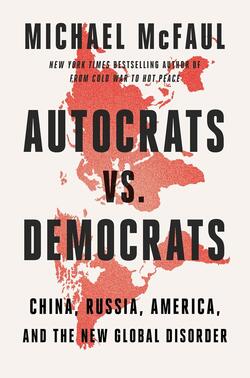
Cover of Autocrats vs Democrats Book

Amid the constant party divisions in Washington, DC, one issue generates stunning consensus—China—with Republicans and Democrats alike battling over which party can take the most hawkish stance toward the ascendant superpower. Indeed, far from trying to avoid a new Cold War with China, many have embraced it, finding comfort in the familiar construct, almost willing it into existence. And yet, even as politicians and intellectuals race to embrace this Cold War 2.0, many of the perils we face today are distinctly different from those of the Cold War with the Soviets. The alliance between the autocracies of China and Russia, the nature of the ideological struggle, China’s economic might, the rise of the far right in the United States and in Europe, and the growing isolationism and polarization in American society—taken together these represent new challenges for the democratic world. Some elements of the Cold War have reappeared today, but many features of the current great power competition have no analogy from the past century.

For decades Michael McFaul, former ambassador to Russia and international affairs analyst for NBC News, has been one of the preeminent thinkers about American foreign policy. Now, in this provocative work, he challenges the encroaching orthodoxy on Russia and China, arguing persuasively that the way forward is not to force our current conflict into a decades-old paradigm but to learn from our Cold War past so that democracy can again emerge victorious. Examining America’s layered, modern history with both Russia and China, he demonstrates that, instead of simplistically framing our competition with China and Russia as a second Cold War, we must understand the unique military, economic, and ideological challenges that come from China and Russia today, and the develop innovative policies that follow from that analysis, not just a return to the Cold War playbook.

At once a clarion call for American foreign policy and a forceful rebuttal of the creeping Washington consensus around China, Autocrats vs. Democrats demonstrates that the key to prevailing in this new era isn’t simply defeating our enemies through might, but using their oppressive regimes against them—to remind the world of the power and potential that our democratic freedoms make possible. 

Michael McFaul headshot

Professor Michael McFaul

FSI Director
"Autocrats vs. Democrats: China, Russia, America, and the New Global" is available starting October 28, 2025.
ORDER NOW
All Publications button
1
Publication Type
Books
Publication Date
Subtitle

From FSI Director, New York Times bestselling author, and former ambassador to Russia Michael McFaul comes a clear-eyed look at how the rise of autocratic China and Russia are compelling some to think that we have entered a new Cold War—and why we must reject that thinking in order to prevail. 

Authors
Michael A. McFaul
Book Publisher
Mariner Books
Authors
News Type
Commentary
Date
Paragraphs

On August 15, President Donald Trump welcomed Vladimir Putin to the Joint Base Elmendorf-Richardson in Anchorage, Alaska. It was the first time since their sideline meeting in 2019 at the G20 meeting in Osaka, Japan that the two leaders have met, and the first time Putin has traveled to the United States since the United Nations General Assembly in New York in 2015.

While President Volodymyr Zelenskyy of Ukraine met with President Trump in Washington, DC the following  week, some observers have expressed trepidation over the prospect of a deal being made between Russia and the United States without the input of Ukraine.

Writing for Brookings ahead of the summit, Steven Pifer, an affiliate at the Center for International Security and Cooperation and The Europe Center, and a former U.S. Ambassador to Ukraine warned:

“Putin will seek to trap Trump into endorsing a position that incorporates the major elements of long-standing Russian demands. If Trump agrees, he will suffer unflattering comparisons to Neville Chamberlain, who agreed to surrender a large part of Czechoslovakia to Nazi Germany in 1938. While the Czechoslovakian government concluded it had no choice and accepted the territorial loss, the Ukrainians will say no. They will not embrace their own capitulation.”

So how did the meeting in Anchorage actually play out?

In commentary on social media, FSI Director and former U.S. Ambassador to Russia Michael McFaul summarized the talks in the context of the Yalta Conference, an agreement between the United States, the United Kingdom, and the Soviet Union made in the waning months of WWII that quickly fell apart when Joseph Stalin broke promises made to Western leaders to maintain and support democratic elections in Eastern Europe.

Speaking on NPR’s Morning Edition, McFaul elaborated on his concerns: 

“What I think the worst outcome would be is if President Trump starts negotiating on behalf of the Ukrainians without the Ukrainians in the room. Trump needs something tangible, and I hope that doesn't make him too anxious to start negotiating on behalf of the Ukrainians because that would be a disaster. If he jams President Zelenskyy with something he can't accept, that would be the worst of all outcomes.”

Pifer echoed his relief about the lack of discussion over particulars about Ukraine between the two leaders, but also pointed out that the broadest goal of the meeting also hadn’t been met.

“The good news is, President Trump didn’t give away the store. I was concerned he might get into bargaining on details about Ukraine without the Ukrainians there, which would be to their detriment. But it seems Mr. Trump failed in his stated goal to achieve a ceasefire between Russia and Ukraine,” said Pifer. 

But even without a concrete policy outcome, Pifer says the Alaska meeting was an optical victory for Russia: 

“The significance for Vladimir Putin is that the meeting happened in the first place. Since Russia launched its invasion of Ukraine back in 2022, there’s been a boycott by Western leaders of any kind of face-to-face meeting with Putin. And by hosting him in Alaska, Trump broke that boycott. That is being played up in Moscow as a huge victory that Putin has been legitimized again.”

On Monday, August 18, President Zelenskyy and a cadre of other European leaders met with President Trump at the White House to discuss the Friday meeting and reinforce Europe’s positions and redlines against capitulation to Russian demands.

In analysis for Foreign Policy, Pifer outlined the stakes of this follow-up meeting for the European delegation:

“Zelenskyy and his European colleagues face a tricky challenge. They have to diplomatically offer suggestions to walk Trump back from a position that he does not appear to understand would be bad for Ukraine, bad for Europe, and bad for American interests. And they have to do so without setting off an explosion that could disrupt U.S.-Ukrainian and U.S.-European relations.”

McFaul is also cautious about the tone and tack of the discussions moving forward:

“I think it’s a good thing [the Europeans and Trump] are talking about security guarantees,“ he told Alex Witt on MSNBC. “But the devil is in the details. We keep hearing something about ‘NATO-like security guarantees.’ Why not just NATO security guarantees?"

The argument for building a lasting ceasefire in Ukraine based on NATO membership is a proposal McFaul has long supported.

“This notion that these guarantees are going to be something like NATO but less than NATO . . . if I were the Ukrainians, that would make me nervous. They had guarantees like that in 1994 called the Budapest Memorandum, and it meant nothing. It didn’t stop Putin from invading in 2014, and it didn’t stop him from launching a full-scale war in 2022,” McFaul reminded viewers.

“To me,” he argues, “it has to be NATO, not NATO-lite. The only way to do real, credible security guarantees for Ukraine is membership in NATO.”

In assessing the White House meeting with President Zelenskyy and European leadership, Rose Gottemoeller, the William J. Perry lecturer at CISAC and former deputy secretary of NATO, is cautiously optimistic. 

“This was a major step along the road, and it was vital that the Europeans were there as well as Ukraine,” she told the CBC.

A seasoned negotiator with direct experience working on high-level diplomacy with Russia, Gottemoeller is no stranger to the long process of dealmaking with the Kremlin.

“There are many steps to get through. We are not there yet. As much as Trump would like to walk out of the Oval Office and say, ‘We got the deal done,’ I think there will be many more hoops to jump through before that is possible.”


Additional insights from our scholars on the Trump-Putin summit and White House meeting with Zelenskyy and other European leaders can be found at the following links:

Russia, Ukraine, and Trump on Katie Couric
Trump Meets with Putin: Experts React in the Bulletin of the Atomic Scientists
There Are No Participation Trophies in High-Stakes Diplomacy on Substack


Stay Connected

Subscribe for email updates to stay up-to-date on commentary and analysis from FSI scholars.

Read More

Hero Image
Vladimir Putin and Donald Trump in conversation on the tarmac of the Joint Base Elmendorf-Richardson on August 15, 2025 in Anchorage, Alaska.
Photo Credit: Getty Images
All News button
1
Subtitle

FSI scholars Michael McFaul, Steven Pifer, and Rose Gottemoeller analyze the Alaska meeting between Donald Trump and Vladimir Putin and its implications for Ukraine’s security and sovereignty.

Image
Vladimir Putin and Donald Trump in conversation on the tarmac of the Joint Base Elmendorf-Richardson on August 15, 2025 in Anchorage, Alaska.
Photo credit Photo Credit: Getty Images
Title
After the Trump-Putin Summit, Is Ending the Ukraine-Russia War Any Closer?
Aria Label
Read More After the Trump-Putin Summit, Is Ending the Ukraine-Russia War Any Closer?
Date Label
Display Hero Image Wide (1320px)
No
Authors
News Type
News
Date
Paragraphs

As Russia’s full-scale invasion of Ukraine enters its fourth year, the resilience of international support is being tested. Public opinion in neighboring countries — many of which have absorbed refugees and face direct geopolitical pressure — has become a critical variable in sustaining aid and solidarity. In a REDS seminar talk, co-hosted by CDDRL and The Europe Center, Princeton Professor of Politics Grigore Pop-Eleches shared findings from a major research project examining what drives support for Ukraine — and whether empathy can help counter growing war fatigue.

The study draws on two waves of public opinion surveys conducted in eight countries bordering Ukraine and/or Russia: Latvia, Lithuania, Poland, Hungary, Romania, Moldova, Kazakhstan, and Azerbaijan. Over 1,000 people were surveyed in each country, with a randomly assigned half receiving a brief empathy prompt. This prompt asked them to reflect on the daily challenges Ukrainians face living in a war zone. The goal was to measure whether simply imagining life in Ukraine could increase support for the Ukrainian cause.

The presentation began by outlining the stakes. Support for Ukraine has implications beyond aid flows. It affects how elites justify their positions, how international coalitions hold, and how misinformation, especially from Russia, can shift public discourse. The researchers focused on whether empathy-based interventions could increase not only emotional identification with Ukrainians, but also concrete actions such as signing petitions, donating money, or supporting humanitarian and military aid.

The results were striking. The empathy prompt had a clear and consistent effect: participants who received it expressed more sympathy for Ukrainians, more concern for their well-being, and greater willingness to support aid, both humanitarian and military. Statistical tests showed that these effects were driven by increased emotional connection (not concerns about the security of their own country), highlighting the central role of affective empathy.

Importantly, the effects were not uniform. They were strongest in countries like Hungary and Lithuania, and among individuals with strong attachments to their own national group and among those who had not previously interacted with Ukrainian refugees. Conversely, those who identified closer with Russians or who regularly consumed Russian media showed weaker or even no response. This suggests that perspective-taking can be powerful — but only in the absence of competing narratives.

The presentation concluded with a discussion of the broader implications. Empathy may offer a low-cost, scalable way to strengthen international solidarity — but its success depends on timing, exposure, and context. In countries with few refugees or limited media exposure to Ukraine, empathy interventions can fill an important emotional gap. However, where pro-Russian sentiment or misinformation dominates, their effects are muted.

At a moment when global support for Ukraine hangs in the balance, this research offers an encouraging insight: even brief moments of reflection can move people toward solidarity — if the conditions are right.

Read More

Brian Taylor
News

“No Peace in Sight:” Ideology, Territory, and the Stalemate in the Russo-Ukraine War

In a recent REDS Seminar, Syracuse University Professor of Political Science Brian Taylor examined the state of the war, the prospects for peace, and the political dynamics shaping both Ukrainian resistance and Russian aggression.
“No Peace in Sight:” Ideology, Territory, and the Stalemate in the Russo-Ukraine War
Juliet Johnson presented her research in a REDS Seminar, co-hosted by CDDRL and TEC, on February 27, 2025.
News

Show Me the Money: Central Bank Museums and Public Trust in Monetary Governance

Juliet Johnson, Professor of Political Science at McGill University, explores how central banks build public trust through museums.
Show Me the Money: Central Bank Museums and Public Trust in Monetary Governance
Yoshiko Herrera presented her research in a REDS Seminar co-hosted by CDDRL and TEC on January 16, 2025.
News

Identities and War: Lessons from Russia’s War on Ukraine

Political Science scholar Yoshiko Herrera examines how identity shapes the causes, conduct, and consequences of war, especially in the wake of Russia’s invasion of Ukraine.
Identities and War: Lessons from Russia’s War on Ukraine
Hero Image
Grigore Pop-Eleches discussed his research in a REDS Seminar on May 1, 2025.
Grigore Pop-Eleches discussed his research in a REDS Seminar on May 1, 2025. | Soraya Johnson
All News button
1
Subtitle

In a REDS seminar talk, co-hosted by CDDRL and The Europe Center, Princeton Professor of Politics Grigore Pop-Eleches shared findings from a major research project examining what drives support for Ukraine — and whether empathy can help counter growing war fatigue.

Date Label
Subscribe to Russia