
Front End Display Name
2018
Featured Graduate Student Research: Jane Esberg
News Type
News
Date
Paragraphs
 Jane Esberg is a PhD Candidate in Political Science. Her research focuses on authoritarian repression in historical dictatorships, using new micro-data on political killings, political prisoner trials, and pop culture censorship. She is a Stanford Interdisciplinary Graduate Fellow and a fellow at the Center for Ethics in Society. With the support of a research grant from The Europe Center, Jane traveled to Madrid and Salamanca in September 2016 and September 2017 to research civilian and military court records dating back to the days of Franco.
While literature on repression often treats it only as a means to suppress opposition, many dictators rely on a base of support to maintain power. Through her dissertation research Jane seeks to understand the political logic of repression by exploring how regimes use tactics to stifle opposition and appeal to supporters. While her work predominantly uses microdata from Chile's dictatorship to explore political killings, political prisoner trials, and popular culture censorship, she also looks at the use of courts to try political prisoners in Spain under Franco (1939-1975). This has taken her to archives in Madrid and Salamanca. During her first trip she collected the 4,000 case summaries from the Tribunal of Public Order (TOP), a civilian court in charge of political crimes from 1963 to 1975, through the human rights group Lawyers of Atocha (Abogados de Atocha). Jane's second trip focused on exploring the military tribunal records from the same period, which cover violent crimes. Funding from The Europe Center also contributed to digitizing the TOP summaries, which Jane will use for quantitative text analysis.
Hero Image

All News button
1
Terms
Image

Aria Label
Read more about Jane's GSGC experience
Featured Graduate Student Research: Simeon Ehrlich
News Type
News
Date
Paragraphs
Image
Image

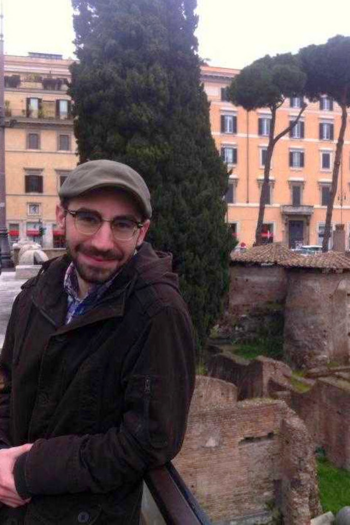
Through analysis of the plans of more than one hundred sites during his time abroad, he was able to trace concurrent developments in the organization of Greek and Etruscan sites, in terms of the coordination, alignment, and orthogonality of the buildings, streets, and blocks that comprise their plans. On this basis, he was able to develop an argument positing that grid planning is indeed the culmination of a series of organizational principles affecting urban plans, that grid planning only emerges under certain topographic conditions, and that the Greeks found settlements on sites meeting these conditions at an earlier date than the Etruscans. Thus, he finds that the Etruscans did not copy the grid plan from the Greeks; rather, they had the potential to implement it all along, they simply lacked for an opportunity to do so. This research serves as the basis for a history of grid planning in Classical antiquity and is complemented by case studies showing the weakening of the conditions sustaining grid planning during the Roman empire and the removal of these conditions in late antiquity.
Hero Image

All News button
1
Terms
Image

Aria Label
Read more about Simeon's GSGC experience
Featured Graduate Student Research: Rachel Midura
News Type
News
Date
Paragraphs
 Our featured graduate student this month is Rachel Midura, PhD candidate in the Department of History and fellow at the Center for Spatial and Textual Analysis. Anne's research for her dissertation focuses on the postal, political, and information networks of Northern Italy from 1550 to 1720. With the support of a research grant from The Europe Center, Rachel traveled to archives in Milan, Bergamo, and London in December and January of 2016-2017 to explore their collections of notarial documents and inter-postal agreements.
  1667. Pallavicino: Image from German translation of satirical epistolary novel ascribed to Ferrante Pallavicino.
Hero Image

All News button
1
Terms
Image

Link text
PHD CANDIDATE IN HISTORY
Aria Label
Read more about PHD CANDIDATE IN HISTORY Rachel Midura's GSGC experience (2017-2018)
Display Hero Image Wide (1320px)
No