International Relations

FSI researchers strive to understand how countries relate to one another, and what policies are needed to achieve global stability and prosperity. International relations experts focus on the challenging U.S.-Russian relationship, the alliance between the U.S. and Japan and the limitations of America’s counterinsurgency strategy in Afghanistan.

Foreign aid is also examined by scholars trying to understand whether money earmarked for health improvements reaches those who need it most. And FSI’s Walter H. Shorenstein Asia-Pacific Research Center has published on the need for strong South Korean leadership in dealing with its northern neighbor.

FSI researchers also look at the citizens who drive international relations, studying the effects of migration and how borders shape people’s lives. Meanwhile FSI students are very much involved in this area, working with the United Nations in Ethiopia to rethink refugee communities.

Trade is also a key component of international relations, with FSI approaching the topic from a slew of angles and states. The economy of trade is rife for study, with an APARC event on the implications of more open trade policies in Japan, and FSI researchers making sense of who would benefit from a free trade zone between the European Union and the United States.

Encina Hall
616 Serra Street
Stanford, CA  94305-6165

0
Visiting Student Researcher at The Europe Center, 2015-2016
massimo_mannino.jpg

Massimo Mannino is a Visiting Student Researcher from the University of St.Gallen, Switzerland, under the supervision of Michael Bechtel (University of St.Gallen) and Jens Hainmueller (Stanford University). His dissertation explores the political economy of natural disasters and is part of a project funded by the Swiss National Science Foundation.

Authors
News Type
News
Date
Paragraphs

The new European Security Initiative at Stanford will examine the long-term policy issues and trends in Europe's changing geopolitical landscape, especially given Russia's growing aggression in the region.


First, it was the 2014 annexation of Crimea. Then, it was the intervention in eastern Ukraine. Most recently, airstrikes and naval cruise missiles are hitting targets in Syria.

What, many are wondering, is Russian President Vladimir Putin up to?

Russia's spate of aggressive tactics has thrust Europe into a new era of uncertainty and has raised pertinent policy questions that Stanford scholars have set out to explore more deeply with the launch this fall of a new European Security Initiative (ESI).

The working group of a dozen senior faculty members – whose breadth of expertise in Russian and Eurasian affairs spans multiple administrations – portrays Russia's actions as constituting the greatest challenge to European security and stability since the end of the Cold War. At the same time, Russia's own unstable economy and political landscape complicate the matter; policy changes moving forward will be high-stakes decisions, as Russia and the West step into a period of sustained competition.

Stanford, with its heavyweight lineup, is poised to play a role. The European Security Initiative – formed by the Freeman Spogli Institute for International Studies (FSI), the Europe Center, the Hoover Institution and other university partners – will serve as the collaborative framework for the policy research.

"Policymakers in Washington have to react immediately to events in the world, making it difficult to develop longer-term strategies for dealing with ongoing challenges," said FSI's director, Michael McFaul. "At Stanford, we have the luxury of being able to think about longer trends and then recommend more enduring strategies to our colleagues in government.

"We also have deep expertise on Russia and Europe, which assigns us a special responsibility to tackle these new challenges to European security."

The initial group of Stanford faculty involved in the initiative includes: McFaul, former U.S. ambassador to Russia and a professor of political science; Condoleezza Rice, former U.S. secretary of state and a professor of political science; international studies Professor Coit Blacker, former special assistant to President Bill Clinton and director for Russian, Ukrainian and Eurasian Affairs on the National Security Council; David Holloway, professor of history and of political science, and one of the world's leading authorities on Russia's nuclear weapons program and defense policies; and Kathryn Stoner, an expert on Russia's governance and political economy and a senior fellow at FSI. 

Analyzing Russia's actions

One of the first objectives of the initiative is to understand the nature of the conflicts at hand and develop theories on Russia's domestic and international intentions.

For example, is Putin trying to re-establish Russian dominance over former Soviet states? Is he trying to distract internal constituencies from an array of domestic problems? Depending on the answers, the initiative's faculty members say the United States would have to pursue different policy options.

Working group discussions and a series of public events featuring key figures in U.S.-Russian and European policy will facilitate the Stanford-based dialogue and help broaden the academic discussion among students.

In September, for instance, ESI launched the new academic year with a talk at the Europe Center by Anders Fogh Rasmussen, who was at the center of European and global politics as the former secretary-general of NATO.

Other fall quarter ESI events, past and upcoming, include an Oct. 14 talk by Sergey Aleksashenko, a former deputy chairman of the Russian Central Bank; a Nov. 2 visit by Vladimir Milov, the former Russian deputy minister of energy; and a Nov. 9 visit by General Philip M. Breedlove, supreme allied commander, Europe. 

Students, scholarship

In addition, Stanford students are showing a growing interest in Putin's actions and the unfolding refugee crisis in Europe. Applications for new student fellowships on European issues in Brussels this past summer far outstripped the six spaces available. To capitalize on this renewed interest, the initiative will involve students through events, new fellowships and a new seminar.

The initiative aims to rebuild scholarship in an area of academic interest that waned as the Cold War ended.

"At the end of the Cold War, many thought that we no longer needed to study Russia. I myself even stopped teaching courses on Russia and Eastern Europe," McFaul said. "That was a mistake." He noted that Stanford is ideally positioned to seed a new generation of expertise on Russia and Europe.

FSI provided the startup money to create the initiative, but it will be looking for funds to sustain the program.


This article was originally published in The Stanford Report on October 28, 2015.

Hero Image
15803 europe news
All News button
1

Encina Hall

616 Serra St., C100

Stanford, CA 94305-6055

(650) 723-9732
0
sam_rebo_headshot.jpg

Sam Rebo is a Research and Project Assistant at FSI. He aids FSI Director Michael McFaul with background research for his upcoming book and facilitates FSI's new European Security Initiative.

Sam received his B.A. in International Relations with Honors in International Security from Stanford University. In the past, he has worked at the Moscow Carnegie Center, the French Institute of International Relations in Paris, and Global Integrity in Washington, D.C. His interests include Soccer and the Violin. He claims to make the best grilled cheese sandwich known to man.

Research Assistant and Project Coordinator
-


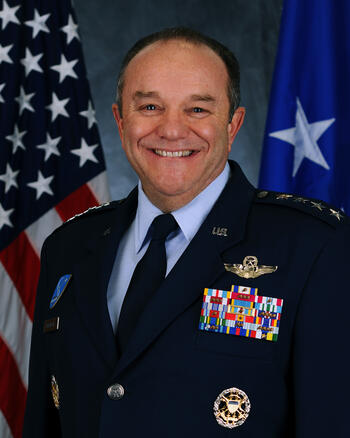
General Philip M. Breedlove will discuss the rapidly evolving geopolitical climate in Europe. Additionally, he will highlight many of the current and future security challenges which the United States and NATO must be prepared for.

Image
Photo of General Philip M. Breedlove


Gen. Breedlove is Commander, Supreme Allied Command, Europe, SHAPE, Belgium and Headquarters, U.S. European Command, Stuttgart, Germany.   

The General was raised in Forest Park, Ga., and was commissioned in 1977 as a distinguished graduate of Georgia Tech's ROTC program. He has been assigned to numerous operational, command and staff positions, and has completed nine overseas tours, including two remote tours. He has commanded a fighter squadron, an operations group, three fighter wings, and a numbered air force. Additionally, he has served as Vice Chief of Staff of the U.S. Air Force, Washington, D.C. Operations Officer in the Pacific Command Division on the Joint Staff; Executive Officer to the Commander of Headquarters Air Combat Command; the Senior Military Assistant to the Secretary of the Air Force; and Vice Director for Strategic Plans and Policy on the Joint Staff. 

Prior to assuming his current position, General Breedlove served as the Commander, U.S. Air Forces in Europe; Commander, U.S. Air Forces Africa; Commander, Air Component Command, Ramstein; and Director, Joint Air Power Competence Centre, Kalkar, Germany.  He was responsible for Air Forces activities, conducted through 3rd Air Force, in an area of operations covering more than 19 million square miles.  This area included 105 countries in Europe, Africa, Asia and the Middle East, and the Arctic and Atlantic oceans.  As Vice Chief, he presided over the Air Staff and served as a member of the Joint Chiefs of Staff Requirements Oversight Council and Deputy Advisory Working Group. He assisted the Chief of Staff with organizing, training, and equipping of 680,000 active-duty, Guard, Reserve and civilian forces serving in the United States and overseas. General Breedlove has flown combat missions in Operation Joint Forge/Joint Guardian. He is a command pilot with 3,500 flying hours, primarily in the F-16.

Koret Taube Conference Center (Room 130)
Gunn-SIEPR Building
366 Galvez Avenue


General Philip M. Breedlove Commander, Supreme Allied Command, Europe, SHAPE, Belgium and Headquarters, U.S. European Command, Stuttgart, Germany Speaker
Lectures
-

This event is now full.  Please contact khaley@stanford.edu if you would like to be added to the wait list.

Russian President Vladimir Putin is not the cipher he is sometimes thought to be. His early life, his career in intelligence, and his early service in the newly democratic St. Petersburg -- explain the policies now on display at home and increasingly abroad. Putin has evolved as the country has, becoming the most consequential leader of any country in the world. Although he is often portrayed as an enigma or as caricature, it is essential to understand the characteristics, events and goals that motivate him.  

Steven Lee Myers has worked at The New York Times for twenty-six years, seven of them in Russia during the period when Putin consolidated his power. He spent two years as bureau chief in Baghdad, covering the winding down of the American war in Iraq, and now covers national security issues. He lives in Washington, D.C.


Steven Lee Myers Diplomatic Correspondent, Washington Bureau, The New York Times
Lectures
-

**Reservations for this event is closed**  We are at capacity and cannot accept further reservations.


Twenty-four years ago the Soviet Union collapsed. Since then, Russia has been transformed in many dimensions but it is difficult to describe the country today.  According to its Constitution, Russia is a democratic republic and federation, but modern Russia looks more like an absolute monarchy. The Russian economy is dominated by state corporations, the oligarchs of the 90's, and the cronies of the 2000’s. The economy has been in recession for more than a year and hasn’t exhibited any signs of recovery. Is the country stable? Can it face its governance and economic challenges? Can we forecast the medium-term future of the Russian economy? Could the economy collapse?


Sergey Aleksashenko is a Senior Fellow at the Development Center (a Moscow-based think tank) and Nonresident Senior fellow at the Brookings Institution. Since graduating Moscow State University in 1986, he has been involved in academia, the public sector, and in business. From 1990-1991 he was appointed to the Commission on Economic reforms of the Government of the USSR as one of the "500 days" plan members. In 1993-1995 he worked as deputy Minister of Finance of Russia in charge of budgetary planning, macroeconomic, and tax policy. From 1995-1998 he was responsible for monetary policy as the first deputy Governor of the Central bank of Russia. From 2000 to 2004 he was the deputy CEO of the Interros Holding where he lead the strategy and business development teams. In 2006-2008 he was the Chairman and CEO of Merrill Lynch Russia, the largest financial institution in Moscow, where he greatly increased the bank's scope and presence. Before the financial crisis of 2008, he returned to academia and became the Director of Macroeconomic Research at the Higher School of Economics in Moscow. At the same time, he sat on the boards of Aeroflot, United Grain company, United Aircraft Corporation, and the National Reserve bank. At the end of 2012 he faced political persecution and in September 2013 he left Russia for Washington D.C. where he currently resides. 

Sergey Aleksashenko Former Deputy Chairman of the Russian Central Bank
Lectures
0
Visiting Scholar at The Europe Center, 2024
Professor of Global History, University of Vienna
Distinguished Visiting Austrian Chair Professor at The Europe Center, 2015-2016
martina_kaller_1.png

Martina Kaller is a philosopher and historian with a clear professional background in global history and a main focus on the Global South. She studied in Vienna, Berlin and at the Universidad Autónoma de México (UNAM). She earned her Ph.D in epistemology of history from University of Vienna and did her postdoctoral thesis in modern history there as well. Her main research focus is on global food history and global studies of food.

At University of Vienna she co-directs the EU funded Master Erasmus Mundus-program, called “Global Studies—A European Perspective.” A consortium conformed by global studies specialists from the London School of Economics (UK), the University of Leipzig (Germany), Roskilde University (Denmark), the Willy Brand Center at University of Wroclaw (Poland), and at University of Vienna, proved that a joint studies program with incoming students from whole over the world works and equally turned greatly attractive for European students.

Her teaching philosophy is guided by a firm belief in the freedom of inquiry, encouraging students to discover and rigorously research the questions that emerge from their own interests, while applying stringent methodological standards. She welcomes difference, dialogue and respect among diverse and divergent points of view. Her courses are characterized by mutual respect, a sense of responsibility and reliability.


Encina Hall
616 Serra Street
Stanford, CA  94305
 

0
Post-doctoral Fellow at The Europe Center, 2015-2016
p1020604.jpg

Sarah Cormack-Patton received her Ph.D. in Political Science from the University of Pittsburgh in August 2015. She is a political economist working at the nexus of comparative politics and international relations with a focus on European politics. Sarah is interested in how the cross-border movement of goods, capital, and people impacts the domestic policy-making process, and how domestic politics affect these cross-border flows. In her current research, Sarah examines these questions through the lens of international migration. Sarah's doctoral dissertation examined the ways in which varying bundles of migrant rights affect domestic preferences over immigration, the effect of these rights on the policy-making coalitions that form over immigration, and how these preferences aggregate in various institutional environments. In addition to her Ph.D., Sarah holds a BS in International Affairs and Modern Languages (French) and MS in International Affairs from the Georgia Institute of Technology and a MA in Political Science from the University of Pittsburgh.

 
News Type
News
Date
Paragraphs

The recent discovery of at least 50 dead migrants aboard a boat off the shores of Libya sparked a discussion on KQED Radio’s “forum with Michael Krasny" about the escalating crisis (Thurs., Aug. 27, 2015). Cécile Alduy, Stanford associate professor of French literature and affiliated faculty at The Europe Center was one of those asked to weigh in on Europe’s migration policy struggle.

Also joining the discussion was Gregory Maniatis, senior European Policy Fellow at the Migration Policy Institute and Tom Nuttall, Charlemagne columnist for The Economist.

Visit KQED Radio's Forum web article “More Migrants Found Dead as Hundreds of Thousands Flee to Europe” to download a recording of this interview.


Hero Image
Shutterstock photo of immigrants at the border between Greece and Macedonia.
Idomeni, Greece - August 19 , 2015: Hundreds of immigrants at the border between Greece and Macedonia.
Ververidis Vasilis / Shutterstock.com
All News button
1
Subscribe to International Relations