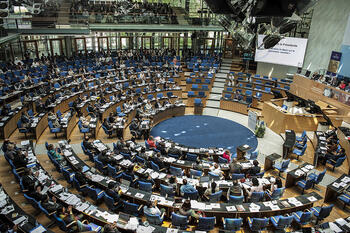
Special Event: The European Migration Crisis
Upcoming talk by Emily Arnold-Fernández, Founder and Executive Director, Asylum Access.
Discussants:
James Cavallaro, Professor of Law, Stanford Law School
Jenny S. Martinez, Professor of Law, Stanford Law School
"Human Rights and Refugees in Europe"
Date: January 22, 2016
Time: 12:00PM to 1:30PM
Location: Bechtel Conference Center, Encina Hall
RSVP by 5:00PM January 19, 2016.
 Working in conjunction with the WSD HANDA Center for Human Rights and International Justice, The Europe Center is pleased to announce a talk by Emily Arnold-Fernández, Founder and Executive Director of Asylum Access. During her visit to Stanford, Ms. Arnold-Fernández will discuss the rights of refugees and obligations of states under international law more generally before focusing on how European Union law affects these rights and obligations. Discussants James Cavallaro and Jenny S. Martinez, both of whom are professors of law at Stanford Law School, will further explore how international law has influenced the ways in which Europe and the larger international community has addressed the latest refugee crisis.
Emily Arnold-Fernández is a lawyer who has advocated nationally and internationally for the human rights of women, children, and other vulnerable individuals. She first became involved in refugee rights in 2002, when she represented refugees in United Nations proceedings in Cairo, Egypt. Recognizing that refugees throughout Africa, Asia, and Latin America were almost always unequipped to go into a legal proceeding in a foreign country, alone, and explain why they should not be deported, Ms. Arnold-Fernández founded Asylum Access in 2005 in order to advocate on behalf of refugees seeking to assert their rights. For her work with this underserved and vulnerable community, Ms. Arnold-Fernández has been honored by the Dalai Lama as one of 50 “Unsung Heroes of Compassion” from around the world (2009), Waldzell Institute’s Architects of the Future Award (2012), and Grinnell College Young Innovator for Social Justice Prize (2013). Ms. Arnold-Fernández holds a B.A. from Pomona College (1999) and a J.D. from Georgetown University Law Center (2004). We invite you to visit our website for additional information about this event.
Featured Faculty Research: Peter Koudijs
We would like to introduce you to some of The Europe Center's faculty affiliates. Our featured faculty member this month is Peter Koudijs, who is an Assistant Professor of Finance in the Graduate School of Business.
 Peter earned his Ph.D. in Economics, Finance, and Management from the Universitat Pompeu Fabra in Spain in 2011 and joined the faculty at Stanford University that same year. In his research, Peter uses historical evidence to shed light on the functioning of financial markets, focusing specifically on asset prices in the short and long run and on the role of bankruptcy protection on risk taking and investment. His recent article in theJournal of Political Economy examines the effect of private information on asset prices. While it is widely accepted that private information affects asset prices, the unobservable nature of private information obscures the dynamics of this relationship. The theoretical literature on this topic suggests that actors engaging in insider trading will strategically spread out trades over time. Specifically, because trading behavior provides information about asset value through changes in price, spreading out trades controls the flow of value information to the market and increases the actor's profits. In a novel empirical test of this relationship, Peter examines prices of English securities traded in London and Amsterdam in the 18th century. During this time, twice-weekly boats delivered information about these English assets from London to Amsterdam. While news typically arrived in Amsterdam three days after departing London, inclement weather and poor infrastructure frequently slowed travel, resulting in delays of varying lengths. If actors with private information were indeed engaging in the theorized strategic trading behavior, asset prices in Amsterdam would correlate with those in London even in the absence of new information and this behavior would vary as a function of expected ship arrivals. This is exactly what Peter finds. His paper contributes to the literature on financial markets by using a unique historical context to provide evidence of the role of private information and strategic investor behavior in shaping asset prices. In related work, forthcoming in the Journal of Finance, Peter uses this same historical setting to examine the importance of public information and liquidity shocks on asset price discovery. We invite you to visit our website for additional information about this research.
Publication Details: Koudijs, Peter. 2015. “Those Who Know Most: Insider Trading in Eighteenth-Century Amsterdam.” Journal of Political Economy 123(6):1356-1409.
Featured Graduate Student Research: Leonardo Barleta
We would like to introduce you to some of the students that we support and the projects on which they are working. Our featured student this month is Leonardo Barleta (History). Leonardo is a Ph.D. student in the Department of History at Stanford University.
 Leonardo is a historian who is interested in the emergence and historical development of peripheral regions of empire. His current research uses the case of the Portuguese empire to examine the mechanisms that European empires developed to administer their colonies in the Early Modern period. The European colonial powers created vast imperial structures designed to administer distant parts of their empires. Yet the communication technology of the time resulted in both leaders in the imperial capital and administrators in far-flung territories making decisions in the absence of complete information. Scholars have sought to understand the decision-making process of authorities under these conditions of inconsistent communication and unreliable information, and some have argued that this led decision-makers to be indifferent to local knowledge. In research at Lisbon's Arquivo Histórico Ultramarino, National Archive Torre do Tombo, and Biblioteca Nacional, partially supported by The Europe Center, Leonardo uncovered evidence to the contrary. His archival research suggests that local knowledge - transmitted to the imperial capital via letters from litigants seeking dispute settlements in distant parts of the empire or petitions to the king by mobile vassals - served as an important source of information for those administering faraway domains.
Leonardo is currently using the data retrieved from the archives to develop his dissertation prospectus, which examines the development of peripheral regions of the Portuguese empire. He expects to defend his prospectus before the end of the academic year and to return to the archives to continue collecting data for this project.
Upcoming Graduate Student Grant Competition: Accepting Applications March 28, 2016 - April 15, 2016
The Europe Center invites applications from graduate and professional students at Stanford University whose research or work focuses on Europe. Funds are available for Ph.D. candidates across a wide range of disciplines in the humanities and social sciences to prepare for dissertation research and to conduct research on approved dissertation projects. The Europe Center also supports early graduate students who wish to determine the feasibility of a dissertation topic or acquire training relevant for that topic. Additionally, funds are available for professional students whose interests focus on some aspect of European politics, economics, history, or culture; the latter may be used to support an internship or a research project. For more information please visit our website.
Call for Applications: The Europe Center Undergraduate Internship Program in Europe
Application Deadline: February 9, 2016
A key priority of The Europe Center is to provide Stanford’s undergraduate student community with opportunities to develop a deep understanding of contemporary European society and affairs. By promoting knowledge about the opportunities and challenges facing one of the world’s most economically and politically integrated regions, the Center strives to equip our future leaders with the tools necessary to tackle complex problems related to governance, geopolitics, and economic interdependence both in Europe and in the world more broadly.
In order to facilitate this goal, The Europe Center is sponsoring undergraduate internships to be completed in summer 2016. Sponsored internships are available with the following entities:
We invite applications from Stanford University undergraduate students interested in these exciting opportunities. For more information please visit our website.
Recap: Supreme Allied Commander Europe, General Philip M. Breedlove, Visits Stanford
 Europe is facing a dynamic and evolving geopolitical situation, with conflicts on two fronts. To the east, Russia seeks to expand both its territory and its power; to the south, the Syrian civil war continues to generate refugee flows into Europe. In his November visit to Stanford, General Philip M. Breedlove, Supreme Allied Commander Europe, spoke about these threats and discussed the central role of NATO in buttressing European security. General Breedlove drew attention to the nexus of these two security threats, positing that Russian involvement in Syria is intended to promote the image of Russia as a world power and to foster in the region regimes supportive of Russia. While Russia argues that its intervention in Syria is intended to promote global peace by helping to end the Syrian conflict, General Breedlove suggests that the sincerity of this claim is undermined by Russian intransigence over Georgia and Ukraine. Ultimately, he argued that maintaining security in the contemporary geopolitical context requires a continued commitment to NATO and the Transatlantic security apparatus. Following his presentation, General Breedlove engaged in a lively question and answer session with the audience, fielding questions on topics such as the ability of NATO member states to meet their 2 percent military spending commitment, how to engage with Russia without playing into the narrative that the west is surrounding them, and the prospects for Afghanistan. To watch General Breedlove's talk and the following question and answer period in full, please visit our website.
Distinguished Visiting Austrian Chair Professor at Stanford University: Herlinde Pauer-Studer
 The Europe Center is delighted to welcome Distinguished Visiting Austrian Chair Professor, Herlinde Pauer-Studer, to Stanford University. Dr. Pauer-Studer is a professor of philosophy at the University of Vienna and her research interests include ethics, political philosophy, and legal philosophy. She earned her Ph.D. in philosophy from the University of Salzburg. During her time at Stanford University, Dr. Pauer-Studer will be teaching in the Department of Philosophy and working on a book about the normative distortions in the National Socialist legal system, focusing on the period 1933-1939. Please join us in welcoming Dr. Pauer-Studer to The Europe Center and Stanford University.
The Europe Center Sponsored Events
January 22, 2016
12:00PM - 1:30PM
Emily Arnold-Fernández, Founder and Executive Director, Asylum Access
"Human Rights and Refugees in Europe"
Bechtel Conference Center, Encina Hall
RSVP by 5:00PM January 19, 2016.
This event is co-sponsored by The Europe Center and the WSD HANDA Center for Human Rights and International Justice.
February 8, 2016
11:30AM - 1:00PM
Didac Queralt, Institute of Political Economy and Governance (IPEG), Barcelona
Workshop Title TBD
Encina Hall West, Room 400 (Graham Stuart Lounge)
No RSVP required.
This seminar is part of the Comparative Politics Workshop in the Department of Political Science and is co-sponsored by The Europe Center.
February 11, 2016
12:00PM - 1:30PM
David Laitin, Department of Political Science
Book Launch: Why Muslim Integration Fails in Christian-Heritage Societies
CISAC Central Conference Center, Encina Hall
RSVP by 5:00PM February 8, 2016.
Save the Date: February 18-19, 2016
8:00AM - 5:00PM
Workshop: Heritage Bureaucracies: Theoretical and Practical Perspectives
Stanford Archaeology Center
This conference is co-sponsored by The Europe Center, Stanford Archaeology Center, Cantor Arts Center, Department of Anthropology, Center for Russian, East European & Eurasian Studies, Stanford Humanities Center, The Europe Center, France-Stanford Center for Interdisciplinary Studies, and The Mediterranean Studies Forum.
Please visit our website for more information.
March 28, 2016
12:00PM - 1:30PM
Adam Tooze, Columbia University
NATO Expansion and the Swap Lines: the Unspoken Geopolitics of the Financial Crisis in Europe, 2007-2013
Encina Hall East, Reuben Hills Conference Room
RSVP by 5:00PM March 24, 2016.
April 25, 2016
11:30AM - 1:00PM
Torben Iversen, Harvard University
Workshop Title TBD
Encina Hall West, Room 400 (Graham Stuart Lounge)
No RSVP required.
This seminar is part of the Comparative Politics Workshop in the Department of Political Science and is co-sponsored by The Europe Center.
Save the Date: April 28-29, 2016
9:00AM - 5:00PM
Conference: Networks of European Enlightenment
Levinthal Hall, Stanford Humanities Center
This conference is co-sponsored by The Europe Center, the French Cultural Workshop, the Stanford Humanities Center, and the Division of Literatures, Cultures, and Languages.
May 9, 2016
11:30AM - 1:00PM
Monica Martinez-Bravo, Centro de Estudios Monetarios y Financieros (CEMFI), Madrid
Workshop Title TBD
Encina Hall West, Room 400 (Graham Stuart Lounge)
No RSVP required.
This seminar is part of the Comparative Politics Workshop in the Department of Political Science and is co-sponsored by The Europe Center.
May 16, 2016
11:30AM - 1:00PM
Daniel Stegmueller, University of Mannheim
Workshop Title TBD
Encina Hall West, Room 400 (Graham Stuart Lounge)
No RSVP required.
This seminar is part of the Comparative Politics Workshop in the Department of Political Science and is co-sponsored by The Europe Center.
European Security Initiative Events
February 2, 2016
12:00PM - 1:30PM
Roger Cohen, New York Times
Talk Title TBD
Location TBD
RSVP by 5:00PM January 29, 2016.