Governance

FSI's research on the origins, character and consequences of government institutions spans continents and academic disciplines. The institute’s senior fellows and their colleagues across Stanford examine the principles of public administration and implementation. Their work focuses on how maternal health care is delivered in rural China, how public action can create wealth and eliminate poverty, and why U.S. immigration reform keeps stalling. 

FSI’s work includes comparative studies of how institutions help resolve policy and societal issues. Scholars aim to clearly define and make sense of the rule of law, examining how it is invoked and applied around the world. 

FSI researchers also investigate government services – trying to understand and measure how they work, whom they serve and how good they are. They assess energy services aimed at helping the poorest people around the world and explore public opinion on torture policies. The Children in Crisis project addresses how child health interventions interact with political reform. Specific research on governance, organizations and security capitalizes on FSI's longstanding interests and looks at how governance and organizational issues affect a nation’s ability to address security and international cooperation.

Encina Hall
Stanford University
Stanford, CA 94305

0
Visiting Professor, The Europe Center, International Policy Studies and the Stanford Law School
M.Karayanni_3x4.jpg J.S.D.

Michael Mousa Karayanni, is the Bruce W. Wayne Professor of International Law, Faculty of Law, Hebrew University of Jerusalem. His research interests include private international law and inter-religious law, multiculturalism and civil procedure. He is the author of Conflicts in a Conflict (forthcoming, OUP 2013). Professor Karayanni graduated from the University of Pennsylvania Law School (SJD, 2003) and Hebrew University of Jerusalem (LLD (Hons.), 2000). 

Encina Hall
Stanford University
Stanford, CA 94305

0
Visiting Researcher and Anna Lindh Fellow, The Europe Center
Tygesen.3x4.jpg

Christian is a PhD candidate from Copenhagen University, Department of Political Science. He received his B.Sc. and M.Sc. in Political Science from Copenhagen University in 2006 and 2010. From Feb. 2008 to Aug. 2009, Christian served at the Royal Danish Embassy in Washington D.C., USA. From 2004-2005, he chaired the Jacque Delor Community at the Department of Political Science, Copenhagen University.

Christian’s dissertation is focused on the contemporary development of Afghanistan’s civil-military relations and how this will shape the political progress of the country. He has conducted extensive field work in Afghanistan, while working in the Political Affairs section of the Royal Danish Embassy in Kabul in 2011 (Feb.-July) and 2012 (May-June).

Christian will work at The Europe Center as an Anna Lindh Fellow from Oct. 2012 to Jan. 2013. During this period, his principal aim is to complete drafts of his two main analysis chapters and submit and publish two articles on state-building and civil-military relations, and measuring progress in counterinsurgency warfare.

News Type
Q&As
Date
Paragraphs

President Obama and Mitt Romney meet for their third debate to discuss foreign policy on Monday, when moderator Bob Schieffer is sure to ask them about last month's terrorist attack in Libya and the nuclear capabilities of Iran.

In anticipation of the final match between the presidential candidates, researchers from five centers at Stanford’s Freeman Spogli Institute for International Studies ask the additional questions they want answered and explain what voters should keep in mind.


What can we learn from the Arab Spring about how to balance our values and our interests when people in authoritarian regimes rise up to demand freedom?  

What to listen for: First, the candidates should address whether they believe the U.S. has a moral obligation to support other peoples’ aspirations for freedom and democracy. Second, they need to say how we should respond when longtime allies like Egypt’s Hosni Mubarak confront movements for democratic change.

And that leads to more specific questions pertaining to Arab states that the candidates need to answer: What price have we paid in terms of our moral standing in the region by tacitly accepting the savage repression by the monarchy in Bahrain of that country's movement for democracy and human rights?  How much would they risk in terms of our strategic relationship with Bahrain and Saudi Arabia by denouncing and seeking to restrain this repression? What human rights and humanitarian obligations do we have in the Syrian crisis?  And do we have a national interest in taking more concrete steps to assist the Syrian resistance?  On the other hand, how can we assist the resistance in a way that does not empower Islamist extremists or draw us into another regional war?  

Look for how the candidates will wrestle with difficult trade-offs, and whether either will rise above the partisan debate to recognize the enduring bipartisan commitment in the Congress to supporting democratic development abroad.  And watch for some sign of where they stand on the spectrum between “idealism” and “realism” in American foreign policy.  Will they see that pressing Arab states to move in the direction of democracy, and supporting other efforts around the world to build and sustain democracy, is positioning the United States on “the right side of history”?

~Larry Diamond, director of the Center on Democracy, Development, and the Rule of Law


What do you consider to be the greatest threats our country faces, and how would you address them in an environment of profound partisan divisions and tightly constrained budgets? 

What to listen for: History teaches that some of the most effective presidential administrations understand America's external challenges but also recognize the interdependence between America's place in the world and its domestic situation.

Accordingly, Americans should expect their president to be deeply knowledgeable about the United States and its larger global context, but also possessed of the vision and determination to build the country's domestic strength.

The president should understand the threats posed by nuclear proliferation and terrorist organizations. The president should be ready to lead in managing the complex risks Americans face from potential pandemics, global warming, possible cyber attacks on a vulnerable infrastructure, and failing states.

Just as important, the president needs to be capable of leading an often-polarized legislative process and effectively addressing fiscal challenges such as the looming sequestration of budgets for the Department of Defense and other key agencies. The president needs to recognize that America's place in the world is at risk when the vast bulk of middle class students are performing at levels comparable to students in Estonia, Latvia and Bulgaria, and needs to be capable of engaging American citizens fully in addressing these shared domestic and international challenges.

~Mariano-Florentino Cuéllar, co-director of the Center for International Security and Cooperation


Should our government help American farmers cope with climate impacts on food production, and should this assistance be extended to other countries – particularly poor countries – whose food production is also threatened by climate variability and climate change?

What to listen for: Most representatives in Congress would like to eliminate government handouts, and many would also like to turn away from any discussion of climate change. Yet this year, U.S. taxpayers are set to pay up to $20 billion to farmers for crop insurance after extreme drought and heat conditions damaged yields in the Midwest.

With the 2012 farm bill stalled in Congress, the candidates need to be clear about whether they support government subsidized crop insurance for American farmers. They should also articulate their views on climate threats to food production in the U.S. and abroad.

Without a substantial crop insurance program, American farmers will face serious risks of income losses and loan defaults. And without foreign assistance for climate adaptation, the number of people going hungry could well exceed 15 percent of the world's population. 

~Rosamond L. Naylor, director of the Center on Food Security and the Environment


What is your vision for the United States’ future relationship with Europe? 

What to listen for: Between the end of World War II and the end of the Cold War, it was the United States and Europe that ensured world peace. But in recent years, it seems that “Europe” and “European” have become pejoratives in American political discourse. There’s been an uneasiness over whether we’re still friends and whether we still need each other. But of course we do.

Europe and the European Union share with the United States of America the most fundamental values, such as individual freedom, freedom of speech, freedom to live and work where you choose. There’s a shared respect of basic human rights. There are big differences with the Chinese, and big differences with the Russians. When you look around, it’s really the U.S. and Europe together with robust democracies such as Canada and Australia that have the strongest sense of shared values.

So the candidates should talk about what they would do as president to make sure those values are preserved and protected and how they would make the cooperation between the U.S. and Europe more effective and substantive as the world is confronting so many challenges like international terrorism, cyber security threats, human rights abuses, underdevelopment and bad governance.

~Amir Eshel, director of The Europe Center


Historical and territorial issues are bedeviling relations in East Asia, particularly among Japan, China, South Korea, and Southeast Asian countries. What should the United States do to try to reduce tensions and resolve these issues?

What to listen for: Far from easing as time passes, unresolved historical, territorial, and maritime issues in East Asia have worsened over the past few years. There have been naval clashes, major demonstrations, assaults on individuals, economic boycotts, and harsh diplomatic exchanges. If the present trend continues, military clashes – possibly involving American allies – are possible.

All of the issues are rooted in history. Many stem from Imperial Japan’s aggression a century ago, and some derive from China’s more assertive behavior toward its neighbors as it continues its dramatic economic and military growth. But almost all of problems are related in some way or another to decisions that the United States took—or did not take—in its leadership of the postwar settlement with Japan.

The United States’ response to the worsening situation so far has been to declare a strategic “rebalancing” toward East Asia, aimed largely at maintaining its military presence in the region during a time of increasing fiscal constraint at home. Meanwhile, the historic roots of the controversies go unaddressed.

The United States should no longer assume that the regional tensions will ease by themselves and rely on its military presence to manage the situation. It should conduct a major policy review, aimed at using its influence creatively and to the maximum to resolve the historical issues that threaten peace in the present day.

~David Straub, associate director of the Korea Studies Program at the Walter H. Shorentein Asia-Pacific Research Center


Compiled by Adam Gorlick.

Hero Image
debatepic
President Obama and Mitt Romney speak during the second presidential debate on Oct. 16, 2012. Their third and final debate will focus on foreign policy.
Reuters
All News button
1
-

Could you ever forgive the people who slaughtered your family? In 1994, hundreds of thousands of Rwandan Hutus were incited to wipe out the countrys Tutsi minority. From the crowded capital to the smallest village, local patrols massacred lifelong friends and family members, most often with machetes and improvised weapons. Announced in 2001, and ending this year, the government put in place the Gacaca Tribunals open-air hearings with citizen-judges meant to try their neighbors and rebuild the nation. As part of this experiment in reconciliation, confessed genocide killers are sent home from prison, while traumatized survivors are asked to forgive them and resume living side-by-side. Filming for close to a decade in a tiny hamlet, award-winning filmmaker Anne Aghion has charted the impact of Gacaca on survivors and perpetrators alike. Through their fear and anger, accusations and defenses, blurry truths, inconsolable sadness, and hope for life renewed, she captures the emotional journey to coexistence. (Synopsis courtesy of iMDb)


Anne Aghion, the film's writer and director, will introduce the film to the audience.  This screening is the opening event of the 2 day conference, "Stanford Interdisciplinary Conference on Conscience" (11/8/12-11/9/12), of which Ms. Aghion will also be the keynote speaker.

Oksenberg Conference Room

Anne Aghion Film maker and writer Speaker
Conferences
Paragraphs

The debt crisis is clear: Smaller areas can be managed better than large nations. Therefore they should be autonomous - under the umbrella of the European Union.

All Publications button
1
Publication Type
Commentary
Publication Date
Journal Publisher
Financial Times Germany
Authors
Authors
Roland Hsu
News Type
News
Date
Paragraphs

In the midst of the “Arab Spring”, and President Obama’s push for Palestinian-Israeli peace, The Europe Center (TEC) and the Van Leer Jerusalem Institute hosted a May 18-19 conference on “Democracy in Adversity and Diversity” in Jerusalem, the first of a sequence of conferences in TEC’s collaborative project on Reconciliation.

The conference gathered leading analysts of democratization and civil conflict, including FSI’s Francis Fukuyama, Stephen D. Krasner, and Kathryn Stoner.  During two days of conference sessions, scholars and analysts from Europe, the United States, and the Middle East compared historical and contemporary cross-border and civil society cleavages with the goal to promote informed policy.

Co-organizers Kathryn Stoner-Weiss (FSI) and Michael Karayanni (The Hebrew University) convened colleagues to address policy challenges including:

  • What has been and what should be democracy?
  • How do we translate democratic theory into practical governance?
  • How do we manage diversity in contemporary democracies?
  • What is the relationship between democracy and development?
  • How do we anticipate and respond to transitions and movements towards democracy?

Experts in liberal, secular, and fundamentalist political thought in Arab, Palestinian, Christian, Jewish, and Muslim policies proposed answers and areas for further study.  Insights included the following:

  • European and Israeli voters are increasingly electing far right nationalists, while Arab populations are calling for democracy. 
  • The deepest rifts are not between but within societies.  In Europe, Israel, and in the Hamas-Fatah Palestinian National Authority, far-right populist, ultra-orthodox, and fundamentalist parties appeal to anti-democratic world-views.  The result is hardening rhetoric that damages civil society and overwhelms the capacity for reasoned debate and resolution. Leaders compete with the minority far-right and in so doing compete for the narrow populist constituency rather than focusing on the greater interest of society.

Next steps include publications, scholar exchange, and a second international conference, “History and Memory: Global and Local Dimensions” (Stanford 2012), which aims to examine the interplay between history and memory, and how to overcome foundational narratives without requiring amnesia.

All News button
1
-

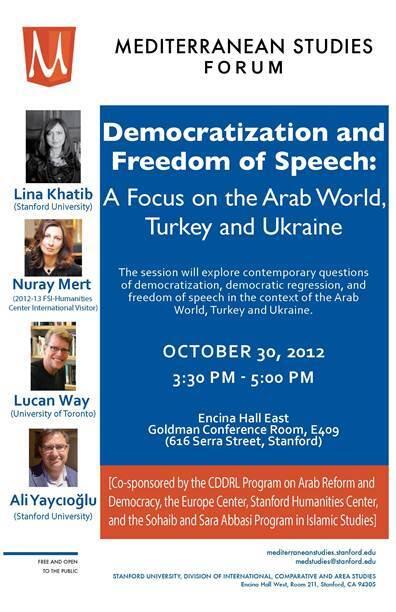
Co-sponsored by CDDRL Program on Arab Reform and Democracy, the Europe Center, Stanford Humanities Center, and the Abbasi Program in Islamic Studies

More info: http://www.stanford.edu/group/mediterranean/cgi-bin/web/2012/08/democratization-and-freedom-of-speech-a-focus-on-turkey-arab-world-and-ukraine/

Image

Richard and Rhoda Goldman Conference Room

Nuray Mert FSI-Humanities Center International Visitor Panelist
Lina Khatib Program Manager for the Program on Arab Reform and Democracy Panelist CDDRL
Lucan Way Associate Professor of Political Science Panelist University of Toronto
Ali Yaycioğlu Assistant Professor of Middle East History Moderator Stanford
Panel Discussions
-

Co-sponsored by the Abbasi Program on Islamic Studies, CDDRL Program on Arab Reform and Democracy, the Europe Center, Stanford Humanities Center, the Mediterranean Studies Forum, and the Center for Russian, East European and Eurasian Studies.

Reuben W. Hills Conference Room

Nuray Mert 2012-13 FSI-Humanities International Visitor Speaker
Lina Khatib Speaker
Lucan Way Speaker
Ali Yaycioğlu Speaker
Panel Discussions
Subscribe to Governance