Special Event: The European Security Initiative
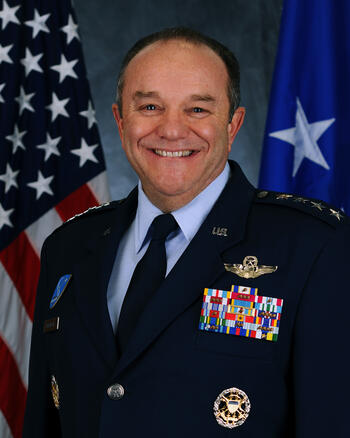
Upcoming talk by Supreme Allied Commander Europe, General Philip M. Breedlove.
"Europe at the Crossroads"
Date: November 9, 2015
Time: 12:00PM to 1:30PM
Location: Koret Taube Conference Center, Room 130
RSVP by 5:00PM November 5, 2015.
General Philip M. Breedlove is a four-star general in the United States Air Force and the current Supreme Allied Commander Europe (SACEUR). In this position, General Breedlove is one of NATO's two strategic commanders and is the head of Allied Command Operations (ACO). General Breedlove became the Supreme Allied Commander, Europe on 13 May 2013. During his visit to Stanford, General Breedlove will discuss Europe's rapidly-evolving geopolitical climate and highlight many of the security challenges for which the United States and NATO must prepare.
General Breedlove has served in the United States Air Force since graduating from the Georgia Institute of Technology in 1977. Immediately prior to assuming his current position, General Breedlove served as Commander, U.S. Air Forces in Europe; Commander, U.S. Air Forces Africa; Commander Headquarters Allied Air Command, Ramstein; and Director, Joint Air Power Competence Centre, Kalkar Germany. We invite you to visit ourwebsite for additional information about this event.
Featured Faculty Research: Jens Hainmueller
We would like to introduce you to some of the faculty members that we support and the projects on which they are working. Our featured faculty member this month is Jens Hainmueller, who is an Associate Professor in the Department of Political Science.

Jens earned his Ph.D. in Government from Harvard University in 2009 and joined the faculty at Stanford University in 2014. His research interests include statistical methods, immigration, political economy, and political behavior. An example of Jens's research on immigration and migrant integration is his recent co-authored work with Dominik Hangertner at the London School of Economics and Giuseppe Pietrantuono at the University of Zurich, which examined the effect of naturalization on migrant political integration into the host society. Establishing the effects of naturalization on political integration is complicated by an unobservable selection process; a non-random sample of migrants chooses to apply for naturalization and a non-random sample of naturalization applicants is approved. As a result, previous work has neither been able to establish the direction of the relationship between naturalization and poitical integration nor isolate the effect of naturalization on political integration vis-à-vis alternatives. In order to limit the bias induced by this dual-selection process, Jens and his coauthors analyzed data from Switzerland, where some municipalities used referendums to make decisions on naturalization applications. By limiting the sample to those applications that were approved or rejected by only a few votes, the authors were able to establish treatment and control groups that were otherwise equivalent, thereby removing selection bias from their data. Using this unbiased sample, Jens and his coauthors found that naturalization indeed has a positive effect on migrant political integration by increasing political participation, political knowledge, and political efficacy, among others. This research was published in the Proceedings of the National Academy of Sciences. We invite you to visit our website for additional information about this research.
Publication Details: Hainmueller, Jens, Dominik Hangartner, and Guiseppe Pietrantuono. 2015. "Naturalization Fosters the Long-Term Political Integration of Immigrants." Proceedings of the National Academy of Sciences of the United States of America 112(41):12,651-12,656.
Featured Graduate Student Research: Jason Weinreb
We would like to introduce you to some of the students that we support and the projects on which they are working. Our featured student this month is Jason Weinreb (Political Science). Jason is a Ph.D. Candidate in the Department of Political Science at Stanford University.
 Jason is a political economist who is interested in political risk, the politics of public finance, and economic history. His dissertation examines how newly-independent states finance themselves, focusing on former British colonies. Analysis of the London Stock Exchange in the quarter century following World War II reveals a surprising trend: colonial debt bond prices remained remarkably stable throughout decolonization. In his research at the British National Archives in London, funded in part by The Europe Center, Jason found that price stability was an insufficient indicator of investor confidence. Far from reflecting investors unperturbed by the uncertainty of decolonization, Jason's research uncovers evidence that investors were indeed concerned about the effects of independence on their investment. In fact, investor concerns manifested in higher interest rates, fewer colonial debt bond issues, and lower subscription rates relative to earlier periods. His archival research further uncovers factors that explain why colonial debt bond prices fail to reflect investor sentiment. Chief among these was the British government's intervention in the market. Its strategic purchase and holding of colonial debt bonds ensured price stability despite investor concerns.
Featured Event: Taking the Stand - A Film Presentation and Q&A with Survivors of the Holocaust
 Pictured: Renée Firestone, Hermine Liska, and Bernhard Rammerstorfer
By: Christof Brandtner and Sebastian Schuster
This year we commemorate the 70th anniversary of the liberation of Auschwitz. At the same time, the number of people who can give us a personal account of the cruelties of the Holocaust is dwindling. Together with students from the Stanford Austria Club, The Europe Center hosted two survivors of the Holocaust and witnesses of the Nazi era: Renée Firestone (born in 1924 in today's Ukraine) and Hermine Liska (born 1930 in Austria). Firestone and Liska were introduced by TEC affiliated faculty Prof. Amir Eshel, interviewed by Austrian documentarian Bernhard Rammerstorfer, and answered engaging questions from students and community members in the audience. In their accounts, Firestone and Liska reported on the years leading up to their persecution, highlighted the importance of religion and family for their survival, and pointed out connections between the diaspora of the 1930s and 1940s and the current global refugee crisis. Rammerstorfer also presented his newest film and book project ‘Taking the stand: We have more to say’ which condenses the experience and memories of nine Holocaust survivors in response to 100 questions from high school students around the world.
Recap: Former NATO Secretary General Anders Fogh Rasmussen Visits Stanford
 In his recent visit to Stanford University, former NATO Secretary General Anders Fogh Rasmussen painted a bleak picture of global politics. The hope of the Arab Spring has been replaced by new authoritarian regimes, civil war, and ISIS. Russia is becoming more internally authoritarian and externally aggressive. According to one measure, global levels of freedom have been in decline for the past nine consecutive years. "It looks", he said, "as if a Pandora's box of religious, ethnic, and political strife has been opened, and many nations have plunged into chaos and extremism." According to Rasmussen, successfully navigating these global challenges requires a concerted effort among liberal democratic states, spearheaded by American leadership. In order to create a strong global community of liberal democracies, he advocated strengthening the Transatlantic alliance. In addition to the existing military alliance forged through NATO, he proposed the creation of a Transatlantic Free Trade Area (TAFTA) and a Transatlantic peoples program, which would foster educational, scientific, and cultural exchanges among the partner states. More than 150 people attended the talk, which was held on September 25. To watch Rasmussen's talk in full, please visit our website.
Fall 2015 Graduate Student Grant Competition Winners Announced
Please join us in congratulating the winners of The Europe Center Fall 2015 Graduate Student Grant Competition:
- Elena Dancu, Comparative Literature, "From Vienna to Rio de Janeiro: Stefan Zweig and a World in Ruins."
- Mathilde Emeriau, Political Science, "Discrimination and Integration of Asylum Seekers in France."
- William Parmer, Philosophy, "The Art of Cruelty."
- Rebecca Perlman, Political Science, "The Politics of Protection: Health and Safety Regulation in a Globalized Marketplace."
- Nicola Pierri, Economics, "Credit Constraints and Firms' Productivity: Evidence from the Italian Economy."
- Jens Pohlmann, German Studies, "Capitalizing on the Avant-Garde? An Analysis of Adversarial Authors’ Marketing Strategies in the Second Half of the 20th Century."
- Beata Szymkow, History, "Nationalisms Interacting, L'viv 1890-1914."
- Alice Underwood, Comparative Literature, "The Comrade's Deviant Body: Myth, Citizenship, and Socialist Decay in the Pre-Perestroika Soviet Union."
- Ashley Walters, History, "The Evolution of a Modern Jewish Legal Defense Against Anti-Semitism in Late Imperial Russia ."
- Jason Weinreb, Political Science, "Decolonization's Money Doctor: The Bank of England and Commonwealth Central Banks, 1955 - 1970."
- Seth Werfel, Political Science, "Representation as Intermediation."
- Duygu Yildirim, History, "Historicizing Nature: Approaches to The Natural History of Crete in the Eastern Mediterranean."
Please visit our
website for more information about our Graduate Student Grant program.
The Europe Center Sponsored Events
November 5, 2015
6:30PM - 9:30PM
Romanian Film Festival (Stanford, Day 1)
"Travelling Shorts:Families Beyond Boundaries"
East Asia Library, Room 224, Lathrop Library Building
Please visit our website for additional information.
November 8, 2015
1:00PM - 8:45PM
Romanian Film Festival (Stanford, Day 2)
"Travelling Shorts:Families Beyond Boundaries"
Cubberley Auditorium
Please visit our website for additional information.
November 9, 2015
12:00PM - 1:15PM Mart Kuldkepp, Scandinavian Studies, University College London
"Russian deserters to Sweden in World War I"
Reuben Hills Conference Room, Encina Hall East
Open to Stanford affiliates only.
RSVP requested
This seminar is organized by the Center for Russian, Eastern European and Eurasian Studies and co-sponsored by The Europe Center.
European Security Initiative Events
November 9, 2015
12:00PM - 1:30PM
General Philip M. Breedlove, Supreme Allied Commander Europe and Commander, US European Command, NATO
"Europe at the Crossroads"
Koret-Taube Conference Center, Room 130, Gunn-SIERP Building
RSVP by 5:00PM November 5, 2015.
November 10, 2015
5:30PM - 7:00PM
Lilia Shevtsova, Non-Resident Fellow, Brookings Institution and Associate Fellow Russia-Eurasia Program, Chatham House - The Royal Institute of International Affairs
"Russia as a Global Challenge"
Bechtel Conference Center, Encina Hall
RSVP requested
Save the Date: January 5, 2016
Sergei Guriev, Professor of Economics, New Economic School, Moscow and Visiting Professor of Economics, Sciences Po, Paris
Other Campus Events of Interest
November 16, 2015
6:30PM - 8:15PM
"In the Crosswinds" (2014) Film Screening
Cubberley Auditorium, Cubberley Education Library
RSVP requested
For more information, please visit the event website.
We welcome you to visit our website for additional details.

 FSI researchers work to understand continuity and change in societies as they confront their problems and opportunities. This includes the implications of