History
-

Professor Marci Shore will discuss her project that focuses on Husserl's phenomenology, and later Heidegger's (and Sartre's) existentialism as these philosophical currents took shape in Eastern Europe, primarily but not only Czechoslovakia and Poland.  The project is structured around philosophical personalities, exploring their encounters and their dialogues and relationships with one another.  It's also a project about how the stakes of the questions they pose change, how epistemological questions become ontological questions and later explicitly ethical questions.

Marci Shore is associate professor of history at Yale University.  She is the translator of Michał Głowiński's The Black Seasons and the author of Caviar and Ashes: A Warsaw Generation's Life and Death in Marxism, 1918-1968.  Currently she is at work on a book project titled “Phenomenological Encounters: Scenes from Central Europe,” an examination of the history of phenomenology and existentialism in East-Central Europe.

Co-sponsored by the Center for Russian, East European, and Eurasian Studies, Department of History, and the Division of Literatures, Cultures, and Languages

Building 200 (History Corner)
Room 307

Marci Shore Associate Professor of History Speaker Yale University
Seminars
-

* NOTE:  The venue has been changed to the Barnes/McDowell Rooms at the Fisher Conference Center in the Arrillaga Alumni Center.

Professor Marci Shore will be speaking on the topic of her recent book, The Taste of Ashes: The Afterlife of Totalitarianism in Easten Europe.  The collapse of communism opened the archives, illuminating the tragedy of twentieth-century Eastern Europe: there were moments in which no decisions were innocent, in which all possible choices caused suffering.  The Taste of Ashes is an account of the darker side of the revolutions of 1989, when the ghost of communism--no longer Marx’s “specter to come"--became a haunting presence of the past.

Marci Shore is associate professor of history at Yale University.  She is the translator of Michał Głowiński's The Black Seasons and the author of Caviar and Ashes: A Warsaw Generation's Life and Death in Marxism, 1918-1968.  Currently she is at work on a book project titled “Phenomenological Encounters: Scenes from Central Europe,” an examination of the history of phenomenology and existentialism in East-Central Europe.


Co-sponsored by the Center for Russian, East European and Eurasian Studies, Taube Center for Jewish Studies and the Department of History.

NOTE NEW VENUE:
The Barnes/McDowell Rooms
Fisher Conference Center
Arrillaga Alumni Center

Marci Shore Associate Professor of History Speaker Yale University
Seminars
-

“In the fields with which we are concerned, knowledge [Erkenntnis] comes only in lightning flashes. The text is the long roll of thunder that follows,” This sentence from his Arcades-project belongs to the most fluently cited passages of Benjamin’s work. However, in contrast to many reading the lecture argues that this has not to be understood as a metaphor. Instead lightening flash and image function as words mutually replacing each other in order to describe a mode of sudden, simultaneous recognition / knowledge that is at the centre of his image-based epistemology.

This lecture argues that this epistemology is informed by (1) an intense study of paintings and other pieces of visual arts and (2) the engagement with the development of media technology in modernity. Whereas the younger Benjamin studied the perceptive mode of visual art as a site of afterlife of an epiphanic mode of insight he later, in the context of his project on modernity, turned this mode of knowledge, due to the invention of electricity and technical media, into a modern epistemology. Through a kind of breaking in of technique into iconography many of its conventional figures were turned into epistemological constellations. In this way Benjamin developed a theory of knowledge and history based in simultaneity.

Co-sponsored by the Department of German Studies, Department of Comparative Literature,  Stanford Humanities Center, Division of Literatures, Cultures, and Languages, Department of English, Program in Modern Thought and Literature, and the Interdisciplinary Working Group in Critical Theory.

Levinthal Hall

Sigrid Weigel Director Speaker the Center for Literary and Cultural Research in Berlin (ZfL)

121 Pigott Hall
Stanford University
Stanford, CA 94305

(650) 723-4204
0
Senior Fellow, by courtesy, at the Freeman Spogli Institute for International Studies
Rosina Pierotti Professor of Italian Literature
Professor of French and Italian
download.png PhD

Professor Harrison received his doctorate in Romance Studies from Cornell University in 1984, with a dissertation on Dante's Vita Nuova. In 1985 he accepted a visiting assistant professorship in the Department of French and Italian at Stanford. In 1986 he joined the faculty as an assistant professor. He was granted tenure in 1992 and was promoted to full professor in 1995. In 1997 Stanford offered him the Rosina Pierotti Chair. In 2002, he was named chair of the Department of French and Italian. In 2014 he was knighted "Chevalier" by the French Republic.  He is a member of the American Academy of Arts & Sciences, and lead guitarist for the cerebral rock band Glass Wave.

Professor Harrison's first book, The Body of Beatrice, was published by Johns Hopkins University Press in 1988. It deals with medieval Italian lyric poetry, with special emphasis on Dante's early work La Vita NuovaThe Body of Beatrice was translated into Japanese in 1994. Over the next few years Professor Harrison worked on his next book, Forests: The Shadow of Civilization, which appeared in 1992 with University of Chicago Press. This book deals with the ways in which the Western imagination has symbolized, represented, and conceived of forests, primarily in literature, religion, and mythology. It offers a select history that begins in antiquity and ends in our own time. Forests appeared simultaneously in English, French, Italian, and German. It subsequently appeared in Japanese and Korean as well. In 1994 his book Rome, la Pluie: A Quoi Bon Littérature? appeared in France, Italy, and Germany. This book is written in the form of dialogues between two characters and deals with topics such as art restoration, the vocation of literature, and the place of the dead in contemporary society.

Professor Harrison's next book, The Dominion of the Dead, published in 2003 by University of Chicago Press, examines the relations the living maintain with the dead in diverse secular realms. This book was translated into German, French and Italian. Professor Harrison's book Gardens: An Essay on the Human Condition appeared in 2008 with the University of Chicago Press, in French with Le Pommier, and in Italian with Fazi Editori , and in German with Hanser Verlag (it subsequently appeared in Chinese translation). His most recent book Juvenescence: A Cultural History of Our Age came out in 2014 with Chicago University Press.  In 2005 Harrison started a literary talk show on KZSU radio called "Entitled Opinions."  The show features hour long conversations with a variety of scholars, writers, and scientists.  Robert Harrison is also the Director of Another Look, a Stanford-based book club.

Affiliated faculty at The Europe Center
Robert Harrison Professor of Italian and Rosina Pierotti Professor in Italian Literature Commentator
Conferences
Paragraphs

This is a magisterial new account of the day-to-day practice of Russian criminal justice in the seventeenth and early eighteenth centuries. Nancy Kollmann contrasts Russian written law with its pragmatic application by local judges, arguing that this combination of formal law and legal institutions with informal, flexible practice contributed to the country's social and political stability. She also places Russian developments in the broader context of early modern European state-building strategies of governance and legal practice. She compares Russia's rituals of execution to the 'spectacles of suffering' of contemporary European capital punishment and uncovers the dramatic ways in which even the tsar himself, complying with Moscow's ideologies of legitimacy, bent to the moral economy of the crowd in moments of uprising. Throughout, the book assesses how criminal legal practice used violence strategically, administering horrific punishments in some cases and in others accommodating with local communities and popular concepts of justice.

All Publications button
1
Publication Type
Books
Publication Date
Journal Publisher
Cambridge University Press
Authors
Nancy Kollmann
Number
978-1107025134
-

Although Czechoslovak politicians in exile frequently proclaimed towards the end of the Second World War an ambition for their country to mediate between the U.S.S.R. and the Western powers, their deeds and utterances, imprinted in Soviet, Czech and other archival materials, testify to something else.  With their faith in the West fatally shaken by Munich 1938, which was only amplified by the U.S. failure to liberate Prague in May 1945, they relied on a Soviet security guarantee against any further German aggression and on Stalin's promises of non-interference in internal Czechoslovak affairs. However, numerous concessions to the Soviet wishes and a growing domestic power of the Czechoslovak Communists undermined this cardboard castle that in the atmosphere of the growing East-West confrontation finally collapsed in February 1948.

Co-sponsored by the Center for Russian, East European, and Eurasian Studies (CREEES) and the Department of History

Building 200 (History Corner),
Room 307

Encina Hall
616 Serra Street, C205-4
Stanford, CA 94305

0
Visiting Scholar, The Europe Center
Smetana_3x4_Fotka.jpg

Vit Smetana is a senior research fellow at the Institute of Contemporary History – Academy of Sciences of the Czech Republic, and also teaches modern international history at the Faculty of Social Sciences, Charles University in Prague.  His professional interest lies primarily in the policies of the great powers towards Czechoslovakia and Central Europe in the late 1930s and throughout the 1940s. His research during his stay at Stanford focuses on the topic “The Czech, Slovak and other Central European exiles in the Second World War and beyond”.

Dr. Smetana is the author of In the Shadow of Munich. British Policy towards Czechoslovakia from the Endorsement to the Renunciation of the Munich Agreement (1938-1942) (2008) and co-author of Draze zaplacená svoboda. Osvobození Československa 1944-45  (Dearly Paid Freedom. The Liberation of Czechoslovakia 1944-45) in two volumes (2009).  He also edited  the Czech version of the Robert F. Kennedy memoir of the Cuban Missle Crisis, Thirteen Days (1999).

Vit Smetana Senior Research Fellow at the Institute of Contemporary History – Academy of Sciences of the Czech Republic, and Visiting Scholar at The Europe Center Speaker
Seminars
Authors
Roland Hsu
News Type
News
Date
Paragraphs

In the midst of the “Arab Spring”, and President Obama’s push for Palestinian-Israeli peace, The Europe Center (TEC) and the Van Leer Jerusalem Institute hosted a May 18-19 conference on “Democracy in Adversity and Diversity” in Jerusalem, the first of a sequence of conferences in TEC’s collaborative project on Reconciliation.

The conference gathered leading analysts of democratization and civil conflict, including FSI’s Francis Fukuyama, Stephen D. Krasner, and Kathryn Stoner.  During two days of conference sessions, scholars and analysts from Europe, the United States, and the Middle East compared historical and contemporary cross-border and civil society cleavages with the goal to promote informed policy.

Co-organizers Kathryn Stoner-Weiss (FSI) and Michael Karayanni (The Hebrew University) convened colleagues to address policy challenges including:

  • What has been and what should be democracy?
  • How do we translate democratic theory into practical governance?
  • How do we manage diversity in contemporary democracies?
  • What is the relationship between democracy and development?
  • How do we anticipate and respond to transitions and movements towards democracy?

Experts in liberal, secular, and fundamentalist political thought in Arab, Palestinian, Christian, Jewish, and Muslim policies proposed answers and areas for further study.  Insights included the following:

  • European and Israeli voters are increasingly electing far right nationalists, while Arab populations are calling for democracy. 
  • The deepest rifts are not between but within societies.  In Europe, Israel, and in the Hamas-Fatah Palestinian National Authority, far-right populist, ultra-orthodox, and fundamentalist parties appeal to anti-democratic world-views.  The result is hardening rhetoric that damages civil society and overwhelms the capacity for reasoned debate and resolution. Leaders compete with the minority far-right and in so doing compete for the narrow populist constituency rather than focusing on the greater interest of society.

Next steps include publications, scholar exchange, and a second international conference, “History and Memory: Global and Local Dimensions” (Stanford 2012), which aims to examine the interplay between history and memory, and how to overcome foundational narratives without requiring amnesia.

All News button
1
-

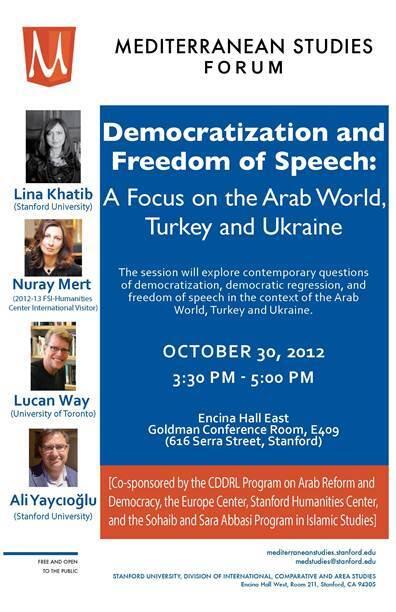
Co-sponsored by CDDRL Program on Arab Reform and Democracy, the Europe Center, Stanford Humanities Center, and the Abbasi Program in Islamic Studies

More info: http://www.stanford.edu/group/mediterranean/cgi-bin/web/2012/08/democratization-and-freedom-of-speech-a-focus-on-turkey-arab-world-and-ukraine/

Image

Richard and Rhoda Goldman Conference Room

Nuray Mert FSI-Humanities Center International Visitor Panelist
Lina Khatib Program Manager for the Program on Arab Reform and Democracy Panelist CDDRL
Lucan Way Associate Professor of Political Science Panelist University of Toronto
Ali Yaycioğlu Assistant Professor of Middle East History Moderator Stanford
Panel Discussions

Encina Hall
616 Serra Street, C205-4
Stanford, CA 94305

0
Visiting Scholar, The Europe Center
Smetana_3x4_Fotka.jpg

Vit Smetana is a senior research fellow at the Institute of Contemporary History – Academy of Sciences of the Czech Republic, and also teaches modern international history at the Faculty of Social Sciences, Charles University in Prague.  His professional interest lies primarily in the policies of the great powers towards Czechoslovakia and Central Europe in the late 1930s and throughout the 1940s. His research during his stay at Stanford focuses on the topic “The Czech, Slovak and other Central European exiles in the Second World War and beyond”.

Dr. Smetana is the author of In the Shadow of Munich. British Policy towards Czechoslovakia from the Endorsement to the Renunciation of the Munich Agreement (1938-1942) (2008) and co-author of Draze zaplacená svoboda. Osvobození Československa 1944-45  (Dearly Paid Freedom. The Liberation of Czechoslovakia 1944-45) in two volumes (2009).  He also edited  the Czech version of the Robert F. Kennedy memoir of the Cuban Missle Crisis, Thirteen Days (1999).

Subscribe to History