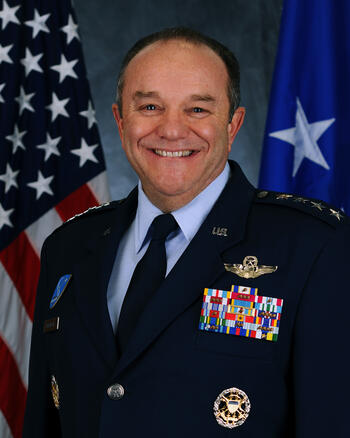
Please mark your calendars for a talk by former NATO Secretary General Anders Fogh Rasmussen.
"We Need American Global Leadership"
Date: September 25, 2015
Time: 12:00PM to 1:30PM
Location: Bechtel Conference Center, Encina Hall
RSVP by 5:00PM September 21, 2015
 Anders Fogh Rasmussen has been at the center of European and global politics for three decades as Secretary General of NATO, Prime Minister of Denmark, Danish Minister of Economic Affairs, and a leading Danish parliamentarian. Mr Rasmussen took office as the North Atlantic Treaty Organization’s 12th Secretary General on August 1, 2009 and held that position until September 30, 2014. His tenure marked a fundamental transformation of the alliance. He oversaw the alliance’s operational peak with six operations on three continents including Afghanistan, Kosovo, Libya, counter-piracy operations along the Somali coast, and a training mission in Iraq. Upon leaving NATO, Mr. Rasmussen founded Rasmussen Global, which provides geopolitical and strategic consulting services and advises clients on a wide range of issues such as international security, transatlantic relations, the European Union, and emerging markets. We invite you to visit our website for additional information about this event.
Featured Graduate Student Research: Nicola Bianchi
We would like to introduce you to some of the students that we support and the projects on which they are working. Our featured student this month is Nicola Bianchi (Economics). Nicola obtained his Ph.D. in Economics from Stanford University in 2015. He has since joined the Department of Management and Strategy at the Kellogg School of Management at Northwestern University as an Assistant Professor.
 Nicola's dissertation examines the economics of education and innovation. His recent research examines the effect of a 1961 Italian reform that increased access to university STEM (science, technology, engineering, and math) programs. Using data that he digitized from hand-written transcripts and income tax returns, a process funded in part by The Europe Center, he shows a surprising result. As expected, many more students completed STEM degrees. However, these students did not earn higher incomes, relative to earlier cohorts that were denied access into university. He explains this finding by showing that educational expansion congested college resources and made the student body more heterogeneous, which in turn decreased human capital accumulation. He also demonstrates that the most talented students (not directly affected by the policy) abandoned STEM in favor of other college majors where educational expansion did not take place. This work contributes to the literature on the public finance of education by isolating and quantifying increased college access and by examining within-major, within-cohort, and between-course variation, rather than relying exclusively on cross-cohort comparisons. The results of this research have been covered by the Washington Post.
Call for Proposals: Graduate Student Grant Competition
Accepting Applications: September 21, 2015 - October 16, 2015
The Europe Center invites applications from graduate and professional students at Stanford University whose research or work focuses on Europe. Funds are available for Ph.D. candidates across a wide range of disciplines in the humanities and social sciences to prepare for dissertation research and to conduct research on approved dissertation projects. The Europe Center also supports early graduate students who wish to determine the feasibility of a dissertation topic or acquire training relevant for that topic. Additionally, funds are available for professional students whose interests focus on some aspect of European politics, economics, history, or culture; the latter may be used to support an internship or a research project. For more information please visit our website.
The Europe Center Undergraduate Internship Program
The Europe Center offers Stanford undergraduates the opportunity to apply for summer internships with leading European think tanks and international organizations. To date, the initiative has partnerships with Brussels-based think tanks, Centre for European Policy Studies (CEPS) and Breugel, and with the European Parliament's Alliance of Liberals and Democrats in Europe (ALDE).
This past summer The Europe Center sponsored six undergraduate student internships. Jake Leih (International Relations, 2016) and Eddy Rosales Chavez (International Relations, 2017) were selected for positions at ALDE, Ameena Tawakol (Public Policy, 2017), Grace Choi (Economics, 2018) and Hope Sheils (International Relations, 2016) for positions at Bruegel and Kate Wilson (Public Policy, 2016) for a position at CEPS.
The students have documented their summer internships in a blog. The highlights of the students' experiences included a trip to Strasbourg for the European Parliament's plenary session, various research projects on topics such as free trade agreements (FTAs) and the Transatlantic Trade and Investment Partnership (TTIP), geographical trade indicators, tax policy, and immigration and visa practices, working on European Parliament committee amendments, and a celebrity spotting - dining just a few tables away from then-Greek Prime Minister, Alexis Tsipras. Overall, the students describe their experiences as invaluable. For more information on The Europe Center's Undergraduate Internship Program, please visit our website.
The Europe Center and University of Vienna Conference: The Haves and the Have Nots
 Few topics have captured mass, political, and scholarly attention as consistently as income inequality and the distribution of wealth. Seeking to better understand these phenomena by adding a more historical perspective to contemporary debates, Stanford University's Walter Scheidel and colleagues at the University of Vienna organized a conference of scholars working on inequality. Over the course of three days, attendees presented cutting-edge research on historical analyses of inequality within and across countries over three millennia. This conference, The Haves and the Have Nots: Exploring the Global History of Wealth and Income Inequality, was sponsored by The Europe Center and the University of Vienna. Additional information about the participants and their projects can be found in the conference program.
Distinguished Visiting Austrian Chair Professor at Stanford University: Martina Kaller
 The Europe Center is delighted to welcome Distinguished Visiting Austrian Chair Professor, Martina Kaller, to Stanford University. Dr. Kaller is a philosopher and historian working on global history with a focus on the Global South. She studied in Vienna, Berlin and at the Universidad Autónoma de México (UNAM). She earned her Ph.D. in epistemology of history from the University of Vienna and did her postdoctoral thesis in modern history there as well. Her main research focus is on global food history and global studies of food. While visiting Stanford, Dr. Kaller will be teaching in the Department of History and researching food supply in global cities.
Meet The Europe Center's Postdoctoral Scholar: Sarah Cormack-Patton
 Sarah Cormack-Patton received her Ph.D. in Political Science from the University of Pittsburgh in August 2015. She is a political economist working at the nexus of comparative politics and international relations with a focus on European politics. Sarah is interested in how the cross-border movement of goods, capital, and people impacts the domestic policy-making process, and how domestic politics in turn affect these cross-border flows. In her current research, Sarah is focused on international migration. Her doctoral dissertation examined the ways in which varying bundles of migrant rights affect domestic preferences over immigration, the effect of these rights on the policy-making coalitions that form over immigration, and how these preferences aggregate in various institutional environments.
The Europe Center Sponsored Events
October 13, 2015
5:30PM - 7:00PM
Renee Firestone, Hermine Liska, and Bernhard Rammerstorfer
"Taking the Stand - A film presentation and Q&A with survivors of the Holocaust"
Location to be announced
RSVP by 5:00PM October 9, 2015
Save the Date: October 30, 2015
Conference: "On Cruelty: Global Reflections for the Age of Revolutions to the War on Citizenship"
This conference is co-sponsored by The Europe Center, Department of History, The Abbasi Program in Islamic Studies, School of Humanities & Sciences, Program in Ethics in Society, The France-Stanford Center for Interdisciplinary Studies, Department of Religious Studies, Center for South Asia, Stanford Global Studies.
Save the Date: November 9, 2015
Mart Kuldkepp, Tartu University
"Russian deserters to Sweden in World War I"
This seminar is organized by the Center for Russian, Eastern European and Eurasian Studies and co-sponsored by The Europe Center.
European Security Initiative Events
September 24, 2015
4:30PM - 5:45PM
Toomas Hendrik Ilves, President of Estonia
"Democracy Rebooted: The Future of Technology in Elections"
Bechtel Conference Center, Encina Hall
RSVP by 5:00PM September 23, 2015
September 25, 2015
12:00PM - 1:30PM
Anders Fogh Rasmussen, former Secretary General, NATO
"We Need American Global Leadership"
Bechtel Conference Center, Encina Hall
RSVP by 5:00PM September 21, 2015
Save the Date: October 14, 2015
Sergey Aleksashenko, Senior Fellow, Development Center (a Mosco-based think tank) and Nonresident Senior Fellow, Brookings Institution
October 27, 2015
5:30PM - 7:00PM
Lena Jonson, Swedish Institute of International Affairs (UI)
"Art and Protest in Putin's Russia"
Location to be announced
No RSVP required
November 2, 2015
12:00PM - 1:30PM
Vladimir Milov, President, Institute of Energy Policy
"The Global Impact of Russia's Political and Economic Situation"
Reuben Hills Conference Room
RSVP by 5:00PM October 28, 2015
Save the Date: November 10, 2015
Lilia Shevtsova, Senior Associate, Carnegie Endowment for International Peace
Save the Date: January 5, 2016
Sergei Guriev, Visiting Professor of Economics, Sciences Po - Paris
We welcome you to visit our website for additional details.