-


Image
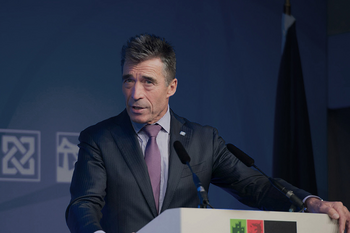
Anders Fogh Rasmussen


Anders Fogh Rasmussen has been at the centre of European and global politics for three decades as Secretary General of NATO, Prime Minister of Denmark, Danish Minister of Economic Affairs, and a leading Danish parliamentarian.

In 1998, Mr. Rasmussen became chairman of the Danish Liberal Party and leader of the Danish opposition. In the parliamentary elections 2001, his party won a landslide victory and became the biggest party in the Danish parliament. He formed his first government, and became Prime Minister of a coalition consisting of the Liberal Party and the Conservative People’s Party. His government was re-elected in 2005 and 2007 respectively, and he held the position as Prime Minister until he was elected as future NATO Secretary General at the Strasbourg-Kehl Summit in April 2009.

Anders Fogh Rasmussen took office as the North Atlantic Treaty Organization’s 12th Secretary General on August 1, 2009 and held that position until September 30, 2014. His tenure marked a fundamental transformation of the Alliance. Mr. Rasmussen oversaw the Alliance’s operational peak with six operations on three continents including Afghanistan, Kosovo and Libya, as well as counter-piracy along the Somali coast, a training mission in Iraq and a counter-terrorism operation in the Mediterranean.

He developed a new Strategic Concept, which sets the Alliance’s core priorities for the future. In the midst of the most serious economic crisis in recent time, he launched “Smart Defence” to help nations make more efficient use of their resources through more multinational cooperation. And in response to Russia’s aggression against Ukraine, he initiated a “Readiness Action Plan” adopted by Heads of State at a historic summit in Wales to strengthen the collective defence to an unprecedented level since the end of the Cold War. A reformer who made the Alliance leaner and more efficient, Mr. Rasmussen also extended and strengthened NATO’s partnerships with nations around the world, making it the hub of a network of international security partnerships.

Upon leaving NATO, Mr. Rasmussen founded Rasmussen Global, which provides geopolitical and strategic consulting services and advises clients on a wide range of issues such as international security, transatlantic relations, the European Union, and emerging markets.

Born in 1953, Mr. Rasmussen earned an M.Sc. in Economics from the University of Aarhus in 1978.


Anders Fogh Rasmussen Founder and Chairman of Rasmussen Global and former Secretary-General of NATO Speaker
Seminars
News Type
News
Date
Paragraphs

Special Event: The Europe Center Lectureship on Europe and the World


Please mark your calendars for the second annual lectures in this series by Joel Mokyr, Robert H. Strotz Professor of Arts and Sciences, and Professor of Economics and History at Northwestern University. 

“Culture of Growth:  Origins of the Modern Economy” 
Date:  May 20, 2015 
Time:  4:00 - 5:30 p.m. 
Location:  Bechtel Conference Center, Encina Hall

Why and how did the modern economy emerge? An understanding of the origins of Modern Economic Growth that started with the Industrial Revolution requires a more complete analysis of the growth of the “useful arts” (applied science and technology) in Europe before the Industrial Revolution between 1500 and 1700. The cultural beliefs of the educated elite changed dramatically in this era. An economic approach to cultural change sheds considerable light on what changed in this era that made the modern economy possible. 

“Long-Term Economic Change in China and Europe:  The Needham Paradox Revisited” 
Date:  May 21, 2015 
Time:  4:00 - 5:30 p.m. 
Location:  Bechtel Conference Center, Encina Hall

Many eminent scholars have argued for decades now on the origins and causes of the “Great Divergence” between Europe and China. Cultural factors that determined the big difference in the willingness to engage in and accept intellectual innovation and scientific research in practical application played an important role and created the “Needham Puzzle.” An economic analysis of the roots of this cultural gap shows how it came about and what its effects were on long-term economic development.


Image
Professor Joel Mokyr, Northwestern University

Joel Mokyr specializes in economic history and the economics of technological change and population change. He is the author of Why Ireland Starved: An Analytical and Quantitative Study of the Irish EconomyThe Lever of Riches: Technological Creativity and Economic ProgressThe British Industrial Revolution: An Economic PerspectiveThe Gifts of Athena: Historical Origins of the Knowledge Economy, and The Enlightened Economy. He is currently working on the intellectual and institutional origins of modern economic growth and the way they interacted with technological elements. We welcome you to visit our website for additional details about this event.


Introducing the Stanford Global Studies Minor with a Concentration in European Studies


The Europe Center is pleased to announce that starting in Fall 2015, Stanford undergraduate students will have the opportunity to minor in Global Studies, with a concentration in European Studies. The new minor will allow those students who have developed an interdisciplinary interest in the history, culture, politics, societies, and institutions of Europe, past and present, to organize their studies in a coherent and mentored fashion. Students will have an opportunity to design their focus within the minor to encourage the interdisciplinary and comparative study of a vast array of topics related to Europe. The minor is especially well-suited for undergraduates who plan to make Europe-based overseas studies a part of their Stanford experience. Students and faculty interested in learning more about the program should contact Ken Scheve at scheve@stanford.edu or Christophe Crombez at crombez@stanford.edu.


Recap:  French Ambassador Gérard Araud Visits Stanford

 
France is grappling with rising terrorism and the climate change problem, French Ambassador Gérard Araud said during a talk sponsored by The Europe Center. “We had been expecting a terrorist attack for some time,” said Araud, referencing the January massacre in Paris in which two shooters who identified themselves as Islamic terrorists killed 12 people at the Charlie Hebdo newspaper offices and wounded several others. “The attack in Paris was like our 9/11.”
 
Image
Gérard Araud, French Ambassador to the United States; May 1, 2015

He said that France is undertaking both educational and law enforcement efforts aimed at taming the spread of radicalized Islamic youth in the country – but there is no easy solution. For example, it is almost impossible to monitor all the potential suspects, shut down offensive websites only to see them pop up shortly thereafter, and even track youth coming and going from Islamic campaigns in places like Syria and Iraq. “Everything,” Araud said, “depends on the balance between civil liberties and law enforcement. We’re trying to adjust to this new threat.” More than a hundred people turned out for Araud's talk, which was held in the Koret-Taube Conference Center. The event, held May 1, was billed as the “State of the France-U.S. Relationship and Priorities for 2015.” Araud was appointed Ambassador of France to the United States in 2014. He has held positions within the Ministry of Foreign Affairs and International Development. (Reporting by Clifton B. Parker. Additional details about this event can be found here.)


Spring 2014 Graduate Student Grant Competition Winners Announced

 
Please join us in congratulating the winners of The Europe Center Spring 2015 Graduate Student Grant Competition:


  • Alexandra BlackmanPolitical Science, “The Politicization of Faith: Understanding the Rise of Political Islamism in the Contemporary Middle East”
  • Lukas DovernHistory, “Investing in Socialism: A History of the People’s Republic of Poland as Part of a Global Monetary and Financial System”
  • Andre FischerGerman Studies, “Mythic thought and utopian aesthetics in German postwar culture”
  • Adriane FreshPolitical Science, “Essays on Elites, Institutions and Development”
  • Daniel-Oliver Garcia-Macia, Economics, “The Financing of Ideas and the Great Deviation”
  • Melissa KagenGerman Studies, “‘Alle Wege der Welt’: Wandering in German/Jewish opera after Wagner”
  • Michelle KahnHistory, “Everyday Integration: Turks, Germans, and the Boundaries of Europe”
  • Camilla MazzucatoAnthropology & Archaeology, “The emergence of megasites in Central Anatolia: the view from Çatalhöyük”
  • Agustina PaglayanPolitical Science, “Comparative Political Economy of Education and Human Capital”
  • Julia RoeverHistory, “When Medicine Fails: The Origins of Medical Malpractice in Early Modern Italy”
  • David Y. YangEconomics, “The Lives of Others - Stasi and the Impairment of Social Trust”
  • Ruxi ZhangPolitical Science, “The Role of Middle Classes in Democratization in Post-Communist States”


The Spring Grant Competition winners will join 10 graduate students who were awarded competitive research grants by the Center in Fall 2014.

All News button
1
-

Demetrios G. Papademetriou is Distinguished Senior Fellow, Co-Founder and President Emeritus of the Migration Policy Institute (MPI), and President of MPI Europe. Dr. Papademetriou has published more than 270 books, monographs, articles and research reports on migration and related issues, and advises senior government officials, foundations, and civil society organizations in dozens of countries. He also convenes the Transatlantic Council on Migration and the Regional (North American) Migration Study Group, chairs the Advisory Board of The Open Society Foundations’ International Migration Initiative (IMI), and is Co-Founder and Chair Emeritus of Metropolis.

Demetrios G. Papademetriou Distinguished Senior Fellow, Co-Founder and President Emeritus of the Migration Policy Institute (MPI) and President of MPI Europe Speaker
Seminars
Authors
News Type
News
Date
Paragraphs

France is grappling with rising terrorism and the climate change problem, French Ambassador Gérard Araud said during a talk sponsored by The Europe Center.

"We had been expecting a terrorist attack for some time," said Araud, referencing the January massacre in Paris in which two shooters who identified themselves as Islamic terrorists killed 12 people at the Charlie Hebdo newspaper offices and wounded several others. "The attack in Paris was like our 9/11."

He said that France is undertaking both educational and law enforcement efforts aimed at taming the spread of radicalized Islamic youth in the country – but there is no easy solution.

For example, it is almost impossible to monitor all the potential suspects, shut down offensive websites only to see them pop up shortly thereafter, and even track youth coming and going from Islamic campaigns in places like Syria and Iraq.

"Everything," Araud said, "depends on the balance between civil liberties and law enforcement. We're trying to adjust to this new threat."

More than a hundred people turned out for Araud's talk, which was held in the Koret-Taube Conference Center. The event, held May 1, was billed as the "State of the France-U.S. Relationship and Priorities for 2015."

Araud was appointed Ambassador of France to the United States in 2014. He has held positions within the Ministry of Foreign Affairs and International Development. During his career, Araud became an expert on the Middle East and security issues, and was the French negotiator on the Iranian nuclear issue from 2003 to 2006.

He spoke about the problem of increasing anti-Semitism in France.

"It's totally unacceptable," he said. On the educational front, French schools routinely teach students about the horrors of the Holocaust and some even make field trips to places like Auschwitz, one of the Nazi concentration camps where Jewish people were exterminated during World War II.

One upcoming topic of global interest, Araud said, is the United Nations climate change conference scheduled to start Nov. 30 in Paris.

He described it as perhaps a "last chance" attempt at an effective global agreement on the issue, and sounded upbeat about the possibility of success. "Things are much more positive than in 2009" when similar talks in Copenhagen failed to spark worldwide unity.

The reasons, he said, are that more countries are acknowledging the impact of carbon emissions and that China has expressed a desire to cooperate. But much depends on the talks in Paris, both their tone and substance.

"Top down approval certainly won't work," Araud said, noting that the conference needs to produce a consistent and credible message of action on climate change that appeals to many countries.

He noted Stanford's new energy system aims to cut campus greenhouse gas emissions by 68 percent and fossil fuel by 65 percent. "It's quite positive," he said.

Michael McFaul, director of the Freeman Spogli Institute for International Studies, introduced Araud and described the bilateral relationship between the United States and France as "central to everything that we do."

McFaul pointed out that Araud played a key role in the writing of the economic sanctions that eventually brought Iran to the nuclear negotiations table.

When he started his speech, Araud said it was his first visit to Stanford. "Thank you for the weather," he smiled.


Clifton B. Parker is a writer for the Stanford News Service.

Hero Image
rsd15 034 0086a
Rod Searcey
All News button
1
-

Due to the high interest in this event, we have moved it to a larger room.  It is now in the Oksenberg Conference Room, Encina Hall, 3rd floor.


The February Minsk II agreement introduced a fragile ceasefire in eastern Ukraine, following a year of crisis and conflict between Kyiv and Moscow.  Ukrainian President Poroshenko needs to grapple with a daunting list of critical economic and political reforms.  Russian President Putin, however, appears intent on destabilizing the Ukrainian government and has the means, including military force, to do so.  What can we expect next in the Ukraine-Russia stand-off, and how should the West respond?

Image
Steven Pifer


Steven Pifer is a senior fellow at the Brookings Institution, where his work focuses on arms control, Ukraine and Russia. A retired Foreign Service officer, his more than 25 years with the State Department included assignments as deputy assistant secretary of state with responsibilities for Russia and Ukraine (2001-2004), ambassador to Ukraine (1998-2000), and special assistant to the president and senior director for Russia, Ukraine and Eurasia on the National Security Council (1996-1997).


Co-sponsored by the Freeman Spogli Institute for International Studies and The Europe Center.

Steven Pifer Senior Fellow Speaker the Brookings Institution
Lectures
News Type
News
Date
Paragraphs


The Europe Center Graduate Student Grant Competition


Call for Spring 2015 Proposals:

The Europe Center is pleased to announce the Spring 2015 Graduate Student Grant Competition for graduate and professional students at Stanford whose research or work focuses on Europe. Funds are available for Ph.D. candidates from across a wide range of disciplines in the humanities and social sciences to prepare for dissertation research and to conduct research on approved dissertation projects. The Europe Center also supports early graduate students who wish to determine the feasibility of a dissertation topic or acquire training relevant for that topic. Moreover, funds are available for professional students whose interests focus on some aspect of European politics, economics, history, or culture; the latter may be used to support an internship or a research project. Grants range from $500 to $5000. Additional information about the grants, as well as the online application form, can be found here.  The deadline for this Spring’s competition is Friday, April 17th. Recipients will be notified by May 4th.

Highlights from Fall 2014:

In Fall 2014, the Center awarded grants to 10 graduate students in departments ranging from History to Economics to Musicology. We would like to introduce you to some of the students that we support and the projects on which they are working. Our featured student this month is Adriane Fresh (Political Science). 

Image
Adriane Fresh
Fresh is interested in how historical political concentration---the concentration of political power within particular interest groups or families---affects long-run economic development, and how this concentration is affected by moments of formal institutional change. To look at these relationships, Fresh uses a newly assembled dataset of the individual characteristics of Members of Parliament (MP) in the British Isles from the 14th to the 19th centuries. She connects that biographical data to historical census data on economic and political development; and examines how concentration changed relative to the Glorious Revolution, the Industrial Revolution and the First Democratic Reform. Fresh requested funding from The Europe Center to purchase data on MP biographies from the 1832-1970 period in order to examine how democratization affected the composition and concentration of political elites. She also obtained land ownership data from the late 19th century to construct measures of economic inequality; digitized and transcribed these data; and coded MP biographies from text-heavy descriptions of MP careers, interests and personal relationships.


2015 Undergraduate Internship Program Winners Announced

A key priority of The Europe Center is to provide Stanford’s undergraduate student community with opportunities to develop a deep understanding of contemporary European society and affairs. By promoting knowledge about the opportunities and challenges facing one of the world’s most economically and politically integrated regions, the Center strives to equip our future leaders with the tools necessary to tackle complex problems both in Europe and in the world more broadly.
 

To this end, the Center recently solicited applications for the second annual The Europe Center Undergraduate Internship Program in Europe. The Center is sponsoring six undergraduate student internships with leading think tanks and international organizations in Europe in Summer 2015. Jacob (Jake) Leih (International Relations, 2016) and Eddy Rosales Chavez (International Relations, 2017) will work at The ALDE Group in the European Parliament. Ameena Tawakol (Public Policy, 2017), Eunhye (Grace) Choi (Economics, 2018), and Audrey (Hope) Sheils (International Relations, 2016) will work at Bruegel, a leading European think tank. Additionally, Kate Wilson (Public Policy, 2016) will work at the Centre for European Policy Studies (CEPS). The Europe Center is also actively seeking to develop ties with business, governmental, and non-governmental organizations in Europe that can participate in The Europe Center Undergraduate Internship Program in future years.


Save the Date: The Europe Center Lectureship on Europe and the World

Please mark your calendars for the second annual lectures in this series by Joel Mokyr, Robert H. Strotz Professor of Arts and Sciences, and Professor of Economics and History at Northwestern University.

Details: May 20 and May 21, 2015; 4:00 - 5:30 p.m.; Bechtel Conference Center, Encina Hall

Image
Joel Mokyr
Joel Mokyr will deliver two lectures on the topic of his forthcoming book, Culture of Growth:  Origins of the Modern Economy, to be published by Princeton University Press and Penguin in 2016. Mokyr specializes in economic history and the economics of technological change and population change. He is the author of Why Ireland Starved: An Analytical and Quantitative Study of the Irish Economy, The Lever of Riches: Technological Creativity and Economic Progress, The British Industrial Revolution: An Economic PerspectiveThe Gifts of Athena: Historical Origins of the Knowledge Economy, and The Enlightened Economy. He has authored over 80 articles and books in his field. His books have won a number of important prizes, including the Joseph Schumpeter Memorial Prize, the Ranki Prize for the Best Book in European Economic History, and the Donald Price Prize. He is currently working on the intellectual and institutional origins of modern economic growth and the way they interacted with technological elements. His current other research is an attempt to apply insights from evolutionary theory to long-run changes in technological knowledge and economic history.


Featured Research:  Cécile Alduy

The Europe Center serves as a research hub bringing together Stanford faculty members, students, and researchers conducting cutting-edge research on topics related to Europe.  Our faculty affiliates draw from the humanities, social sciences, and business and legal traditions, and are at the forefront of scholarly debates on Europe-focused themes.  The Center regularly highlights new research by faculty affiliates that is of interest to the broader community.  
 

Image
Cecile Alduy
Cécile Alduy recently published a new book, Marine Le Pen prise aux mots: Décryptage du nouveau discours frontiste (Seuil 2015). Since Marine Le Pen has taken over its leadership in 2011, the far right National Front party has been on an apparently unstoppable ascent, earning up to 25% of the votes in the latest European elections last May. What is more, in a remarkable political make over, the once infamous political organization has turned almost mainstream, claiming to be the last champion of democracy and French republican values. Is that true? And how does Marine Le Pen manage to convince so many voters that it is? Using text mining software as well as minute semiotic analyses, Cécile Alduy has ciphered more than 500 speeches and texts by Jean-Marie and Marine Le Pen to pinpoint exactly how, and on what topics, the daughter’s discourse differs from that of her father. This book cracks the new National Front rhetorical code to uncover the deeper ideological structures that lie beneath the party’s recent electoral successes.


Workshop Schedules

The Europe Center invites you to attend the talks of speakers in the following workshop series:

Europe and the Global Economy

Apr 23, 2015
Christina Schneider, University of California, San Diego
“Globalizing Electoral Politics:  The Domestic Politics of European Cooperation”
RSVP by Apr 20, 2015
 

European Governance

Apr 9, 2015
Michael Becher, University of Konstanz
“Endogenous Credible Commitment and Party Competition Over Redistribution Under Alternative Electoral Institutions”
RSVP by Apr 6, 2015
 
Apr 16, 2015
Massimiliano Onorato, Institute for Advanced Studies, Lucca
“Military Conflict and the Rise of Urban Europe”
RSVP by Apr 13, 2015
 
May 7, 2015 
Cliff Carrubba, Emory University
“Does Judicial Independence Matter for Judicial Influence?”
RSVP by May 4, 2015


The Europe Center Sponsored Events

Apr 7, 2015
Douglas Lute, United States Ambassador to NATO
“Wales to Warsaw: NATO and the Current State of Transatlantic Security”
RSVP by Apr 2, 2015
 
Apr 8, 2015
Nicholas Crafts, University of Warwick, UK
“A Vision of the Growth Process in a Technologically progressive Economy: the United States, 1899-1941”
RSVP by Apr 7, 2015
 
April 10-11, 2015
"2015 Stanford-University of Vienna Conference on Innovative Experiential Pedagogy"
 
Apr 13, 2015 
Andrea Vindigni, IMT, Lucca Institute for Advanced Studies
“Soldiers and Rebels:  Coups and Civil Wars in Weakly Institutionalized and Fragmented States”
 
Apr 22, 2015
Sascha Becker, University of Warwick, UK
“Religion, Division of Labour and Conflict: Anti-Semitism in German Regions over 700 Years”
RSVP by Apr 21, 2015
 
Apr 23, 2015
Robert Beachy, Yonsei University in Seoul, South Korea
“The Rise and Fall of Ernst Röhm: Männerbund, National Revolution, and the Coming of the Third Reich”
RSVP by Apr 21, 2015
 
May 11, 2015
Ivo H. Daalder, The Chicago Council on Global Affairs
“Perspectives from Ivo H. Daalder”
RSVP by May 7, 2015
 
May 14, 2015
Renata Salecl, Faculty of Law, University of Ljubljana
Keynote Lecture: “From Srebrenica to St. Louis: War Trauma 20 Years Later”
RSVP by May 13, 2015
 
May 15, 2015
Conference:  “Yugoslav Space Twenty Years After Srebrenica”
RSVP by May 14, 2015
 
May 18, 2015
Laurent Cohen-Tanugi, International Lawyer
“What’s Wrong With France?”
RSVP by May 13, 2015
 
May 20-21, 2015
TEC Lectureship on Europe and the World 
“Culture of Growth:  Origins of the Modern Economy”
Joel Mokyr, Robert H. Strotz Professor of Arts and Sciences, Northwestern University
RSVP by May 15, 2015; Additional Details

Save the Date

Apr 15, 2015
Scott Kilner, Career Diplomat with U.S. State Department
“A Career in American Foreign Policy:  Reflections of a U.S. Diplomat on Wester Europe, Turkey, and Afghanistan” (Open to Stanford Students Only)
 
Apr 15, 2015
Julian Weiss, King's College, London
“Between Subversion and Containment: Flavius Josephus, the Jews, and 1492” (Additional Details)
 
May 1, 2015
Talk by Gérard Araud
French Ambassador to the United Sates
 
May 1, 2015
Seminar with Karen Dawisha
Author of Putin's Kleptocracy: Who Owns Russia (2014).
 

We welcome you to visit our website for additional details.

All News button
1
-

At the NATO Summit in Wales in September 2014, NATO leaders were clear about the security challenges on the Alliance’s borders. In the East, Russia’s actions threaten our vision of a Europe that is whole, free and at peace.  On the Alliance’s southeastern border, ISIL’s campaign of terror poses a threat to the stability of the Middle East and beyond.  To the south, across the Mediterranean, Libya is becoming increasingly unstable. As the Alliance continues to confront theses current and emerging threats, one thing is clear as we prepare for the 2016 Summit in Warsaw: NATO will adapt, just as it has throughout its 65-year history.

Image
Douglas Lute, Ambassador of the United States to NATO


In August 2013, Douglas E. Lute was sworn-in as the Ambassador of the United States to the North Atlantic Treaty Organization (NATO).  From 2007 to 2013, Lute served at the White House under Presidents Bush and Obama, first as the Assistant to the President and Deputy National Security Advisor for Iraq and Afghanistan, and more recently as the Deputy Assistant to the President focusing on Afghanistan, Pakistan and India.  In 2010, AMB Lute retired from the U.S. Army as a Lieutenant General after 35 years on active duty.  Prior to the White House, he served as the Director of Operations on the Joint Staff, overseeing U.S. military operations worldwide. He served multiple tours in NATO commands including duty in Germany during the Cold War and commanding U.S. forces in Kosovo.  He holds degrees from the United States Military Academy and Harvard University.

A light lunch will be provided.  Please plan to arrive by 11:30am to allow time to check in at the registration desk, pick up your lunch and be seated by 12:00 noon.

Co-sponsored by The Europe Center, the Freeman Spogli Institute for International Studies, the Center for International Security and Cooperation and the Center for Russian, East European and Eurasian Studies.


Douglas Lute United States Ambassador to NATO Speaker
Lectures
-

Karen Dawisha is the author of Putin’s Kleptocracy. Who Owns Russia? and the Walter E. Havighurst Professor of Political Science and Director of the Havighurst Center at Miami University in Oxford, Ohio.

Co-sponsored by the Center for Russian, East European and Eurasian Studies, The Europe Center, and the Center on Democracy, Development and the Rule of Law.

Encina Hall 3rd Floor
616 Serra Street

Karen Daiwisha Walter E. Havighurst Professor of Political Science Speaker Miami University
Lectures
Subscribe to Europe